
We have a small collection of Tortoises. By far our most impressive specimens are our group of Leopard Tortoises (Geochelone pardalis). Leopard Tortoises are quite social, and they do not get all that big, our 12 year old pair are each about 12 inches in carapace length. We also have an unpaired 5 year old male.
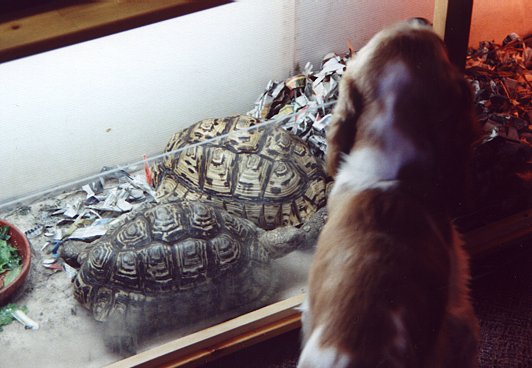
Bailey, our Cocker Spaniel, checking out Lisbon, our 12 year old female Leopard Tortoise (the darker of the two), and Paris, our 11 year old male Leopard Tortoise.
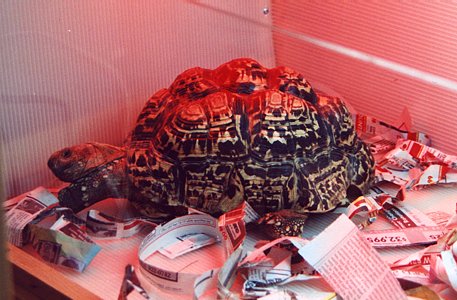
Nuisance - This is our unpaired 5 year old male Leopard Tortoise basking under his heat lamp.
Tortoises require either natural sunlight or a UVB bulb (preferably a ZooMed 5.0 UVB bulb) in their enclosure. In order for Tortoises (and all Herps) to utilize calcium they require vitamin D3, this can be synthesized in their skin with the presence of UVB (ultraviolet B radiation), or it can be given as a supplement in their diet. Supplementing with D3 does not appear to be as effective as natural sunlight. Keeping this in mind it is best to provide a UVB light source even if you are supplementing with D3. Be careful not to overdo D3 supplementation, this is not healthy for the animal. In nature, Tortoises bask in the sun to absorb the suns rays and synthesize their own D3. D3 synthesis can only be achieved in the skin, not the shell, so a basking turtle or tortoise will extend it's head and neck out to maximize exposure to the suns rays as illustrated by Nuisance in the above picture. We also disagree with one popular idea that constantly crops up; a few weeks of exposure to natural sunlight during the summer will last a turtle or tortoise the rest of the year. If tortoises are not getting exposed to natural unfiltered (no glass in between the animal and the sun) sunlight then it should have a UVB bulb and/or D3 supplementation.
We also have a pair of unsexed baby Sulcata Tortoises (Geochelone sulcata). Unlike the Leopards these two little guys (seen below in a ten gallon aquarium) will grow to a very large size. They are one of the largest of the commonly kept Tortoises.
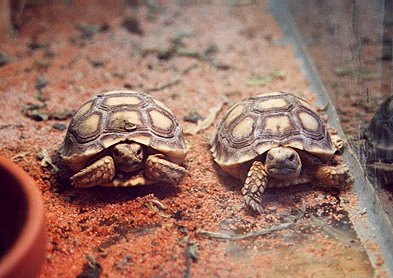
These two, Spanky and Alfalfa, are just 5 inches in length right now, but when full grown can reach weights over 1 hundred pounds, and over 4 feet in length. But they are extremely personable Tortoises which can even be trained and have been known to come when called.
The last members of the Tortoise Family are our Red Foot Tortoises (Geochelone carbonaria). We have one baby Cherry Head Red Foot - we call him Cherry, original huh? We also have 4 young normal Red Foots (Mango, Peach, Melon, and Berry). The Red Foot Tortoise is probably the most popular of the Tortoises because they are really quite small, will stay under 12 inches for many years. They require higher humidity than the Sulcatas and Leopards, which are arid species, these guys are semi-tropical and enjoy a well planted enclosure which they can hide in.
I will have pictures of our Red Foot group up soon.
For more information on Tortoises, visit the Tortoise Trust site, this is an organization devoted to providing and encouraging the exchange of information about Tortoises. They have pages on husbandry and they also have an e-mail discussion group devoted to Tortoises. This discussion group is filled with very helpful people and a lot of information is posted about Tortoise care. Well worth the time if you can keep up with all the messages.