In the woodworking industry, using dyes is very
common. They are used for a number of applications. From finishing for
making the stains, to toners that is applied for blending in different
species of wood, to make the unmatched colors appear uniform in the same
wood. Dyes are also added in coatings for making shading stains, that
results in color and coating in one operation. Dyes are also excellent
for preparing color touchups. All in all, the dyes are a versatile
colorant which has the capacity to improve and enhance finishing, and
restoration operations. In this digram (below) are shown some of the
most popular combinations of dye colors that are used in furniture:
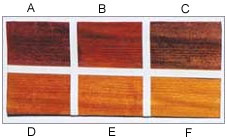
A: Red mahogany; B: Brown mahogany; C:Dark walnut; D:
Medium walnut; E: Red maple F: Golden oak.
For use in Woodworking industries the Dyes are solid generally in
primary, secondary and various premixed colors. They can be found in
liquid or powder form. They are also found in different solubles, like
water, alcohol, lacquer and oil.
 Alcohol
and Lacquer Dyes-
Alcohol
and Lacquer Dyes- These dyes are quite similar to each other. Both
has the capacity to dry exceptionally fast. This makes them very
difficult to apply by brush or wiping. They give best results when
sprayed. Any of of these dyes can be applied to coatings as a
transparent shading stain. They do not raise the wood's grain. Generally
solvents for these solubles are denatured alcohol and lacquer thinners.
Water
type Dyes- It displays the best clarity and is the typically most
transparent. Among the dyes used in woodworking it is the most
colorfast. One factor that is to be considererd here is that as the
solvent is water, the dyeing process is very slow. Unlike Alcohol and
lacquer dyes, they raises the wood grain.
Oil
Dye- Compared to others the oil dye is slow drying process.
Although it allows more open time, but more longer dry time is required.
Dye
Colour- It would be foolishness to judge dye colors when they are
applied, as they are very deceiving to the eye. It is seen that both the
powder and liquid stains sometimes appear as one color, but after
coating, the colors look quite different.
Powder
Dyes- Can also be used along with suitable thinners.
Color
strength of Dyes- It varies from manufacturer to manufacturer.
Please be careful about the manufacturer's recommendation, to make sure
as to what ratio of dye to the solvent is the right one.
Compatability-
There are now a variety of dyes that are available in the market
today. Before opting to buy any dye, it is important to determine
whether it is compatible when sealed with the coatings. Also, if it can
be added to the coating and used for making shading stains. It is also
imperative to know how the dye is applied, what solvent is used to
dissolve or dilute it and which solvent types quickens or slow down its
dry time.
| Dyes |
Pigments |
| Dyes are very good for doing touchups on furniture
because of transparency. Dyes do not block out the natural wood, as
pigmented colorants generally does if they are not thinned out. |
Pigments has its plus points too, as on some
finishes, pigmented colorants are better in matching opaque-colored
finishes. Also, pigmented colorants come up with white colors plus a
plethora of other colors that can be mixed from them. All in all,
there is place in the sun for both dyes and pigments.
|



 Tips
on Selecting the Right Dye
Tips
on Selecting the Right Dye