We all use inkjet inks in our printers of various hues and
application. But do we know that the most vital part of the inkjet
printer is the ink that we use in the cartridge. In fact the determinants
of the quality of printing are the type, quality, and the quantity of
ink in the cartridge. Inkjet inks are classified into the following four
types of categories:
- Water based
- Solvent-based
- Oil-based
- Curing
- Hybrid ink
 Obey
the rules-
Obey
the rules- First and foremost is to obey the printer manufacturer's
advices.
Watch
out for compatibility- The association of ink and paper is a complex
one and difficult to optimize. It has been often seen that
bargain-priced inks or papers leads to results that is not upto the
mark.
Working
ink-paper pairs- Normally the following combination has been seen to
work better:
- Dye/ colorant + coated paper
- Pigment + nanoporous paper
Smart
Choice between pigments and dyes- Remember the choice you make
is some sort of a delicate balance between quality of the colour and the
factor of longevity. If your need is extreme long life, then go for
pigments, but don't forget they may have a reduced color quality in
comparison to dyes. Dyes are the way to go if your criteria is good life
and and colour.
See
the colour gamut comparison charts in proper perspective- Do not
hesitate to ask for direct comparison prints on exactly the type of
media that you would be using. As a thumb rule you should desist from
using pigment inks in printers that are designed for dyes. It may work,
but there is possibility of landing you in trouble.
Water based inkjet inks are very common inks that are
used for printing. Basically, the water or aqueous ink formulations
comprises mainly of a carrier fluid that is able to keep the liquid in a
liquid state thus acting as a sort of carrier for the fluid. They do not
contain any volatile organic compounds in them and has a very low level
of toxicity. They are generally used for application in paper.
However they are not ideal for high resolution printing, as they have a
tendency to bleed or feather. Water-based inkjet inks as a product can
be broadly classified into two general categories:-
The following diagram illustrates both the types
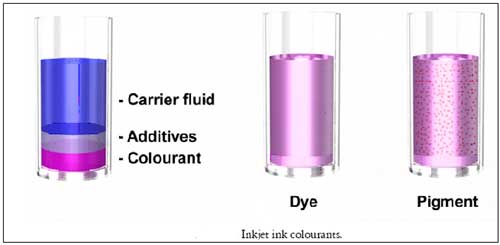
As is clear from the diagram a dye is the type of colourant where it gets
fully dissolved in the carrier fluid. Whereas pigments are fine powders
of solid colourants that gets dispersed in the colour fluid. To
understand the role of dyes and pigments in Water based inkjet inks,
first there is a need to look at the basic ingredients of a water based
inkjet inks.
| Ink component |
Use |
wt-% |
| Colourant |
It gives the ink it's basic function - absorbing of light of
the specific wave length band |
2-8 |
| Carrier fluid |
Suspends or helps in dissolving the colourant |
35-80 |
| Surfactant |
Helps to promote wetting by lowering the surface tension |
0.1-2.0 |
| Humectant |
Helps in inhibiting evaporation(mixes with the carrier fluid) |
10-30 |
| Penetrant |
Helps to penetrate ink in the paper surface |
1-5 |
| Dye solubilizer |
Helps to promote dye solubility in the carrier fluid |
2-5 |
| Anticockle additive |
Checks interaction with paper fibers that can very well lead to
paper cockle |
20-50 |
There has been a great debate regarding which medium
is better whether dyes or pigments. Though there is no conclusive
evidence regarding the superiority, but both Dyes and Pigment-based inks
have their plus and minuses. While water based inkjet inks using dyes
has been a traditionally favoured process. But with changing times
pigment based inks are getting increasingly accepted as a choice. The
following sections give some comparisons between the two.
| Dye Based Ink |
Pigment Based
Ink |
Pluses
- Soluble and stable
- Vast colour pallete
- Enormous range
- Bright and intense colour
- Dyes are far efficient in Graphic printing
- Larger colour pallete
- Bright and vibrant colours
Minuses
- Shows tendency for fading
- Shows limited resistance to water
- Nozzle crusting
Latest Trend: Manufactures are now opting for
combination inks with improved light and water fastness but not at
the cost of colour intensity.
|
Pluses
- Water fastness shows marked improvement
- Improved light fastness
- Distinct improvement in Archivability
- Clarity of Print
- Pigments good in Outdoor Application
Minuses
- Range limited
- Tendency to clog
- Expensive
- Colours not that vibrant and bright
|




 Buying
Tips
Buying
Tips