Thales 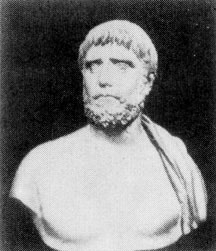
(624 - 546 BC) Greek philosopher who is considered the founder of Greek science, mathematics, and philosophy. He visited Egypt and probably Babylon, bringing back knowledge of astronomy and geometry. He invented deductive mathematics. To him is attributed Thales' theorem. Proclus attributed the following additional mathematical theorems to Thales (Boyer 1968, pp. 50-51): (1) a circle is bisected by a diameter, (2) the base angles of an isosceles triangle are equal, (3) pairs of vertical angles formed by two intersecting lines are equal, and (4) the ASA theorem for triangles. According to Herodotus, Thales predicted the year of the May 28, 585 BC solar eclipse, confirming his access to Babylonian records. Thales believed the Earth to be a flat disk floating on an infinite ocean, and established the Ionian (Milesian) school of Greek astronomy. Thales considered water to be the "first principle" ("arche") of nature. In his theories, Thales "naturalized" supernatural explanations, marking the beginning of scientific methodology. However, his teachings emphasized philosophical speculation over practical applications of science. It is therefore fitting that a legend tells of his falling into a well while pondering the heavens. A passing peasant is said to have fished him out with the comment "here is a man who would study the stars and cannot see what lies at his feet." **The preceding information is provided by the Eric Weisstein's World of Scientific Biogra.** |