Pythagoras 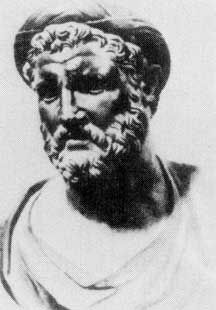
(580 - 520 BC) Greek philosopher and mathematician who founded the mystic Pythagorean cult. The cult he founded was devoted to the study of numbers, which the Pythagoreans saw as concrete, material objects. They studied figurate numbers, defining them as triangular numbers, pentagonal numbers, hexagonal numbers, etc., based on the patterns that numbers of regularly spaced dots formed (Boyer 1968, p. 59-61). Pythagoras's biographer Proclus ascribed two specific mathematical discoveries to Pythagoras: construction of the regular solids (known today as the Platonic solids), and the theory of proportionals. Pythagoras also investigated the ratios of lengths corresponding to musical harmonies, undertook studies in number theory, and developed methods of geometric proof. Among the results attributed to Pythagoras and his followers is the proof that the square root of two (Pythagoras's constant) is irrational, usually attributed to Hippasus. Pythagoras developed a modern theory of vision much simpler than that of Plato. This theory maintained that light is emitted from luminous bodies, can suffer reflections, and causes the sensation of sight when it enters the eyes. He was the first Greek to realize that the morning star and evening star were both the planet Venus. Pythagoras postulated that the Earth was spherical, and added more crystalline spheres to Anaximander's model, one for each planet, to account for the motions of the various planets. In keeping with the assumed magical properties of the number ten, some of the Pythagoreans, led by Philolaus, added a tenth "wanderer" and proposed that there existed a counter-earth which, together with the earth and other "planets," orbited a central fire. Pythagoras believed that the planets produced sounds while tracing out their orbits, producing the "harmony of the spheres." While much of their studies were sheer mysticism, the Pythagoreans were the first to mathematicize the universe. **The preceding information is provided by the Eric Weisstein's World of Scientific Biogra.** |