| LINKS |  |
Last
Updated: May 26, 2007
Webmaster: Richard Kalie |  | Orbiter Vehicle (OV) 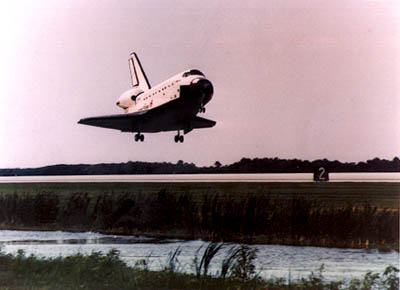
Orbiter (OV)- The orbiter can carry 32,000 pounds into space (14,515 Kilograms) and can bring back 65,000 pounds (29,484 kilograms) of cargo in its payload bay. It can reach an altitude in low earth orbit (LEO) of 100 to 600 nm. There are three active Space Shuttles in the fleet; Atlantis, Endeavour, and Discovery. Along with Enterprise, which conducted testing approach and landing techniques and the fleet lost two shuttles with the tragic explosion that occurred aboard the Space Shuttle Challenger (STS-54L) during liftoff and the disintegration of Space Shuttle Columbia (STS-107) upon re-entry. The Space Shuttle Main Engines (SSME) each provide 394,000 pounds of thrust at sea level. The SSME's are each 14 feet (4.3 meters) long and have a diameter of 7.5 feet (2.3 meters) and each provides a thrust of more than 400,000 pounds (1.8 million Newtons) at sea level. The orbiter can carry a total of 10 people, if needed, and a 30 day mission is possible (with additional supplies), but the orbiter usually carries a crew of 7 and on average it conducts a week to two week mission. The orbiter also has a cross range of 1,100 nautical miles during the ascent and landing phase. The orbiter is commonly known as the "Flying Brick" for how it returns to Earth by gliding and landing with no engine power. Orbiter NamesEach Space Shuttle Orbiter has its own designated name. The Orbiters are each named after a famous pioneering sea vessel, with each vessel establishing new frontiers in research and exploration for the time that they existed. Enterprise (OV-101) Retired was the first Space Shuttle Orbiter that conducted approach and landing tests, but never flew into orbit. It is the only orbiter that is not named after a true sea vessel. It originally was going to be called the Constitution (for America' s bicentennial celebration), but was later changed to Enterprise due to the Star Trek vessel that captured and took the imagination of the American people to an unseen universe. People wrote to the White House to express their feelings that the Orbiter should be called the Enterprise, instead of the proposed Constitution. Challenger (OV-99) Retired was the second operational Orbiter at the Kennedy Space Center (KSC) and shares its name with the Apollo 17 Lunar Module. But, in fact, Challenger was named after an American naval research vessel that sailed the Atlantic and Pacific oceans during the 1870's. Challenger followed Columbia an year later and entered service in 1982. Challenger is no longer part of the active fleet since it was destroyed during takeoff, which resulted in the total loss of the seven member crew and the Orbiter. This catastrophic event grounded the Shuttle fleet for a few years. For more information, please visit Memorial.Columbia (OV-102) Retired was the oldest orbiter in the shuttle fleet and is credited with the first Space Shuttle launch in 1981. Columbia was named after the Boston, Massachusetts based ship, which was captained by American Robert Gray. On May 11, 1792, Gray and his crew maneuvered the Columbia past the dangerous sandbar at the mouth of a river extending more than 1,000 miles through what is today south-eastern British Columbia, Canada, and the Washington-Oregon border. The river was later named after the ship. Gray also led Columbia and its crew on the first American circumnavigation of the globe, carrying a cargo of otter skins to Canton, China, and then returning to Boston. The first ship to cross the world was also named Columbia along with the Apollo 11 command module. Columbia acted as the fleet's scientific instrument by flying various experimental modules, which are located in the Shuttle's cargo bay, and running other types of scientific missions before it was lost in 2003. For more information, please visit Memorial.Endeavour (OV-105) is the newest addition to the shuttle fleet and was selected by the teachers and students in a naming contest. Endeavour entered the fleet, to replace the Space Shuttle Challenger, with its maiden voyage in 1991. It is named after the ship commanded by James Cook, the famous 18th century British explorer, navigator, and astronomer. In August 1768, Cook sailed to the South Pacific to record the event of Venus passing by the earth and sun. This lead astronomers to calculate the distance of earth to the sun and the parameters of the universe. In 1769, Cook became the first person to fully map New Zealand, he also surveyed the eastern coast of Australia and he also navigated the Great Barrier Reef and traveled to Hawaii. Captain Cook also had naturalist Joseph Banks and Carl Solander on board, who collected and cataloged new families and species of plants and numerous new species of animals. Atlantis (OV-104) was the fourth operational orbiter at KSC and was named after the research vessel for the Woods Hole Oceanographic Institute in Massachusetts from 1930 to 1966. The research vessel had two onboard laboratories that took water samples of the ocean from different depths to examine marine life and the water, itself. This directly lead to a better understanding about ocean currents. The crew also used the first electronic sounding devices to help map the ocean floor. Atlantis entered service in 1985 and is most known for its successful launch of the Compton Gamma Ray Observatory. Discovery (OV-103) was the third operational orbiter at Kennedy Space Center and is named after the other sea vessel sailed by Captain James Cook. Cook used this vessel to explore the coasts of southern Alaska and northwestern Canada. It was also involved in the sailing of the south Pacific and the discovery of the Hawaiian Islands. During the Revolutionary War, Benjamin Franklin even made a safe conduct request, because of its scientific importance of its research. 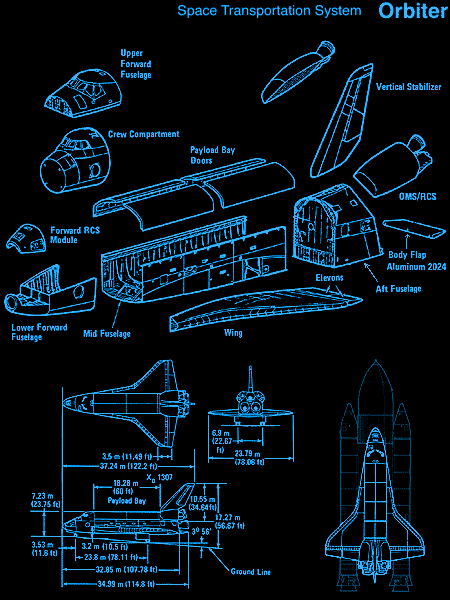
|
| |
|













