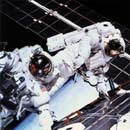
Memorial This page is in dedication to those space explorers who gave their lives to let us explore the outermost wonders of the universe and to help promote peaceful cooperation throughout the world. May God bless their souls. Apollo 1 (AS-204)Introduction: 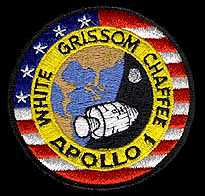 The United States lost its first explorers of the heavens on January 27, 1967 when a flash fire broke out on launch pad 34-A. The fire occurred in the Command Module during a launch pad test of the Apollo/Saturn space vehicle in preparations for the first piloted flight. Once the tragic accident had been analyzed and recommendations had been made, many major design and engineering modifications were made to the vehicle. Also extensive revisions to test planning, test discipline, manufacturing processes and procedures, and quality control were made to the Apollo program and forever shaped U.S. space flight. The United States lost its first explorers of the heavens on January 27, 1967 when a flash fire broke out on launch pad 34-A. The fire occurred in the Command Module during a launch pad test of the Apollo/Saturn space vehicle in preparations for the first piloted flight. Once the tragic accident had been analyzed and recommendations had been made, many major design and engineering modifications were made to the vehicle. Also extensive revisions to test planning, test discipline, manufacturing processes and procedures, and quality control were made to the Apollo program and forever shaped U.S. space flight.
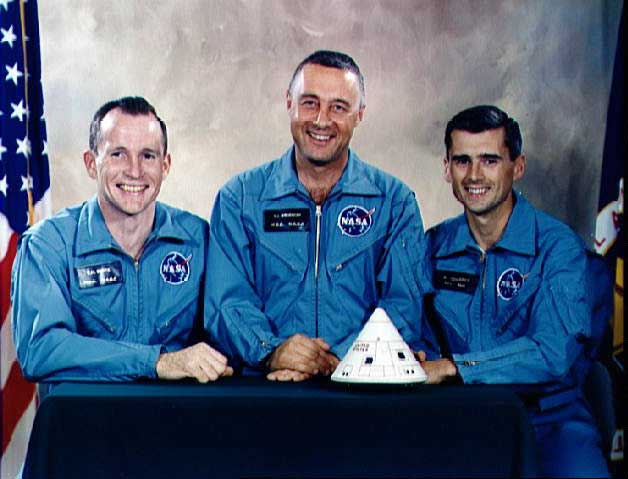 The Crew: The Crew:
Roger Bruce Chaffee Edwards Higgins White, II Virgil "Gus" Ivan Grissom Soyuz 1Introduction: 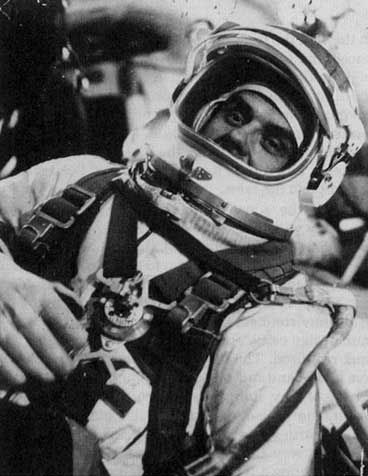 The Soviet Union lunar program was set back 18 months after Soyuz 1 had to make an emergency re-entry attempt that ended up with the death of the first cosmonaut on April 24, 1967. The problem began when one of the solar panels did not deploy correctly and could not be fixed, so the decision was made to bring Vladimir back and he had to manually retrofire the spacecraft for re-entry. The re-entry was successful, but the main chute failed to deploy so the reserve chute was deployed. However, the reserve chute became entangled with the already deployed drag chute and caused the space vehicle to slam into a field with great speed. The Soviet Union lunar program was set back 18 months after Soyuz 1 had to make an emergency re-entry attempt that ended up with the death of the first cosmonaut on April 24, 1967. The problem began when one of the solar panels did not deploy correctly and could not be fixed, so the decision was made to bring Vladimir back and he had to manually retrofire the spacecraft for re-entry. The re-entry was successful, but the main chute failed to deploy so the reserve chute was deployed. However, the reserve chute became entangled with the already deployed drag chute and caused the space vehicle to slam into a field with great speed.
The Crew:Vladimir Komarov Soyuz 11Introduction: 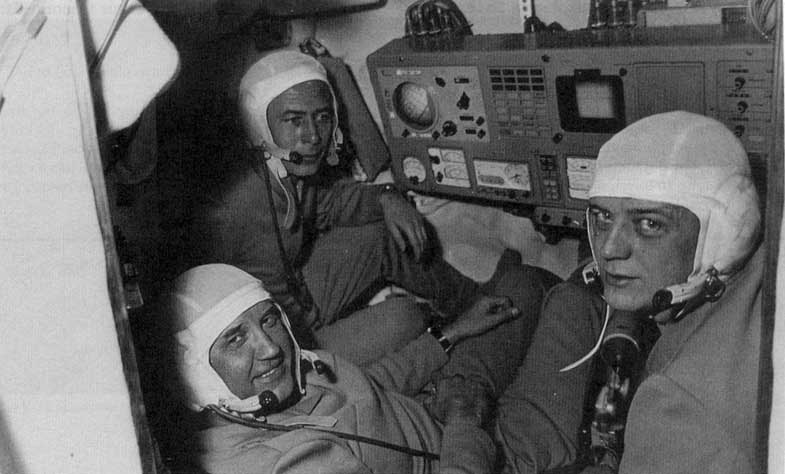 Soyuz 11 marked the first space flight to an orbiting space station, Salyut 1. The crew checked on equipment and instruments, but had to leave earlier then anticipated due to a minor fire and difficult working conditions. On June 29, 1971, the capsule was recovered, however, the crew had perished due to cabin pressure loss. This caused the Soviet Union to modify flights to a crew of two with pressure suits for lift-off and re-entry instead of a flight of three without such pressure suits. Soyuz 11 marked the first space flight to an orbiting space station, Salyut 1. The crew checked on equipment and instruments, but had to leave earlier then anticipated due to a minor fire and difficult working conditions. On June 29, 1971, the capsule was recovered, however, the crew had perished due to cabin pressure loss. This caused the Soviet Union to modify flights to a crew of two with pressure suits for lift-off and re-entry instead of a flight of three without such pressure suits.
The Crew:Viktor Patsayev Georgy Dobrovolsky Vladislov Volkov Space Shuttle Challenger (STS-51L)
Introduction: 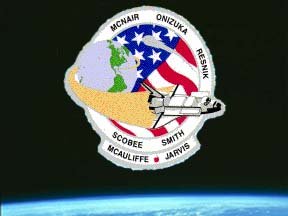 It was an abnormal, blistering cold day at the Kennedy Space Center (KSC) with the media buzzing around and mulling over a milestone in NASA history. The date was January 28, 1986, and the Space Shuttle Challenger was posed on its pad as it waited for its liftoff from KSC with the first civilian teacher to fly a mission to space. Challenger stood on its launch pad of 39B awaiting the liftoff of it's tenth flight and marking the twenty-fifth overall space shuttle flight. At 11:38 AM Eastern Standard Time the ground shook and the heavens rumbled as the shuttle lifted off. Challenger would never be seen again, just seventy three seconds into the launch, tragedy struck and the seven member crew died as the vehicle blew up and spewed pieces of the fallen vessel in all directions. It was an abnormal, blistering cold day at the Kennedy Space Center (KSC) with the media buzzing around and mulling over a milestone in NASA history. The date was January 28, 1986, and the Space Shuttle Challenger was posed on its pad as it waited for its liftoff from KSC with the first civilian teacher to fly a mission to space. Challenger stood on its launch pad of 39B awaiting the liftoff of it's tenth flight and marking the twenty-fifth overall space shuttle flight. At 11:38 AM Eastern Standard Time the ground shook and the heavens rumbled as the shuttle lifted off. Challenger would never be seen again, just seventy three seconds into the launch, tragedy struck and the seven member crew died as the vehicle blew up and spewed pieces of the fallen vessel in all directions.
The Crew:
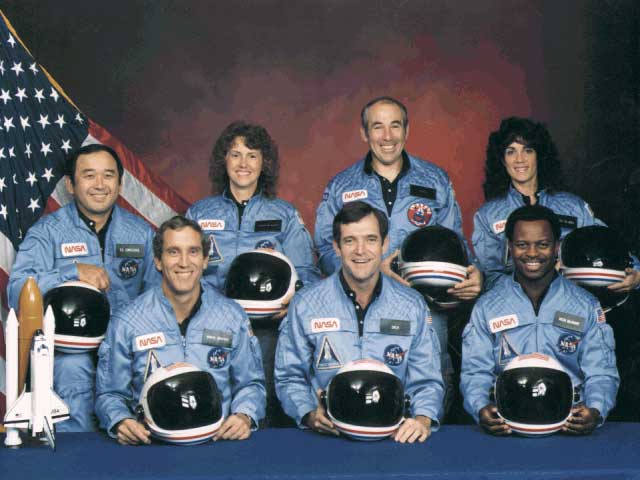 Francis R. Scobee, Commander Francis R. Scobee, Commander
Michael J. Smith, Pilot Judith A. Ruesnik, Mission Specialist Ellison S. Onizuka, Mission Specialist Ronald E. McNair, Mission Specialist Gregory B. Jarvis, Payload Specialist Sharon Christa McAuliffe, Payload Specialist Background Information- The Explosion: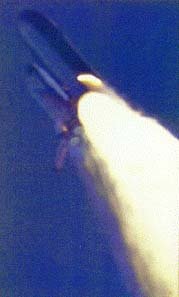 When STS-51L took off from the KSC it was the coldest it ever was for the launch of a shuttle flight (at 36 degrees F). Just 0.68 seconds after the ignition of the solid rocket boosters (SRB's) a black smoke cloud was seen from videotape, coming from the aft field joint of the right SRB. This black smoke suggests that grease, joint insulation, or the rubber O-rings were being burned. This black smoke continued to be shown at this location at an average of three puffs of smoke per a second. The last of these puffs of smoke was seen was recorded at 2.7 seconds and this puffing was an indication that aft field joint was not sealed properly. At 58.8 seconds a flame, was seen on enhanced film, coming from the right Solid Rocket Booster (SRB). The flame was burning toward the inside of SRB and facing near the External Tank (ET). At 59.3 seconds into the flight, the flame became well defined and seen without the enhanced film. As the flame grew in size it put more pressure on the ET and pushed air towards it, at the same time, the flame was burning one of the orbiter struts (attaching the orbiter to the ET), thus it started to weaken as intense heat of 5,600 degrees F burned at the right lower strut. At 64.7 seconds the color of the smoke changed indicating that the flame was mixing with the ET's liquid hydrogen. Just 45 milliseconds later a small glowing light developed between the ET and the shuttle's black ceramic-tiles. At 72 seconds all hell broke loose, the lower strut connecting the Solid Rocket Boosters to the External Tank broke loose form the extreme heat and force enacted upon it. This left the SRB to swing around its top strut and it spun and hammered the orbiters wing and dented it. At 73.12 seconds a white vapor was seen coming from the the bottom corner of the SRB. This vapor was both the hydrogen and oxygen of the ET and the pressure of the hydrogen dramatically changed and caused the hydrogen tank to plow into the oxygen tank. As the two tanks collided, the SRB had hit the top of the ET and put a leak in the upper tank of the ET. At 73.14 all support structures failed and milliseconds later the Challenger erupted into When STS-51L took off from the KSC it was the coldest it ever was for the launch of a shuttle flight (at 36 degrees F). Just 0.68 seconds after the ignition of the solid rocket boosters (SRB's) a black smoke cloud was seen from videotape, coming from the aft field joint of the right SRB. This black smoke suggests that grease, joint insulation, or the rubber O-rings were being burned. This black smoke continued to be shown at this location at an average of three puffs of smoke per a second. The last of these puffs of smoke was seen was recorded at 2.7 seconds and this puffing was an indication that aft field joint was not sealed properly. At 58.8 seconds a flame, was seen on enhanced film, coming from the right Solid Rocket Booster (SRB). The flame was burning toward the inside of SRB and facing near the External Tank (ET). At 59.3 seconds into the flight, the flame became well defined and seen without the enhanced film. As the flame grew in size it put more pressure on the ET and pushed air towards it, at the same time, the flame was burning one of the orbiter struts (attaching the orbiter to the ET), thus it started to weaken as intense heat of 5,600 degrees F burned at the right lower strut. At 64.7 seconds the color of the smoke changed indicating that the flame was mixing with the ET's liquid hydrogen. Just 45 milliseconds later a small glowing light developed between the ET and the shuttle's black ceramic-tiles. At 72 seconds all hell broke loose, the lower strut connecting the Solid Rocket Boosters to the External Tank broke loose form the extreme heat and force enacted upon it. This left the SRB to swing around its top strut and it spun and hammered the orbiters wing and dented it. At 73.12 seconds a white vapor was seen coming from the the bottom corner of the SRB. This vapor was both the hydrogen and oxygen of the ET and the pressure of the hydrogen dramatically changed and caused the hydrogen tank to plow into the oxygen tank. As the two tanks collided, the SRB had hit the top of the ET and put a leak in the upper tank of the ET. At 73.14 all support structures failed and milliseconds later the Challenger erupted into 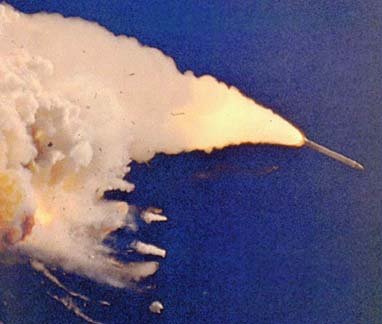 a fire ball. The last reported transmission came at 73.62 seconds and Challenger was traveling at a speed of Mach 1.92 at an altitude of 46,000 feet, at which time the Challenger was encircled in the inferno. Both SRB's flew out of the explosion and were detonated at 110.25 seconds by the Air Force Safety Commander. When the SRB exploded the recovery systems activated and both parachutes opened, upon seeing the parachutes the public thought the crew had escaped. Little did they know that there was no such safety system for the crew. a fire ball. The last reported transmission came at 73.62 seconds and Challenger was traveling at a speed of Mach 1.92 at an altitude of 46,000 feet, at which time the Challenger was encircled in the inferno. Both SRB's flew out of the explosion and were detonated at 110.25 seconds by the Air Force Safety Commander. When the SRB exploded the recovery systems activated and both parachutes opened, upon seeing the parachutes the public thought the crew had escaped. Little did they know that there was no such safety system for the crew.
Mechanical Problems:
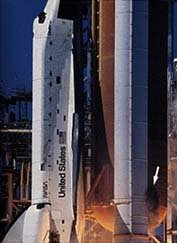 The right field joint was suspect in this horrible disaster, for the reason that smoke was seen in that location shortly after ignition. The Solid Rocket Boosters are made up of four main segments and they are joined together by Tang and Clevis joints (the Tang is shaped like an U and it slides down into the Clevis). And the aft segment connects to the nozzle and this forms the aft field joint. This joint is the one that failed on the right SRB and caused the gas leakage. The joints are sealed with two O-rings, which have a diameter of about .028 inches, to prevent the gases from escaping from the SRB tanks. The O-rings failed, which could have been caused by assembly damage or contamination, a gap opening, joint temperature, putty performance (zinc chromate used to stop gases and is used as a filler from getting to the O-rings), or O-ring compression. During assembly the SRB's change shapes due to stresses on being transported horizontally, the force of weight, or even being used on past Space Shuttle missions. The diameters on both sides need to be accurate up to +.25 inches in order to prevent contamination. During launch the O-rings need to be able to seal the Delta Gap, or gap opening change, and be able to return to their proper state. The pressure of the gases also helps to seal the joints by pushing the O-ring forward into the gap and sealing it, this process is known as pressure auation of O-ring seal. This pressure should be behind the O-ring, while it is in its groove, and is essential in the early stages of the launch. The right field joint was suspect in this horrible disaster, for the reason that smoke was seen in that location shortly after ignition. The Solid Rocket Boosters are made up of four main segments and they are joined together by Tang and Clevis joints (the Tang is shaped like an U and it slides down into the Clevis). And the aft segment connects to the nozzle and this forms the aft field joint. This joint is the one that failed on the right SRB and caused the gas leakage. The joints are sealed with two O-rings, which have a diameter of about .028 inches, to prevent the gases from escaping from the SRB tanks. The O-rings failed, which could have been caused by assembly damage or contamination, a gap opening, joint temperature, putty performance (zinc chromate used to stop gases and is used as a filler from getting to the O-rings), or O-ring compression. During assembly the SRB's change shapes due to stresses on being transported horizontally, the force of weight, or even being used on past Space Shuttle missions. The diameters on both sides need to be accurate up to +.25 inches in order to prevent contamination. During launch the O-rings need to be able to seal the Delta Gap, or gap opening change, and be able to return to their proper state. The pressure of the gases also helps to seal the joints by pushing the O-ring forward into the gap and sealing it, this process is known as pressure auation of O-ring seal. This pressure should be behind the O-ring, while it is in its groove, and is essential in the early stages of the launch.
Weather Conditions:
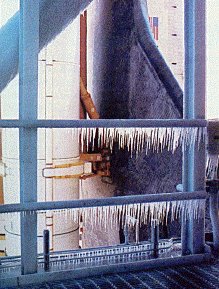 Weather also played a critical role in the fateful voyage of Challenger. The Challenger faced a super cold day, in the ordinary sun filled day in Florida, and broke the record for launching on the coldest day in U.S. manned space flight history, passing the old shuttle record by 10 degrees. The approximate temperature of the aft field joint on the right SRB, at liftoff, was around 28 degrees. This frigid temperature can cause the O-rings to fail in two ways. One effect of cold temperature is that the O-rings don't seal properly this is caused, because the O-rings become very stiff and don't move as quickly as they should. The warmer the launch the less damage the O-rings will encounter and the better the seal will be. The second effect is ice formation, which can occur in the joints and this could have caused the O-ring damage and lead to gas leakage. For Challenger's flight the whole launch tower was covered with ice and it was a good chance that the joints were also filled with ice. It seems that the extreme cold mourning of January. 28, 1986 was a major factor to the disaster, because the coldest SRB was the one that failed. Weather also played a critical role in the fateful voyage of Challenger. The Challenger faced a super cold day, in the ordinary sun filled day in Florida, and broke the record for launching on the coldest day in U.S. manned space flight history, passing the old shuttle record by 10 degrees. The approximate temperature of the aft field joint on the right SRB, at liftoff, was around 28 degrees. This frigid temperature can cause the O-rings to fail in two ways. One effect of cold temperature is that the O-rings don't seal properly this is caused, because the O-rings become very stiff and don't move as quickly as they should. The warmer the launch the less damage the O-rings will encounter and the better the seal will be. The second effect is ice formation, which can occur in the joints and this could have caused the O-ring damage and lead to gas leakage. For Challenger's flight the whole launch tower was covered with ice and it was a good chance that the joints were also filled with ice. It seems that the extreme cold mourning of January. 28, 1986 was a major factor to the disaster, because the coldest SRB was the one that failed.
Space Shuttle Columbia (STS-107) Introduction: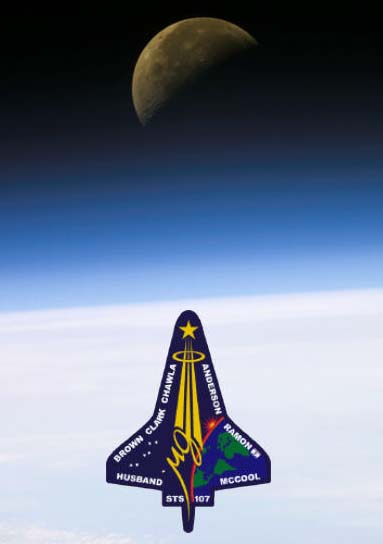 On February 1, 2003, the NASA world changed forever as it lost the second orbiter of the space shuttle fleet. This time the ill-fated voyage was that of Space Shuttle Columbia on mission 107. STS-107 was designated a scientific research mission, however, the humanitarian mission turned to a global tragedy when Columbia disintegrated and the crew of seven was lost upon re-entry over Texas. What is currently known is that the Space Shuttle Columbia suffered a left wing complication that resulted in the loss of the entire vehicle and crew. The cause to the failure was found to have resulted from foam insulation that fell off the External Tank (ET) and hit the leading edge. which punctured a gap in the carbon-carbon structure that allowed superheated gases encountered during reentry to enter and gradually disintegrate the left wing structure. On February 1, 2003, the NASA world changed forever as it lost the second orbiter of the space shuttle fleet. This time the ill-fated voyage was that of Space Shuttle Columbia on mission 107. STS-107 was designated a scientific research mission, however, the humanitarian mission turned to a global tragedy when Columbia disintegrated and the crew of seven was lost upon re-entry over Texas. What is currently known is that the Space Shuttle Columbia suffered a left wing complication that resulted in the loss of the entire vehicle and crew. The cause to the failure was found to have resulted from foam insulation that fell off the External Tank (ET) and hit the leading edge. which punctured a gap in the carbon-carbon structure that allowed superheated gases encountered during reentry to enter and gradually disintegrate the left wing structure.
The Crew: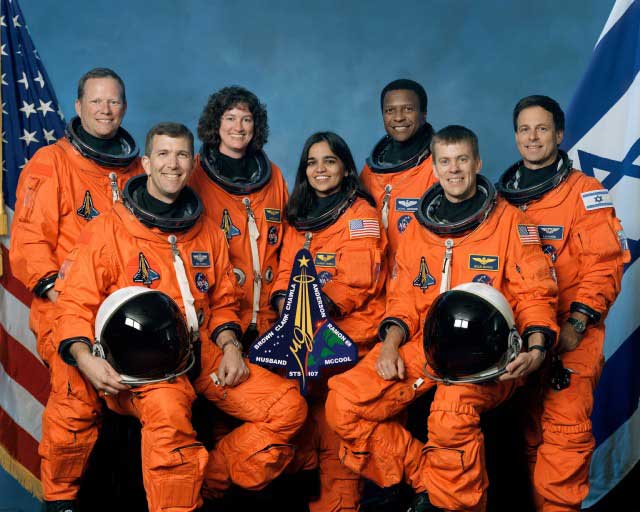 Rick D. Husband, Commander Rick D. Husband, Commander
William C. McCool, Pilot Kalpana Chawla, Mission Specialist David M. Brown, Mission Specialist Michael P. Anderson, Mission Specialist Laurel Blair Salton Clark, Payload Specialist Ilan Ramon, Payload Specialist Columbia Accident Investigation Board's Findings: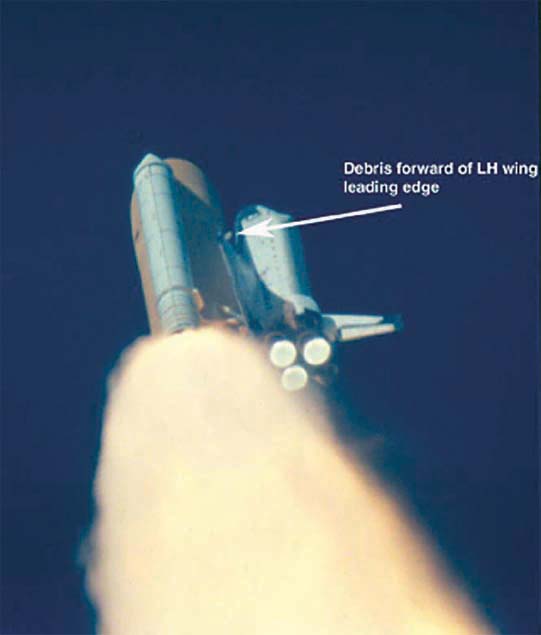 � There were no indications to the Columbia crew or engineers in Mission Control that the mission was in trouble as a result of the foam strike during the ascent. � There were no indications to the Columbia crew or engineers in Mission Control that the mission was in trouble as a result of the foam strike during the ascent.
� A breach in the shuttle's Thermal Protection System allowed superheated air to penetrate through the leading edge insulation and progressively melt the aluminum structure of the left wing.
� The accident was not a random event but rather a result of the spaceflight program's culture, which had as much to do with the accident as the foam did.
� NASA managers allowed practices detrimental to safety to develop, which stifled discussions and caused the evolution of an informal chain of command that operated outside the agency's rules.
� There was no possibility for the crew to survive.
� The shuttle's breakup had the potential to cause casualties among the public on the ground. NASA needs to better protect the public during launches and re-entry.
** Information provided by CNN.com** Columbia Accident Investigation Board's Recommendations: � Continue the space shuttle program with adequate funding. � Continue the space shuttle program with adequate funding.
� Build a complement or replacement for the shuttle.
� Prevent the shuttle's external fuel tank from shedding any debris before flying again.
� Improve the shuttle's ability to sustain minor debris damage and develop tests to determine the resistance of current materials used in the orbiter.
� Develop the capability to inspect and make emergency repairs to the Thermal Protection System while the shuttle is in orbit.
� Upgrade the imaging system to provide more useful views of the shuttle during liftoff. Also consider using aircraft to provide additional views of the orbiter during ascent.
� Design a better system to collect sensor data from the craft.
� Expand a training program for NASA mission teams to look beyond launch and ascent, including the potential for loss of the shuttle and crew while in orbit.
� Establish an independent technical engineering authority that looks at safety and does not have responsibility for schedule or program costs.
� Reformulate management so that NASA's main office of safety has independent oversight over shuttle safety.
� Conduct a vehicle recertification of the shuttle and its systems before operating the craft beyond 2010.
** Information provided by CNN.com** |