Abu Ja'far al-Khwarizmi 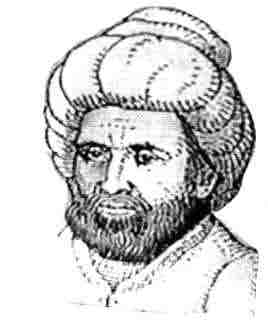
(780 - 850 AD) Little is known of the life of this ninth century Arabic mathematician who also wrote on astronomy, geography, and the calendar. His name indicates that he was "Muhammed, son of Moses, father of Jafar, from Khwarizm," (modern Khiva, south of the Aral Sea in central Asia), but some historians say he came from a district between the Tigris and Euphrates rivers. His algebra book dealt with "what is easiest and most useful," namely linear and quadratic equations, all treated geometrically and without symbols in six cases (there being no zero or negative numbers). The title was "al-kitab almukhtamar fi hisab al-jabr wa'l-muqabala" or "The Compendious Book on Calculation by Completion and Balancing," or more loosely translated, "The Science of Reunion and Opposition." This work was so influential that the word "al-jabr" was commonly applied in later Arabic work of this type and so is the root of our word "algebra" (Gandz). Later, in medieval Europe, an "algebrista" was a bonesetter -- a reuniter, or completer, of bones -- and the barber of the day called himself an "algebrista" for bonesetting and blood-letting were sidelines of the medieval barber. The candy-striped barberpole of today derives from these sidelines: A bloody bandage was wrapped around a poles as an advertisement. Al-Khwarizmi's work on arithmetic was the first to expound the Hindu numeral system with its digits 0, 1, 2, 3, . . . , 9 and decimal place value, which was then a fairly recent arrival from India. This work achieved its greatest success when it was translated into Latin in the twelfth century. It begins "Dixit Algoritmi" (Spoken has Al-Khwarizmi). From this derives "algorizm" and by false etymology, our "algorithm." The Hindu numerals -- like much new mathematics -- were not welcomed by all. In 1299 there was a law in the commercial center of Florence forbidding their use; to this day this law is respected when we write the amount on a check in longhand. "Al-Khwarizmi's scientific achievements were at best mediocre, but they were uncommonly influential" |