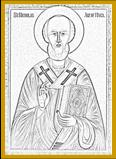
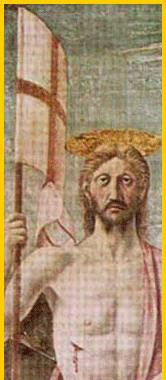
The piece below was written with three particular icons in mind: these icons of the Russian Orthodox Tradition were written for the chapel of Christ Church Anglican Church in Castlemaine. These icons represent Saint Nicholas, Bishop of Myra (Santa Clas) to whom the chapel is dedicated, Christ Pantocrator and a particularly beautiful and tender example of the ‘icon of loving-kindness', an icon type - particlular to the Russian tradition - in which the Madonna and ChristChild embrace.
 |
||||
 |
 |
 |
||
 |
||||
 |
 |
 |
||
 |
||||
 |
 |
|||
 |
||||
 |
||||
 |
||||
 |
||||
 |
||||
 |
||||
 |
||||
 |
||||
 |
||||
 |
|
|
|
|
For God so loved the world, that he gave his only begotten Son that whosoever believeth in him should not perish, but have everlasting life. For God sent not his Son into the world to condemn the world but that the world through him might be saved.
John 3:16 is so often repeated and referred to—even on T-shirts and placards—that many people, non-religious people, knowing almost nothing of the Bible, nevertheless know this bit. We could almost say that it is the most important single statement a Christian can proclaim on the subject of God's unconditional Love for the whole world.
For me this is the thing that makes Christianity unique as a religion—it makes this proclamation the very first thing that must be understood by the faithful about God's relationship with them. This is dangerous knowledge; it's not the kind of stuff that's usually said in public and was, before Christ, only taught to those who were far advanced in their love and understanding of God. This kind of spiritual teaching was always given under a vow of secrecy. Over the course of time and across the religious traditions of the world there have been those who shouted out in the marketplace the truth of God's Love in this world-embracing way. They were usually killed for it, but not for breaking the vow of secrecy. They were killed by the uninitiated faithful who did not understand what they were hearing and mistook this highest Mystery for a blasphemy. This Mystery, therefore, is a secret. When I struggle to understand aspects of the teaching of our faith, reminding myself of this Mystery, made public by Christ, often makes things clearer. As the Fathers of the Church unanimously proclaim: “God became man so that man might become God” or, to put it another way, ‘we become by Grace what Christ is by Nature.'
This is the first thing we are asked to understand, the first teaching, the first step in our relationship with God—the profound extent of His Love that unites us to Him. If it were a human relationship, say a first date, confronted by such an instant and unconditional outpouring of Love, we would think ‘this is going way to fast!' and make excuses to leave. The situation would push us outside our comfort zone. If we stayed out of a sense of chivalry (and presuming we had the courage to stay), at the end of the date we would probably feel exhausted and buffeted, embarrassed and uncomfortable. But this is the very first step in the relationship between God and His Christian people. To face and accept such Divine Love takes courage.
* * *
The icons we have been blessed with in our church on Agitation Hill demand exactly this kind of courage. To consider things like age or origin or artistic tradition is interesting and insightful and, on its own, is comfortable and safe. But our icons, any icons, invite us not so much to look at them but rather to look through them. They are useful as well as decorative, they are windows and like any window, however decorative, we use it to look through at what is beyond. What lies beyond the window frame of an icon? Nothing less than the Heavenly Court itself. Through an icon we gaze upon the people of Paradise, the Communion of Saints, the Angels and even upon the Countenance of God Himself. And at the same time they gaze, through the window frame of the icon, back upon us and upon the world. Standing, kneeling or prostrate before an icon, we meet God face to face.
The icon asks us to stand on the edge of an abyss and, at the edge of our created natures confronted with the uncreated God, to gaze into His Uncreated and Infinite nature and to allow ourselves, the Holy Spirit that is our true selves by rite of Baptism, to gaze upon Itself reflected, so to speak, as in a mirror. And God, at the same time, gazes into us. This is what the icon asks of its viewer: to ‘use' the icon as a sacred instrument is to risk having one's heart pierced by love, to risk being swept away—of being enraptured—and of being challenged to the quick of life. It is a place to learn the fear of God and the Love of God. To look at an icon is easy, but to look through an icon takes courage.
Our icons are not historical relics like the one recently returned by the Vatican to Russia. They were recently written for the chapel and gifted to us by their author, a iconographer trained by the unbroken lineage of teachers that stretch back about fifteen hundred years. It is a tradition that lies at the heart of the Christian faith of our Orthodox brothers and sisters and which remains the common inheritance—the truly catholic tradition—of all Christians. Our icons are only a few years old, but at the same time they are ancient.
There are a handful of legends about the first icons and their truth has nothing to do with whether or not these events are historically accurate. The most familiar legend is of Saint Veronica. As Christ toiled towards Calvary, burdened by the Cross and stained from the tortures He had endured, she gave Him her headscarf to wipe His face and when He gave it back it carried the imprint of His face. The first icon. Through the various legends the theme is always the same: God Himself gives us these icons, they are not a human invention. To my mind it goes like this: God so loved the world … that He entered into it in the Incarnate Person of Christ. He became one of us and because of this He can be present to us in a picture. And because He is God, who dwells within us and amongst us in the Person of the Holy Spirit, when He and His saints are present in a picture they are Really, truly, Present; really there —if anything, more there than we are!
The tradition of icons embraces the human natures of Christ, His Mother and the Saints and at the same time their Divine or deified natures. In short, icons reveal the Sacrament of Communion lived through the hearts of the Lord and the saints, both in the world and in heaven, and are both written by a human iconographer and, at the same time, by the Hand of God Himself. After all, He is the first Artist who created man in His image No wonder then that our Orthodox brothers and sisters venerate (not worship!) icons and pray with (not to!) them. Seeing through these ‘windows unto Heaven' and realising that we too are images of God, called to participate in that same Glory that the icons reveal, we can do no less.
Graeme Castleman
For an in depth look at icons, CLICK HERE
 |
|
|
 |