uguete
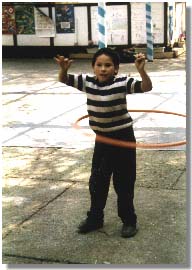
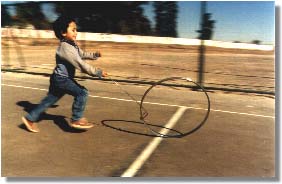
consistente en un arco de madera fino, el cual se hace dat vuelta mediante
la impulsión de un palillo. El juego consiste en mantenerlo en equilibrio
y hacerlo rodar. Es juego de habilidad y destreza. Algunos tenían
grandes diámetros lo cual permitía al niño el traspasarlo
mientras lo hacía girar.
Durante el primer cuarto
de este siglo, se jugaba al aro y era moda que las niñitas con vestidos
adornados con blondas y los niños con trajer de marineros, se fotografiaran
o fueran llevados a cuadros pintados al óleo.
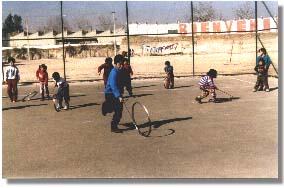
Los niños de las
barriadas juegan llevando el cerco de latón que se emplea para sujetar
las tablas o duelas de las barricas, rodando con la mano o con intervención
de un alambre convenientemente torcido en un extremo; y no faltan los que
juegan con una llanta de automóvil.
No dejan de decirse locuciones
y frases en relación con el aro, como "entrar por el aro o pasar
por el aro", que es realizar obligado por la fuerza o por la maña,
lo que no se quiere hacer.
Origen: Homero, Virgilio
y Ovidio se refieren al aro. Los niños en Roma y Grecia antigua
usaban aros de metal. El aro fue en su origen un objeto sagrado. El círculo
delimita una zona mágica para alejar el espíritu del mal
o para conservar el poderío de la magia. El aro es, como toda figura
redonda y cerrada, un símbolo de la continuidad y de la totalidad
o del tiempo en eterno rotorno. Por eso el anillo ha servido como emblema
del matrimonio, como la pulsera, por igual razón.
Denominación. Argentina,
"arco"; Chile, "aro".
Dispersión. Internacional.
Comentario. François
Rabelais (1495-1550) lo describe en "Gargantúa y Pantagruel", como
entre los juegos que Gargantúa realiza en su infancia.
Pieter Brueghel (1530-1569),
pintor flamenco, lo registra en su citada pintura "Juegos infantiles";
Pierre Auguste Renoir (1841-1919) tiene entre sus cuadros uno que representa
a una niña con aro; y el pintor italiano nacido en Grecia, Giorgio
de Chirico (1888-1978), en su obra "Melancolía y mistero de una
calle", incluye una niña impulsando un aro.
Una trilogía de pintores
chilenos con autoridad, toma el tema: Ernesto Molina Vásquez (c.
1857-1904) tiene muy bien cogida una época de este juego en su tela
"La niña del aro"; Demetrio Reveco (1863-1922), pintor realista,
fijó en una de sus telas al óleo, a una niña
con aro, que él tituló "Niña con juguete"; y sigue
Alfredo Helsby Hazell (1862-1933) quien pintó el "Paseo Atkinson",
en el cual figura una niña que corre tras el aro (Museo Municipal
de Valparaíso).
The Hoop
This game involves a hoop of
thin wood, and a stick used to roll it forward. The challenge of the game
is to maintain the equilibrium of the hoop while making it go round. To
play takes skill and practice. Some of the hoops have such a large diameter
that the child can pass through it while it spins.
During the first quarter
of this century, the hoop game was played and it was the custom for children
who played the game -- girls in dresses adorned with "blondas" and boys
in sailor outfits -- to have their photographs taken or their portrait
painted in oils. The children of the neighborhoods played by taking the
brass hoops that were designed to hold the wood in place on the wine barrels,
rolling the hoops with their hands or with a twisted wire, or sometimes
the game was played with an automobile tire.
There are still many expressions
or sayings in our language that refer to the hoop such as "enter through
the hoop or pass through the hoop" which refers to making someone do something,
by force or trick, that they don't want to do.
Origin: Homer, Virgil and
Ovid refer to the hoop. Children in Rome and ancient Greece used hoops
of metal. The hoop was originally a sacred object. The circle defined a
magical zone to keep away bad spirits or to contain magical powers. The
hoop is, like all round and closed shapes, a symbol of continuity and totality
or of eternal time. For this reason the ring has served as a symbol of
marriage, like the bracelet for the same reason.
Name in Argentina: "arco";
in Chile "aro" (hoop)
Diffusion: International
Commentary: Francois Rabelais
(1495-1550) described it in "Gargantua and Pantagruel" among the games
that Gargantua played in his youth. Peter Bruegel (1530-1569), Flemish
painter, depicted it in his notable painting "Children's Games"; Pierre
Auguste Renoir (1841-1919) has among his paintings one which depicts a
girl with an hoop; and the Italian painter born in Greece, Giorgio de Chirico
(1888-1978), in his work "Melancholy and mystery of a street," includes
a girl rolling a hoop. Three notable Chilean painters also depict this
theme. Ernesto Molina Vásquez (c. 1857-1904) has captured well a
moment in the history of this game in his piece, "The girl with the hoop";
Demetrio
Reveco (1863-1922), realist
painter, focused on a girl with a hoop in one of his oil paintings, with
the title "Girl with a toy." He was followed by Alfredo Helsby Hazell
(1862-1933), who painted the "Paseo Atkinson", in which a girl appears
running behind the hoop.(Municipal Museum of Valparaíso). |