Astrochemistry - Part 3
ASTROCHEMISTRY - Part 3
Return to Astrochemistry - Part 2
Fractional ionization is an important factor in determining
the
cloud's evolution. See above figure on the chemistry that establishes
the
DCO+/HCO+ ratio. The cosmic abundance ratio of deuterium to H
is thought
to be around 1:30,000. In dark molecular clouds nearly
all deuterium is in
HD and nearly all H is in H2.
The cosmic deuterium/H abundance ratio is a measure of the extent
to which
the Universe will expand in the future. Nuclear burning
occurs in stars,
and so the ejection of stellar processed matter
into the interstellar
medium has altered the present day Galactic
deuterium/H ratio from its
cosmological value. The Galactic value
of the deuterium/H ratio almost
certainly varies, as some parts of
the Galaxy have been less processed
by stars than others. The
abundance ratio is determined by measuring the
abundance ratios of
species like DCO+ and HCO+. Also DCN and HCN are
used.
The first detected sign that the Universe is filled with "black
body"
radiation remnant from the Big Bang was obtained from the
optical
absorption features produced by CN molecules against
background
stars.
Star Formation
Stars are being born in the Galaxy at a rate of about one per year.
Many
will survive for over 10 billion years but some will end with
violent
explosions called supernovae in one million years. Stars form in
interstellar clouds. The typical age of a cloud is 10-100 million years.
Initial State Clumps are clumps that allow 10
percent of
the visual light incident on them to penetrate to their
centres. The
initial state clumps possess internal random
velocities that are several
km per second. The motions are thought
to consist of waves in the gas.
In the more highly ionized
material, the waves affect more mass and they
decay far more slowly
than do waves in lowly ionized gas. If waves
(and magnetic fields)
in an initial state clump help to prevent it from
collapsing, the
length of time that the clump will survive depends on the
fractional ionization in it.
Core Cluster Formation
The mechanism triggering the
collapse from the initial state is
unknown. However, a collision between
two clumps will lead to
compression and an increase in the optical depth
of each and an
associated fall in fractional ionization, more rapid wave
decay and
collapse along the field lines. Hence the strongest
clump-clump
collisions may drive the onset of collapse. Once infall begins
it
probably proceeds in an unhindered fashion on a timescale equal to
the free-fall timescale which is calculated with the use of the
theory
of gravity.
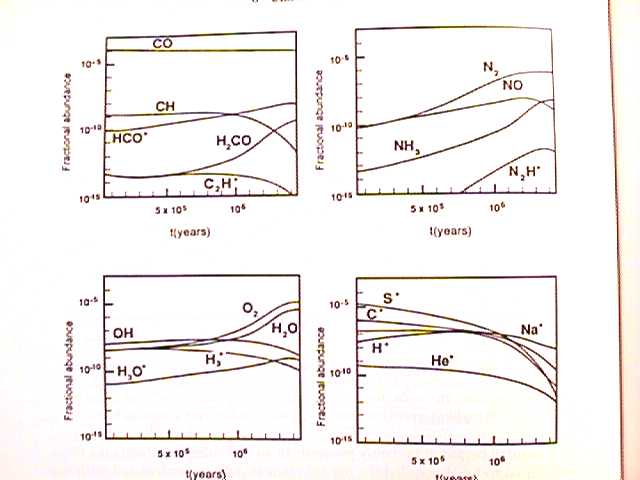
See below for fractional abundances of some species at the clump
centre
during the collapse of a clump.
 Unimpeded collapse, which
may lead to fragmentation, results in some star
formation. When it
is young, a star similar to the Sun loses as much as a
millionth of
its mass in a single year through a stellar wind with a speed
of several hundred kms per second.
Unimpeded collapse, which
may lead to fragmentation, results in some star
formation. When it
is young, a star similar to the Sun loses as much as a
millionth of
its mass in a single year through a stellar wind with a speed
of several hundred kms per second.
Following free-fall collapse, an initial state clump probably
evolves to
produce an object similar to the star forming region
called Barnard 5 and
is called a "core cluster". B5 contains
fragments called cores
(10 solar masses), surrounded by an
intercore medium (1/10 as dense as
core). Stellar objects heat the
nearby dust and produce an energetic
wind.
Core and intercore medium has a temperature of 10-30 K. The stars
will
evolve further. The stars are born in the cores.
Once stars condense they are no longer coupled by friction and by
the
magnetic field to the motion of other matter, as are the gas
and dust
outside the stars. Thus the stars move freely, unlike the
core material,
in the gravitational field and become displaced from
the cores in which
they formed.
The figure below shows a stellar wind sweeping around the boundary of a
core and ablating gas and dust from it.
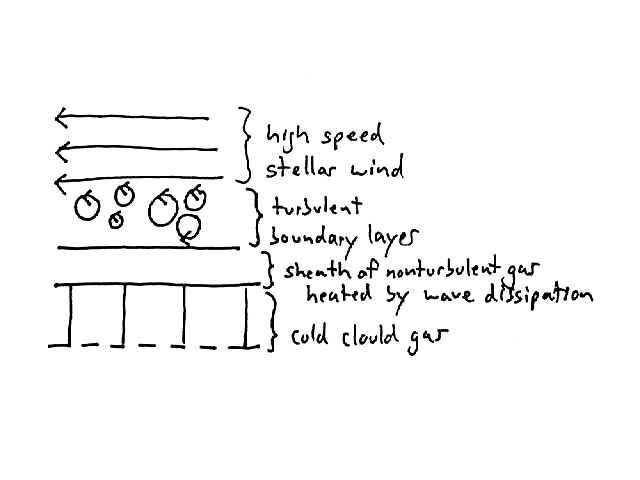 Ablation destroys the cores
and is one means of inhibiting further star
formation, since
without a core, no star can form. As the wind sweeps past
a core it
becomes loaded with molecular gas and perhaps becomes well mixed
with it. All of this activity generates disturbances that heat an
outer
sheath of the molecular core.
Ablation destroys the cores
and is one means of inhibiting further star
formation, since
without a core, no star can form. As the wind sweeps past
a core it
becomes loaded with molecular gas and perhaps becomes well mixed
with it. All of this activity generates disturbances that heat an
outer
sheath of the molecular core.
See below for a schematic representation of the cyclic physical
history
of a parcel of gas in a core cluster.
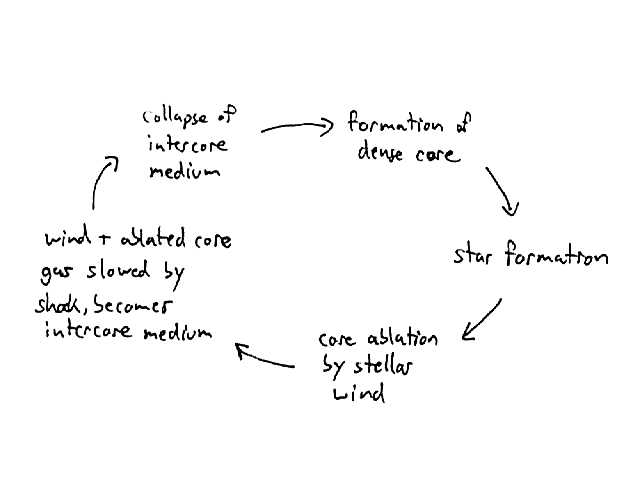 The timescales
associated with the different phases of the cycle are
highly
uncertain. Each core formation probably results in the formation of
a solar-like star or of a binary system of solar-like stars. The chemistry
of the gas varies from phase to phase of the cycle.
During the collapse of
intercore gas to form a core and during the
lifetime of the core, gas phase
chemistry proceeds. At the same
time atoms, ions, and molecules containing
elements heavier than He
stick to any grains with which they collide.
During core collapse
and static core phases, ice formation on grain
surfaces occurs in
parallel with the gas phase chemistry.
The timescales
associated with the different phases of the cycle are
highly
uncertain. Each core formation probably results in the formation of
a solar-like star or of a binary system of solar-like stars. The chemistry
of the gas varies from phase to phase of the cycle.
During the collapse of
intercore gas to form a core and during the
lifetime of the core, gas phase
chemistry proceeds. At the same
time atoms, ions, and molecules containing
elements heavier than He
stick to any grains with which they collide.
During core collapse
and static core phases, ice formation on grain
surfaces occurs in
parallel with the gas phase chemistry.
During the ablation and mixing phase, the molecules from the core
gas are
mixed with H+ and He+ from the stellar wind. When the gas
passes through
the decelerating shock near the bubble edge then the
ices are released
from the grain surfaces as the collisions of hot
gas particles with the
grains sputter the ices. Thus H2O, CO, NH3
and other molecules on the
grain surfaces are injected into the
shocked gas.
Shock heating of a gas can result in a rich chemistry which removes
many
of the atomic species in the gas phase and creates molecules
containing
as much H as possible.
The Infall of a Core to Form a Star
Radio emission from NH3 molecules is often used to study the
detailed
structures of the cores (the observed NH3 emission
profiles give no
evidence for collapse). The densest gas in a core
is the most rapidly
collapsing (and fastest moving). It is also the
gas in which elements
heavier than He are being most quickly
removed from the gas and freezing
out on the dust. NH3 does not
emit radio waves when it has frozen to make
an ice, and so is not
detected. Freeze-out in the dense infalling as also
removes other
molecular species such as H2O and CO.
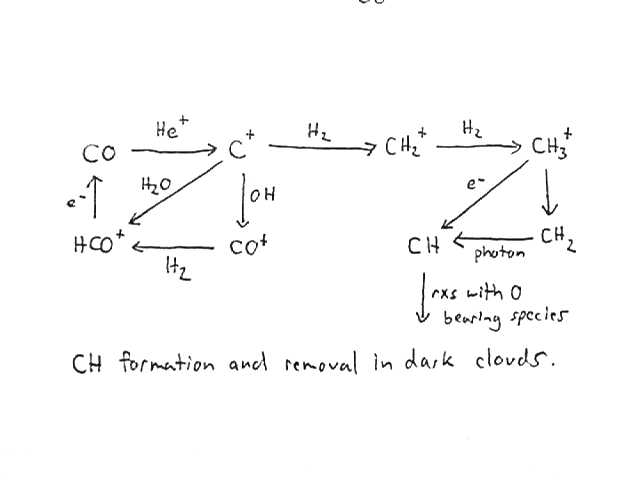
The dominant CH formation and removal processes are shown below.
Regions of Massive Star Formation
Stars with masses up to 50 or 60 times that of the Sun are also
born in
interstellar clouds. The power of the mass loss from
massive stars
(masses greater than 10 solar masses) almost
certainly prevents regions
in which massive stars form from
surviving more than a single generation
of stellar birth. The winds
of the most massive stars have speeds that
are up to ten times
faster than those of more modest stars. The figure
below shows
schematically the different regions in the Orion cloud
(1400 l.y.
distant).
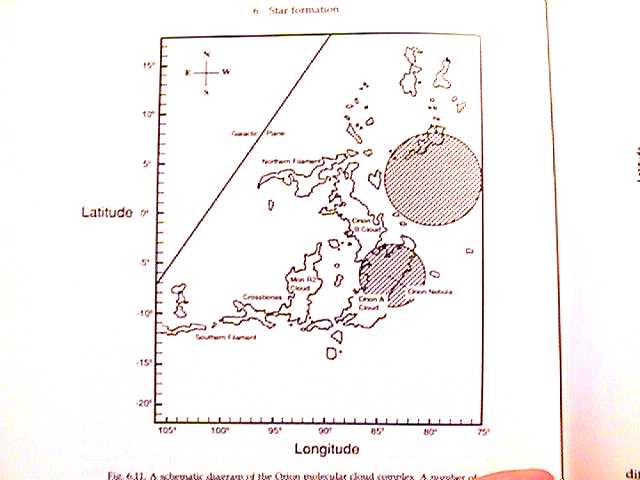 Associations of massive stars are identified by the
cross-hatched areas
on the map.
Associations of massive stars are identified by the
cross-hatched areas
on the map.
The Solar System at Birth
The birth of the Sun, a low-mass star was accompanied by the
formation of
planets, moons, asteroids, comets and meteors which - together with the
Sun around which they orbit - form the Solar
System.
Up to densities of about 10**13 m**-3 the magnetic field acts to
prevent
the spin-up of collapsing protostars. Above this density,
however,
spin-up increases as the collapse proceeds. The decrease
of the efficiency
of magnetic retardation of spin is due to the
drop in the chemically
controlled fractional ionization. The spin-up restricts the collapse rate
of the gas in some directions but
does not interfere with collapse
parallel to the axis about which
the spinning occurs; so a disk-like
structure forms.
Much of what is known about the history of the proto-Solar System disk
during the era of planet formation derives from the analysis
of the
chemical composition of meteoric material.
The sun contains H2 in its sunspots.
The Formation of the Disk
The dusty gaseous nebula from which the Solar System was born
evolved
through a disk-like configuration. The disk-like morphology
of the
proto-Solar Nebula was caused by the rotation of the cloud
of gas and
dust. A molecular cloud rotates on an axis through it on
the same
timescale as the Galaxy rotates around its centre. The
cloud always shows
the same face to the Galactic Centre because the
magnetic field, which
threads through the cloud and the other
interstellar gas around it,
restricts its rotation. The magnetic
field affects cloud rotation.
If a clump in the cloud were to start to collapse, the magnetic
field
would restrict that clump's rotation for a considerable
fraction of the
collapse. However, as the collapse continued, the
fractional ionization in
the clump would drop. A substantial drop
in fractional ionization allows
relative motions to develop between
ions and neutrals, and at very low
fractional ionizations the
magnetic field does not restrict the flow of
the neutral gas. At
low fractional ionizations and high neutral number
densities, the
magnetic field is no longer capable of efficiently
affecting a
clump's rotation or the rotation of a core formed within
the
clump.
During collapse of the core the fractional ionization within it
falls
and the magnetic retardation of rotation weakens. As the core
collapses
it conserves its angular momentum and the core's spin
rate increases as
the core becomes more compact. The spin rate
increases from about 10**-8
y**-1 to 1 y**-1 for the gas and dust
that became the Earth.
Gravitationally driven collapse proceeded much more easily parallel
to
the axis around which material was rotating than in other
directions,
leading to the flattening of the collapsing system and
evolution to a
disk-like structure.
The model disk is usually taken to possess roughly a solar mass and
to
survive for a time comparable to the age of the oldest stars
observed to
have disks, about 10 million years. The extent of the
model disk is
usually assumed to be about the size of the orbit of
Pluto. The typical
number density and temperature of the Solar
Nebula gas at the orbits of
Jupiter, Earth and Mercury was 10**20,
10**21 and 10**22 m**-3 and
100, 1000 and 3000 degrees,
respectively.
Much of the information about the proto-Solar Nebula comes from
studies of
the composition of the meteoritic material which was
left over from the
era of planet formation. Its sold-state chemical
composition was determined
by the conditions in the nebula and
especially in the outer regions of
protoplanets (collection of dust) and gas that contracted to form planets.
Solid material that
became incorporated into planets formed, and
terrestrial rocks have
been so heavily processed that their make-up bears
no resemblance
to that of meteorites. Hence, meteorites are fossils of the
young
Solar System.
Chondrules, of which many meteorites are partially composed, are
small
beads of glassy rock having masses of around one hundredth of
a gram.
They cooled from temperatures exceeding 1700 K within
timescales of tens
of minutes to hours. They are believed to have
been produced by some type
of flash-heating. One possibility is
that lightning struck many regions
in the proto-Solar
Nebula.
For lightning to be produced, the electric field must be strong
enough to
accelerate an electron to a critical energy. The critical
energy is the
ionization potential of the neutral species, i.e. the
energy required in
a collision to knock another electron out of the
neutral atom or molecule.
Lightning is an avalanche phenomenon that
occurs only if the electrons
reach high enough energies.
An electric field is produced by the separation of positively
charged and
negatively charged particles. Lightning in the proto-Solar Nebula could
have been produced if the dominant positive
charge carriers were dust
grains of one size and the dominant
negative charge carriers were dust
grains of another size.
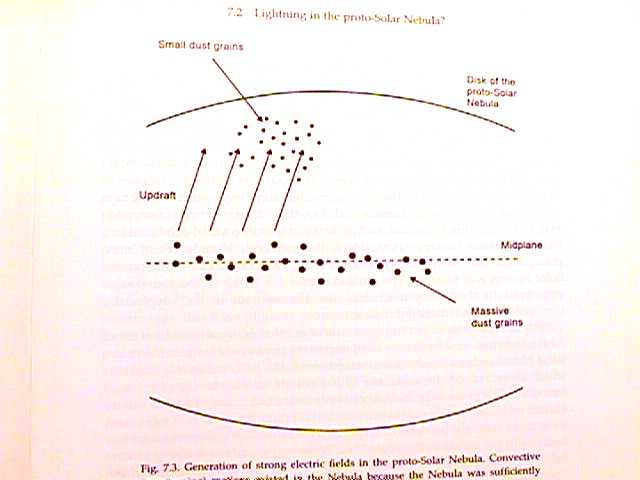
Lightning in the proto-Solar Nebula could have been produced if the
dominant positive charge carriers were dust grains of one size and
the
dominant negative charge carriers were dust grains of another
size. We
then require the motion of one of these two classes of
grains to have been
influenced significantly by gravity, while the
motion of the other must
have been more strongly controlled by the
"winds" that existed in the
proto-Solar Nebula. Such winds were
produced by temperature differences
between the disk's midplane and
its outer boundary. Then charge separation
and strong electric
fields could have been generated. If the
field strength
became great enough a few electrons would have been
accelerated to high
enough energy to cause further ionization and
the onset of the ionization
avalanche, i.e. a lightning discharge.
A necessary condition for the production of lightning in the proto-Solar
Nebula is that grains were by far the dominant carriers of
both positive
and negative charge. The proto-Solar Nebula contained
grains of a wide
variety of sizes with radii ranging up to
millimetres and centimetres.
The larger grains would be expected to
have carried a negative average
charge while the smaller grains a
positive average charge. It seems likely
that the gas phase and
grain chemistry controlled the ionization
structure in the proto-Solar Nebula created ionization conditions that
were favourable for
the stimulation of lightning as the planets formed.
Lightning could
have occurred only in very dense regions of the
proto-Solar Nebula, those associated with protoplanets.
Comet Formation
A comet possesses a solid head containing various ices. The
relative
abundances of the molecules frozen into these ices reflect
the chemical
concentrations in the gas where the comet formed and
may be influenced by
the melting and evaporation of some of the
species during the comet's
lifetime. In Halley's Comet the ice
contains a few times more CO than CH4
and the N2 abundance is
roughly 1 percent that of NH3.
Many meteoritic remnant (but not chondrules) have physical
structures that
are consistent with them having been heated and
then slowly cooled, perhaps
several times. Repeated heating and
cooling may have arisen due to the
random transport of grains
towards and then away from the proto-Sun by the
turbulent eddies
that were present in the proto-Solar Nebula.
As they collapsed, the condensations which became the smaller
planets such
as Earth lost most of the H because their
gravitational fields were too
weak to prevent molecular H from
boiling off, though heavy grains continued
to fall.
One possibility is that comets formed in a part of the proto-Solar
Nebula
that was too cold and too poorly mixed for chemical
abundances to be
altered from the values that they had in the
interstellar gas before it
collapsed.
Why Does the Earth Have Water?
The proto-Earth did not have a sufficiently strong gravitational
field to
retain proto-Solar Nebula gas during planet formation.
Rather, the Earth
is composed of material contained in grains and
the larger stony structures
that were composed by the grains
agglomerating together. The Earth's
atmosphere and surface water
have been released from the stony interior
primarily by volcanic
activity.
Venus has only about a hundred thousandth as much water in its
atmosphere
and on its surface as the Earth.
Possible sources of minerals from which the Earth's water came are
the
higher density proto-Jupiter and proto-Saturn environments.
Mixing of these
minerals into the proto-Solar Nebula would have
been necessary. Another
possibility is that late in the formation
of the Earth it accreted grains
with icy mantles. The icy mantles
may have been remnants of the
interstellar chemistry that occurred
as the Nebula collapsed.
The Sun as A Molecular Source
The Sun has been a molecular source from the birth of the Solar
System up
to the present. Most of the Sun's surface at about 6000
K is too hot for
molecules to survive there. However, the Sun's
outer layers do contain
cooler regions called sunspots. Each
sunspot consists of gas that is
thermally insulated by the local configuration of the magnetic field from
the hotter gas around it.
The sunspots cool to about 4000-4500 K and
though they are
emitting radiation they emit it at lower rates than the
hotter
parts of the Sun's outer envelope and appear to be dark sunspots.
Above a sunspot the temperature drops to about 3200 K over a small
region
of space.
Gas at 3200 K is cool enough for the formation of H2 by the same
sequences that produced it in the era of galaxy formation and which
play a
role in the cool outer envelopes of some stars. UV emission
from solar H2
has been detected, making the Sun the largest
molecular source in the
Solar System.
Stellar Winds and Outflows
During the first million years or so of a star's (with a mass
comparable to
the Sun) life, the star loses a good fraction of a
solar mass of material
in a wind. As this period of high mass loss
ends the star settles down
into the relatively quiescent period of
its "main sequence" phase of
evolution.
Nuclear burning occurs only in the hot central regions of the Sun
and not
in the cooler outer envelop. A star remains in its main
sequence phase
until it burns most of the H in its hot central
region to form He. At the
end of the main sequence phase the star
has a core composed mostly of He.
Helium can also burn through nuclear reactions, and the product of
He
burning is C. The nuclear burning is much more rapid during the
He
core - H shell burning phase of the star's life than during its
main
sequence phase. The faster release of energy results in a
higher rate of
energy input into the outer envelope of the star.
The outer envelope
expands to a radius of about one hundred times
the radius of the Sun, for
a star with a mass similar to that of
the Sun.
As sufficient carbon is produced in the stellar core, a
predominantly
carbon core surrounded by a helium burning shell
which is in turn
surrounded by a hydrogen burning shell comes into
existence.
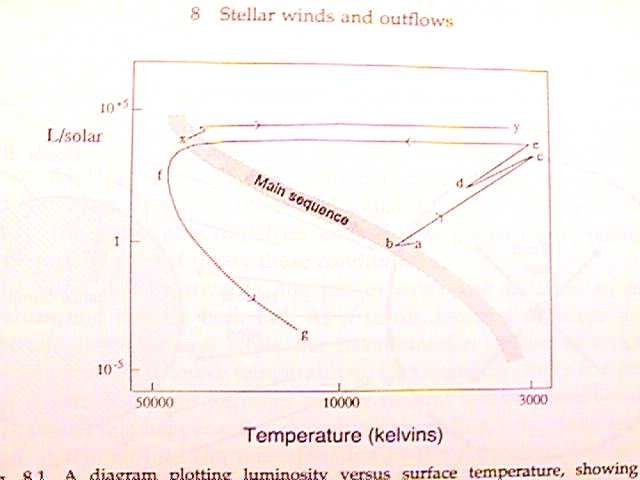
A "T Tauri" phase occurs during the earliest period of the life of
a star.
The evolution of low and high-mass stars is depicted in a
luminosity-temperature plot below.
T Tauri Winds
These are the winds of very young, fairly low mass stars, belonging
to a
class designated by the name of the stars that typifies this
family,
T Tauri. The structure of a T Tauri wind is depicted below.
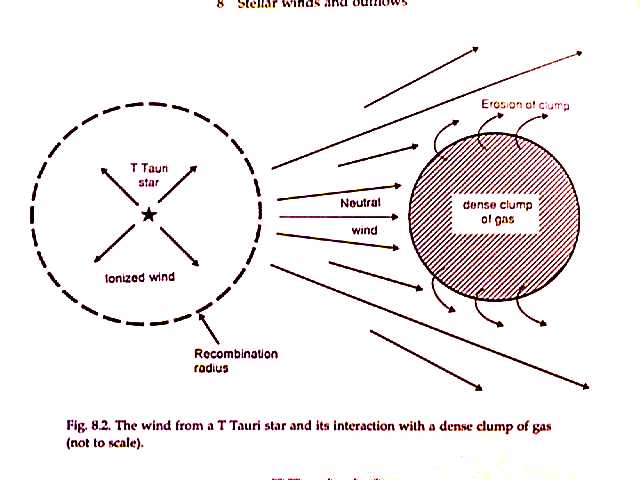
The wind of a T Tauri star has its origin in energetic motions
inside the
star. These motions generate waves which continuously
heat and accelerate
the tenuous outer layers of the star's
atmosphere, creating a wind which
removes mass from the star at a rate estimated to be about 10**-7 solar
masses per year. The gas is
almost completely ionized. The ionization is
caused solely by
collisions. A T Tauri star emits very little UV radiation
that is
capable of ionizing H. The gas is also dust-free; even if dust
grains were present they would be rapidly eroded under these
conditions.
As the gas flows outward it becomes mainly neutral rather than
ionized.
This happens at the recombination radius which is about
six times the
stellar radius. The wind rejoins the interstellar gas
when it has
travelled about a 1000 radii from the star, a distance
that a parcel of
gas covers in under a year.
In T Tauri winds the elements O, C and N (and others too) are
present.
Cool Stellar Envelopes
Very rich chemistries occur in the extended envelopes around some
highly
evolved stars having masses up to a few solar masses. These
are stars
that are shedding their outer envelopes during the phase
in which their
structure is C burning core - He burning shell - H
burning shell. In one
such envelope HCN, HC3N, HC5N...HC11N
(cyanopolyyne sequence) have all
been detected (in IRC +10216).
While the star was cool (gas temperature
about 2000 K) conditions
allowed 3-body collisions to occur. In addition,
dust particles may
form.
This mixture of molecules and dust is how the gas starts its
journey to
interstellar space as depicted below.
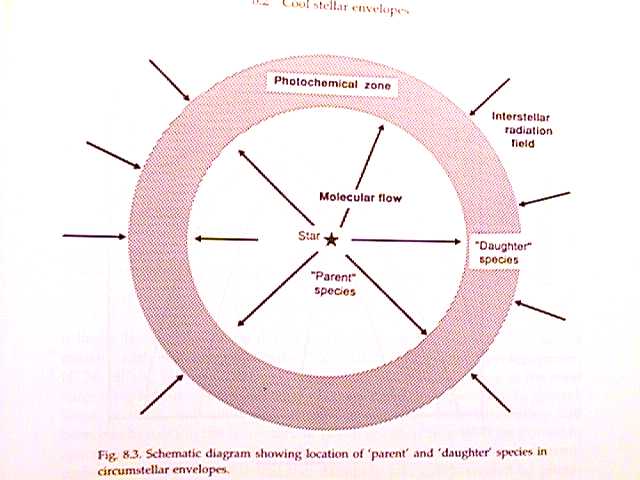
The radiation field from interstellar space penetrates into the
dusty
envelope. Therefore the molecular dissociations and
ionizations caused UV
radiation becomes more frequent. For example,
NH3 (ammonia) is
photodissociated in the outflow to give NH2, NH
and N; HCN is
photodissociated to give CN, C & N, C+ & N; C2H2 is
photodissociated into
C2H, C2, C & C+. Ultimately, as the flow
merges into the diffuse
interstellar medium, it is composed mainly
of atoms H, O, N and the ion C+.
These new species are themselves reactive. In the photochemical
zone the
"parent" molecules mix with the reactive products of their
destruction.
For example, C2H2 + C+ => C3H+ + H2 => C3H3+ + e- =>
C3H2. C3H2 is
cyclopropylyne, a cyclic molecule (see notes). It has
been detected in
interstellar space and appears to be very
common.
The "daughter" species C2H is a progenitor of larger hydrocarbons;
C2H + C2H2 => C4H2 + radiation => C4H (a linear hydrocarbon radical
detected in IRC +10216 which has a massive carbon-rich
outflow).
Some of these molecules were detected in space before they had been
synthesized in the lab.
The complexity of products that can be created is limited by the
amount of
time that any parcel of gas spends in this reactive zone.
When an
oxygen-rich envelope develops around a cool star, the
chemistry will be
much more restricted than in a carbon-rich
envelope. In an oxygen-rich
environment, nearly all the C will be
in CO and very little is available
to feed the extensive
hydrocarbon chemistry that a carbon-rich star
exhibits.
Go to Astrochemistry - Part 4