Astrochemistry - Part 4
ASTROCHEMISTRY - Part 4
Return to Astrochemistry - Part 3
Planetary Nebulae
Eventually the outer envelope of a star with a mass of up to
several solar
masses is lost and the remaining central parts of the
star undergo
contraction. A surface temperature of many tens of
thousands of kelvins is
reached. For a timescale of tens of
thousands of years the star emits tens
of thousands of times as
much energy as the Sun. Eventually, the star cools
to several
thousand K and dims to about one ten thousandth the luminosity
of
the Sun. By then it is a white dwarf with a radius of one a few
percent
of the Sun.
During the hot phase of the star's evolution it develops a wind
which
carries about 10**-7 solar masses away from the star each
year at a speed
of several 1000 kms s**-1. The planetary nebula is
ionized and heated to
around 10**4 K by the stellar radiation.
Molecular emissions from some
planetary nebulae are
observed.
See below for the structure of a developing planetary nebula.
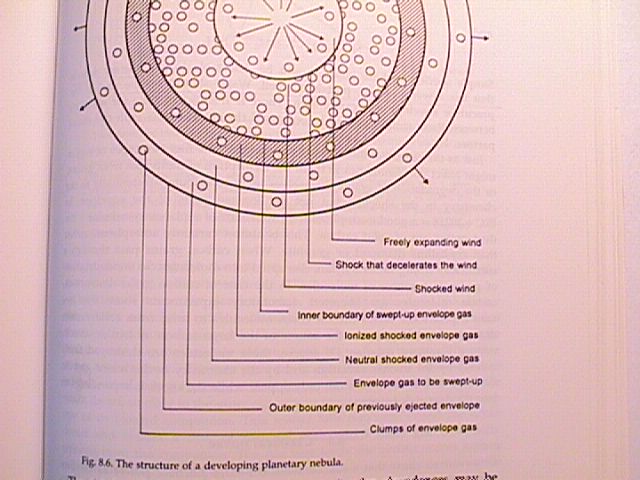 It
shows the structure of a radiation-modified wind-blown bubble
propagating into an envelope. The wind drives a shock through the
envelope,
which is clumpy. The shock causes heating to a couple of
thousand K.
It
shows the structure of a radiation-modified wind-blown bubble
propagating into an envelope. The wind drives a shock through the
envelope,
which is clumpy. The shock causes heating to a couple of
thousand K.
The relative locations of the shock and ionization boundary have
tremendous
importance for the possibility of molecular formation.
There are
potentially three types of molecular region: the
unshocked envelope gas;
the clumps; and the shocked but not yet
ionized envelope gas. If the cool
envelope were carbon rich and CO
contained all the O, then the excess C
would exist as C+. Reactions
of C+ with H2 in the warm dense post-shock
gas are rapid:
(see notes for equation)
and there is also time for neutral reactions to occur such as
CH +
H2 => CH3 + H@ => CH4
and N + H2 => NH + H2 => NH2 + H2 => NH3
Water should not be seen if the precursor envelope was carbon-rich.
Degradation of grains may contribute substantially to the
chemistry. The
destruction of grains is a source of molecules. In
the case of carbon
grain destruction, C molecules are
liberated.
Lab experiments show that we may expect some linear carbon chain
molecules
to arise from solid carbon disruption, so this may be the
source of the
large C molecules seen in mature planetary nebulae.
But these molecules
are destroyed fairly quickly by the intense radiation and by the chemistry
in the warm gas. So the large carbon
molecules can only appear while the
shock is expanding out into the
dust-rich envelope.
Classical Novae arise in double stars. One star
has an
extended envelope and the other star is a white dwarf. The
gas falls
toward the white dwarf and is heated by friction to
trigger the
thermonuclear burning of H (which requires a
temperature of 20 million K)
at the surface of the white dwarf. As
nuclear burning evolves further,
temperatures around 100 million
degrees may be attained in a time as short
as a quarter of an hour,
and the sudden outburst of energy explosively
ejects considerable
amounts of matter (around 10**-4 of a solar mass) at
speeds up to
3000 km s**-1.
See below for the characteristic light curve of a classical nova.
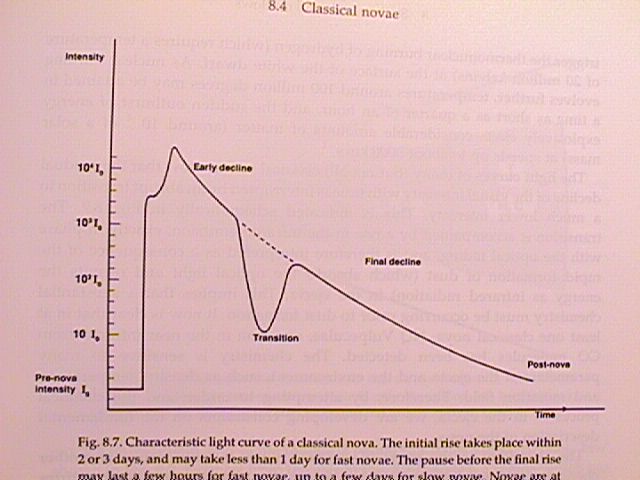 The transition is accompanied by a rise in the IR emission, exactly
in
phase with the optical fading and is therefore interpreted as a
consequence of the rapid formation of dust in the ejecta.
The transition is accompanied by a rise in the IR emission, exactly
in
phase with the optical fading and is therefore interpreted as a
consequence of the rapid formation of dust in the ejecta.
In the ejecta of classical novae gas densities and temperatures are
high
so collisions between atoms are very frequent, but radiation
fields are
very intense so that photodissociation is very fast and
timescales are
very short with changes occurring in days or even
seconds rather than
thousands to millions of years.
See below for how radiation from the star, unimpeded by dust,
"eats" its
way into the receding ejecta ionizing the gas.
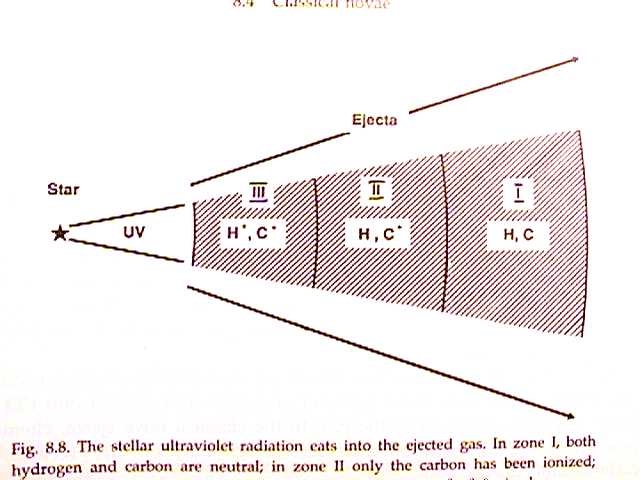
Very soon after the outburst, the radiation has not penetrated very
far so
that close to the star, densities are high enough for three-body
collisions to form H2: H + H + H => H2 + H. However,
collisions can also
destroy H2 in the reverse reaction by shifting
H2 molecules up the ladder
of vibrational states until they reach
the top and fall apart. After a few
days the gas is swept up by the
carbon ionizing front and is now in
zone II. The electrons produced
from the ionization of carbon open up an
additional H2 formation
process: H + e- => H- + H => H2 which takes over
from the three-body reactions as the density falls.
The presence of H2 is important in allowing further chemistry to
proceed:
C+ + H2 => CH+ + H
CH+ + O => CO+ + H
CO+ + H => CO + H+
Large amounts of CO can be established in zone I while in zone II
C is still
largely ionized.
The evidence of observations is that the ejecta of many classical
novae are
C-rich. In the classical nova ejecta, chemistry produces
large hydrocarbon
molecules which may be the precursors of
carbonaceous dust.
Astronomical Masers Near Bright Stars
Laser is the acronym for Light Amplification by the Stimulated
Emission of
Radiation. The M in maser stand for Microwave. Masers
work on the same
physical principle as lasers, but amplify
microwave, millimetre and radio
radiation rather than visible
light. Masers are very brilliant over an
extremely narrow frequency
range and dark at other frequencies.
Astronomical masers are
naturally occurring examples of tremendous
radiation amplifiers and
exist in the vicinities of the brightest young
stars and in the
outflows from highly evolved stars which are shedding
their
envelopes.
Stimulated Emission
There are three different ways in which radiation at the
frequency
corresponding to the energy separation between two levels
of a molecule
can interact with that molecule:
a) an excited molecule can spontaneously emit a photon, and
populate the
lower level;
b) a molecule in the ground level can absorb incident radiation to
become
excited; and
c) emission from an excited molecule can be stimulated by incident
radiation. If most molecules in a column of gas are in excited
levels,
then the stimulated emission process will be more rapid
than the
absorption process, and the intensity of the radiation
will be amplified
as it passes through the column.
Pumping the Maser
A maser can only operate when the population in the exited level is
high
enough relative to that in the lower level. Masing and lasing
cannot occur
in a molecule having only two energy levels. However,
all molecules have
more than two energy levels.
OH Masers Near Young Stars
The OH emission from the brightest young stars is found to be
clumped in
spots at distances of 10**14 - 10**15 m from the stars.
There are many
tens of spots around a single star and each has a
size of 10**12 - 10**13
m (distance from Earth to Sun is 10**11 m)
and emits at a power of one
millionth of the entire luminosity
(about 10**28 joules s**-1), summed
over all wavelength of the
Sun.
About 1-10 percent of the O in the masing regions is in the form of
OH.
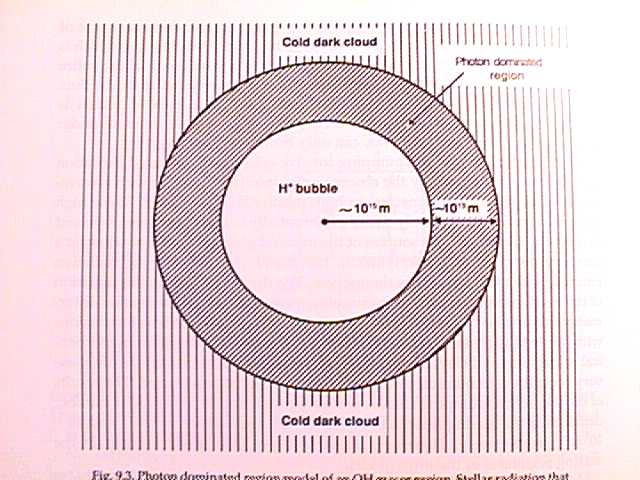 The above figure shows the possible locations of OH masers. The maser
spots
are in transition zones between those parts of a cloud just
beyond the edge
of the sphere that is ionized by the stellar
radiation, where the chemistry
is strongly affected by the photons,
and those parts of a cloud which are
essentially dark.
The above figure shows the possible locations of OH masers. The maser
spots
are in transition zones between those parts of a cloud just
beyond the edge
of the sphere that is ionized by the stellar
radiation, where the chemistry
is strongly affected by the photons,
and those parts of a cloud which are
essentially dark.
At high densities H2 is not a coolant, but a trap for stellar
radiation.
Since the stellar radiation field in the vicinity of the
OH masers is about
one million times as intense as the normal
interstellar background, it is
therefore a tremendous source of
heat.
H2O, OH and CH3OH will be abundant in the same outer part of the
photon
dominated region. The molecules OH and CH3OH show maser
activity there,
though H2O does not, because the physical
conditions necessary to pump OH
and CH3OH masers are similar but
differ substantially from those required
to pump H2O
masers.
H2O Masers Near Young Stars
Unlike OH masers, H2O masers in the vicinities of young stars show
high
speeds of up to about 100 kms s**-1. The pumping mechanism is
thought to
be collisional and requires a temperature of several 100
K to operate
since the upper level is so excited. The individual
Galactic H2O maser
spots have dimensions of about 10**11 m and
powers between 10**-5 and
10**-1 of the total solar
luminosity.
The figure below shows the distributions of OH and H2O masers in the
vicinity of
the Kleinmann-Low Nebula.
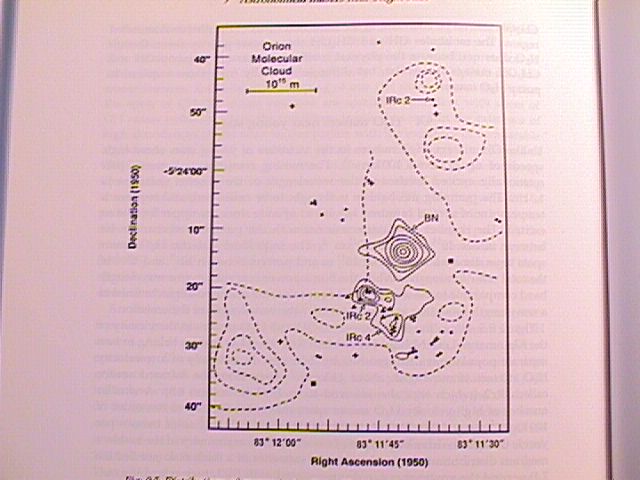 Shocks near the interfaces
between the wind and the ambient medium
probably create the
elevated temperatures required for H2O maser pumping.
Shocks near the interfaces
between the wind and the ambient medium
probably create the
elevated temperatures required for H2O maser pumping.
The gas in shocks in which the high-velocity H2O masers form
contain no
molecules shortly after the initial heating. Speeds as
high as
100 km s**-1 almost certainly cause the dissociation of
molecules. H2O
masers exist where the H2 reformation
occurs.
Masers in Stellar Outflows
The outer envelopes of many very evolved stars contain more O than
C;
these O-rich envelopes contain masers.
One reason that masers are found among bright young stars is that
the
surrounding gas possesses a wide range of physical and chemical
properties.
Because of the large range of conditions, some gas is
likely to possess
the properties necessary for masing to
occur.
The masers found nearest to the stars are SiO masers. They are
generally
seen at radii of about 10**11 m, comparable to the
distance between the
Earth and the Sun.
Stellar envelope H2O masers are seen at distances of roughly 10**12
m from
the stellar centres. As the outward flow continues, H2O is
photodissociated by the interstellar radiation field and OH is
formed.
Stellar envelope OH masers exist at distances of 10**14 m
from the central
stars.
Supernovae
Not til the fire is dying in the grate
Look we for any kinship with the stars.
George Meredith
Stars more massive than about 8 solar masses rapidly consume their primary
fuel, H and undergo enormous explosions called supernovae,
seeding the
Galaxies with the products of thermonuclear burning
which produces mainly
C, O, N, Si and Fe. The injection of heavy
metals such as SI and Fe into
interstellar space is almost entirely
due to supernovae, whereas mass loss
from low-mass stars is also
important for other elements, especially C, O
and N.
The enrichment of the interstellar medium and the mixing of old and
new
interstellar gas are driven by supernova explosions.
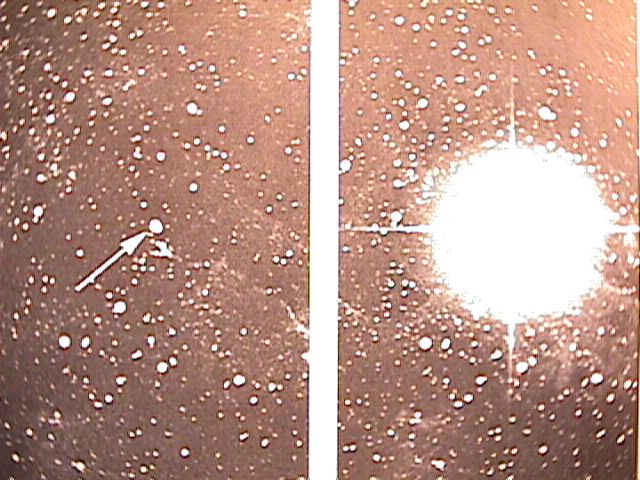 Above are the before and after images of SN 1987A. The
total
energy is 10**46 joules. In one year the Sun radiates a total
of
10**34 joules, a millionth of a millionth of the supernova.
Several
varieties of molecule have been detected in SN 1987A, viz.
CO and SiO.
The chemistry that occurs in the ejecta of supernovae
must be quite
different from that in interstellar clouds.
Above are the before and after images of SN 1987A. The
total
energy is 10**46 joules. In one year the Sun radiates a total
of
10**34 joules, a millionth of a millionth of the supernova.
Several
varieties of molecule have been detected in SN 1987A, viz.
CO and SiO.
The chemistry that occurs in the ejecta of supernovae
must be quite
different from that in interstellar clouds.
What Happens in a Supernova
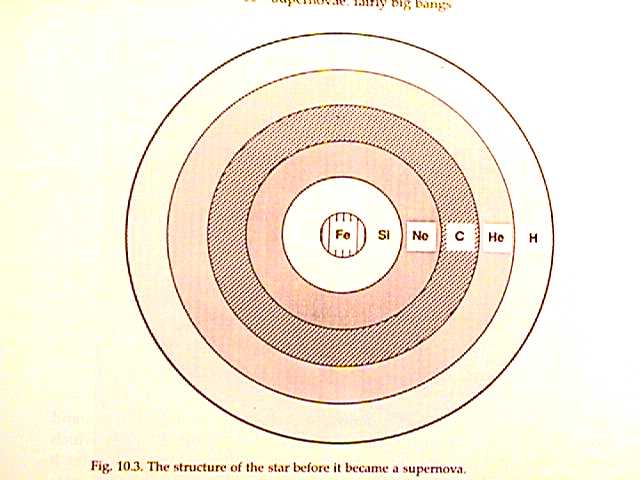
The following figure shows the onion-like structure of shells surrounding the
iron
core at the end of the nonexplosive burning phase of a massive
star's
life.
 The layers of the star outside the iron core fall inwards, only to
impact on the solid neutron star and bounce off it. In the transient
heating accompanying the bounce further
nuclear reactions occur and new
elements are created, some of which
are heavier than Fe, including some
that are radioactive. It is the
bounce which causes the ejection of the
outer layers of the star.
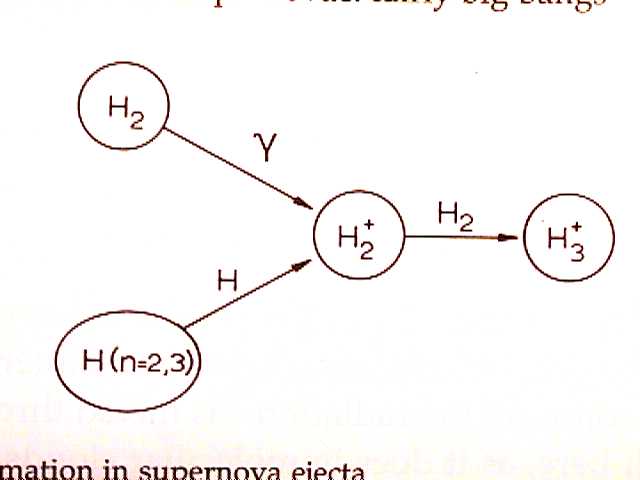
H3+ was also discovered in the ejecta of
SN 1987A.
The layers of the star outside the iron core fall inwards, only to
impact on the solid neutron star and bounce off it. In the transient
heating accompanying the bounce further
nuclear reactions occur and new
elements are created, some of which
are heavier than Fe, including some
that are radioactive. It is the
bounce which causes the ejection of the
outer layers of the star.
H3+ was also discovered in the ejecta of
SN 1987A.
Supernova Chemistry: a H-poor Environment
In supernovae ejecta H is no longer the dominant element; in the
inner part
of the ejecta almost all of it has been processed into
heavier elements.
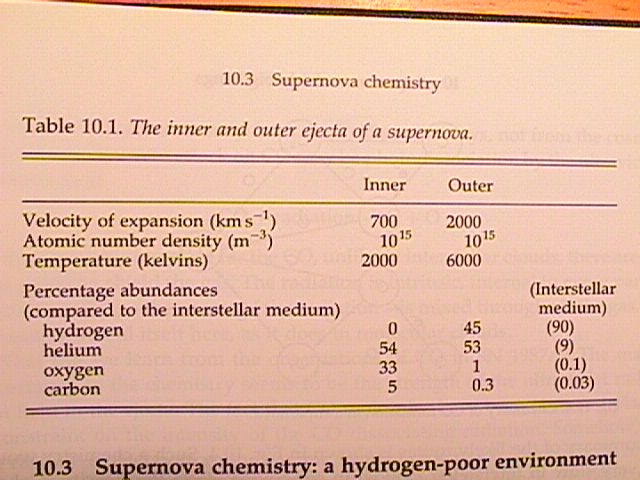
The following table shows the abundances and physical conditions in the
inner and
outer ejecta of a supernova. Both regions of the ejecta
are H-poor
compared to any other astrophysical situation.
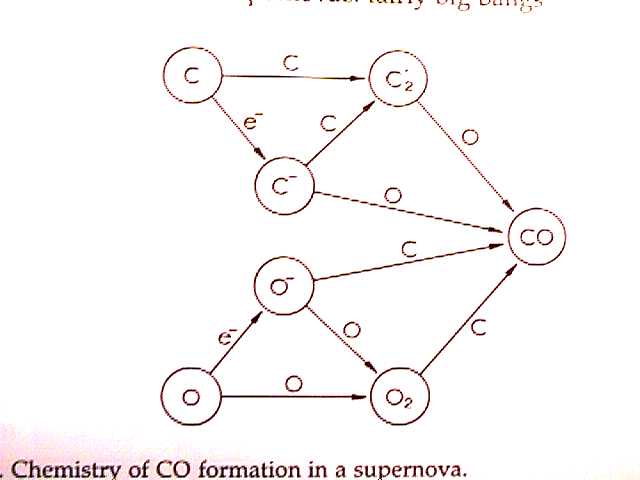
CO was detected in SN 1987A about 3 months after its outburst. See
below for the chemistry of CO formation in a supernova. The
detected CO
seems to have been located in the inner part of the
ejecta where H was
absent.
The chemistry that may form H3+ is illustrated below:
Molecules in Active Galaxies
In many cases the distributions of molecular emissions in active
galaxies
differ substantially from that in the Milky Way. Many
different types of
active galaxies exist.
The Black Hole
The formation of black holes seems to be the natural consequence of
stellar collisions that occur in the dense stellar clusters at the
centres
of the largest, most centrally concentrated galaxies. Once a reasonably
massive seed black hole forms its tidal forces can rip
away the extended
envelopes of evolved stars and grow by accreting
the stripped-off gas,
which forms an accretion disk around the
black hole. The Milky Way Galaxy
has a central black hole with a
mass of about a million times that of the
Sun.
Starburst Galaxies
Starburst galaxies are galaxies that are very bright at IR
wavelengths,
with total luminosities about one million million
(10**12) times that of
the Sun and about ten times that of the
Galaxy. When galaxies collide the
molecular clouds spiral to the
centre of the Galaxy. When they reach the
centre, there frequent
collisions seem to trigger bursts of massive star
formation.
Seyfert Galaxies
Starburst galaxies that have even more concentrated emission
sources.
These Seyfert Galaxies possess bright centres with optical
features
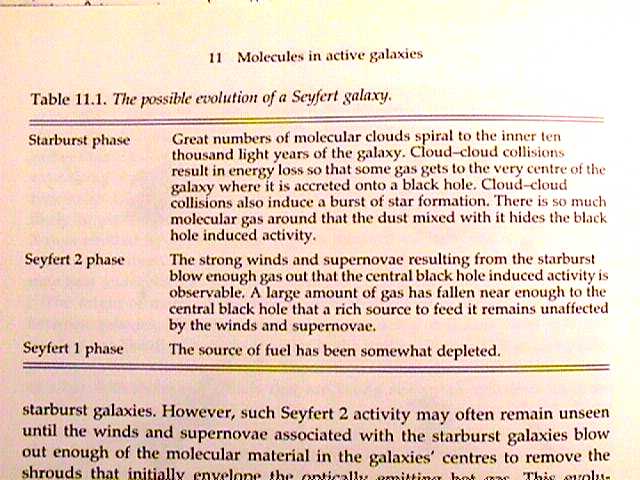
emitted by gas having a wide velocity distribution. The following table
shows the possible evolution of a Seyfert galaxy.
Megamasers and Gigamasers
Mega stands for million and giga for billion. The galaxies that
have the
intrinsically strongest central IR sources often contain
very powerful
masers. These include OH masers that are
intrinsically between a million
and a billion times brighter than
the typical OH masers found in the Milky
Way. In the centres of
active galaxies, parcels of gas that extend over
distances of about
1000 l.y. (about 10**19 m) possess properties that
produce
masing.
Observations have shown that there is an empirical relationship
between
the strength of an extra-Galactic OH maser and the total IR
luminosity of
its Galaxy. The intrinsic strength of the maser
emission increases as the
square of the intrinsic strength of the
IR emission. This may be used as
a means of setting a reliable
distance to a very distant galaxy containing
a gigamaser.
Molecular Features in Quasar Spectra
The most powerful active galaxies are the quasars, or quasi-stellar
objects,
so called because they appeared to the first observers of
them to be
like very blue stars. The nearest quasars are billions
of light years from
the Sun and their intrinsic powers are roughly
10**13 times that of the
Sun, or about 100 times that of the
Galaxy. The great distance of the
nearest quasar means that such
objects no longer exist; they ceased to
exist when the Universe was
younger by roughly the light travel time from
the quasar to the
Earth. It is generally accepted that an accreting black
hole is the
power house of the quasars. CO and H2 have been detected in
quasars.
With references from the book "The Chemically Controlled Cosmos" by
Hartquist and Williams.
Go to Astrochemistry - Part 1