Astrochemistry - Part 2
ASTROCHEMISTRY - Part 2
Return to Astrochemistry - Part 1
Intergalactic Shocks
The fast wind from a galaxy feels the intergalactic gas as an
obstacle
which must bring the flow nearly to a halt. Since the wind
speed is
supersonic, the deceleration is effected by a shock, and
after the wind is
shocked it is very hot, probably more than 10
million K. The unshocked and
shocked wind occupies regions a and b
respectively.
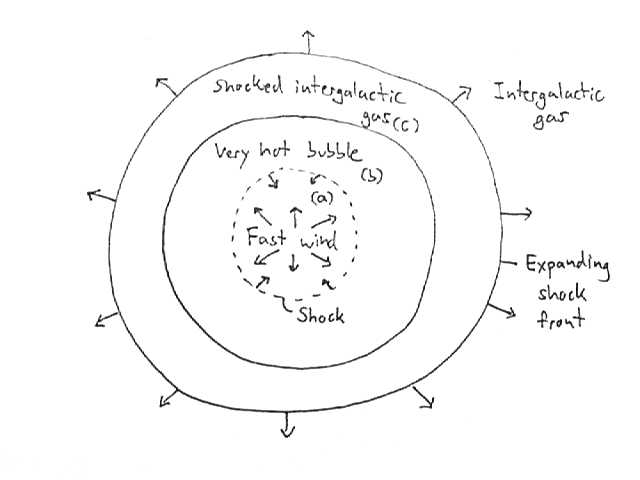 The wind drives a bubble that must expand
because the temperature and
pressure of the shocked wind are so
great. It expands against the cool
intergalactic gas, and the speed
of this expansion is probably several
hundred kilometres per
second, which for the intergalactic gas is also
supersonic. So
another shock develops and moves out into the intergalactic
gas.
Behind this shock is hot shocked intergalactic gas. The ambient and
shocked intergalactic gas are in regions c and d.
The wind drives a bubble that must expand
because the temperature and
pressure of the shocked wind are so
great. It expands against the cool
intergalactic gas, and the speed
of this expansion is probably several
hundred kilometres per
second, which for the intergalactic gas is also
supersonic. So
another shock develops and moves out into the intergalactic
gas.
Behind this shock is hot shocked intergalactic gas. The ambient and
shocked intergalactic gas are in regions c and d.
During their adolescence some galaxies were violent objects. Some
developed fast winds powered by young stars and black holes. These
winds
impinged on the surrounding gas. The speeds of the winds were
many 100's
of kms per second and highly supersonic.
In a young active galaxy the density in the bubble increased and H2
began
to form and a much higher fraction of gas was converted to H2
here than in
the unshocked pregalactic gas. The abundance of H2
molecules was about one
for every thousand H atoms in the swept-up
intergalactic gas, or 1000 times
greater than in the ambient
intergalactic gas. The H2 cooling effect were
consequently much
more powerful, densities increased further, temperatures
were low
and the Jeans masses were relatively small. In the cooled
postshock
intergalactic gas the temperature was probably as low as
100 K,
while the density was about 10**6 m-3. Consequently, the Jeans mass
was about 10**5 solar masses, which is much less than the mass of
a galaxy.
This was most likely the typical fragmentation mass in
the second
generation of gravitational collapse and may be the mass of the basic units
from which the second generation of galaxies
formed. The mass of 10**5
solar masses is characteristic of
collections of stars called globular
clusters. It has been
conjectured that at least some galaxies form by an
agglomeration of
globular clusters, and possibly other galaxies grew by
accreting
them. If a young galaxy had, in addition to a powerful wind,
an
intense source of radiation, then the abundance of molecular H
would
have been affected. Through H2, therefore, the size of the
subgalactic
units was determined. The formation of H2, and the
consequent cooling
properties determined how the Universe became a
collection of galaxies.
Interstellar Clouds - the Birthplaces of Stars
Interstellar clouds fill the space between the stars of the Galaxy.
These
clouds can be tenuous (about 10**3 atoms, ions and electrons
per m**3) or
hot plasma (approx. one million K) or cold (about 10
K) or dense
(about 10**9 atoms and molecules per m**3) and some
which contain even
denser regions in which stars are being
formed.
Galaxies are found to possess a wide range of shapes and physical
characteristics. Some are irregular, apparently chaotic assemblies
of
matter. Others are more organized in appearance. The dark lane
in
NGC4565
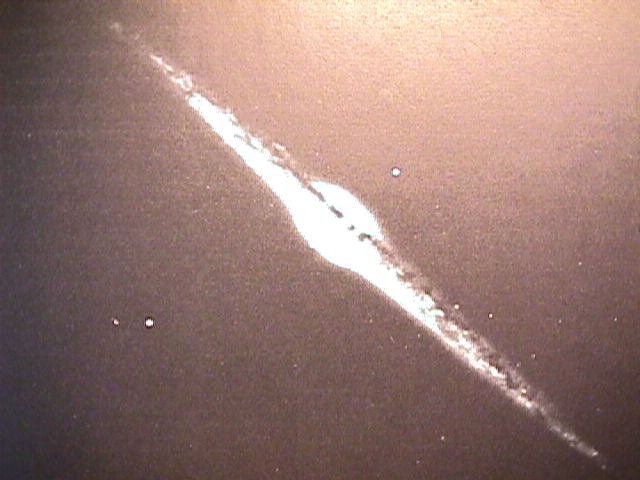 is direct evidence of the presence of interstellar
matter. The
dust in clouds of gas and dust obscures the light of
stars, giving rise to
apparently dark structures. Gas and dust are
generally quite well mixed, so
that the presence of dust, as
indicated by obscuration of starlight,
implies the presence of
gas.
is direct evidence of the presence of interstellar
matter. The
dust in clouds of gas and dust obscures the light of
stars, giving rise to
apparently dark structures. Gas and dust are
generally quite well mixed, so
that the presence of dust, as
indicated by obscuration of starlight,
implies the presence of
gas.
Once a galaxy has formed and stars begin to "burn" their fuel i.e.
H, then
the ashes of these thermonuclear processes begin to
accumulate. These
ashes, principally in the form of C, N and O are
ultimately returned to
interstellar space in stellar winds or in
supernova explosions. There,
they are incorporated in the gas which
forms the next generation of stars.
The atoms of which each of us
is made were at one time in the interior of
a star more massive
than the Sun.
The presence of these elements makes possible a much richer
chemistry than
described in the Early Universe. These elements also
permit the existence
of interstellar dust. Many cool stars
(temperature of about 2000 K)
produce particles of dust in their
atmospheres and blow these particles
into space. Cool carbon-rich
stars make sooty particles, much as a candle
has a sooty flame.
Cool oxygen-rich stars make long lived silicate dust
and this too,
is blown into the surrounding medium.
Turbulence in the gas stirs the dust and the gas and dust remain
well-mixed.
The obscuration of a star by a dusty cloud is always more
pronounced for
blue light than for red; this differential extinction makes all stars seen
through a dust cloud appear
somewhat redder than they should, just as the
Sun is reddened near
the horizon. The general trend of increasing
extinction of
starlight by dust towards shorter wavelengths extends from
the IR
right into the UV.
Dust comprises about 1 percent by mass of the interstellar medium.
The
dust is composed mainly of particles of C and of silicates,
with diameters
comparable to the wavelength of visible light (about
500 nm) and extending
to quite small sizes (< 10 nm). Small
particles are much more numerous than
large though altogether they
contain somewhat less mass than all of the
large particles.
Absorbing or scattering starlight, the dust reduces or eliminates
the
intense destructive power of starlight. The radiation absorbed
by the dust
causes electrons to be ejected from the dust grains and
these are an
important source of energy of the gas; they take
energy from starlight and
share it with the gas. Also the radiation
tends to heat the dust grains so
that they radiate in the IR
region. Dust grains therefore transmute
radiation from the UV and
visible into the IR.
Dust grains also provide surfaces on which H atoms can recombine to
form H2
molecules. the reaction to form H2 on interstellar dust is
the initial
step in all of interstellar chemistry.
At the centres of thick clouds, dust grains are fairly cool (< 10
K) and
protected from radiation that might influence the chemistry
taking place at
their surfaces. This means that molecules such as
H2O stick with high
efficiency, forming icy mantles (mantles have
been positively identified
by spectroscopy). The loss of molecules
from the gas by incorporation into
solid ices can have a
significant effect on the chemistry in an evolving
molecular
cloud.
Diffuse clouds which absorb about one quarter of the optical
starlight
were found to be prevalent with one occurring on average
roughly every
500 l.y. along a line of sight. The number density of
H atoms, the
temperature and extent of such a cloud were about 3 x
10**7 m**-3, 80 K
and 10 l.y. The mass of each is about 100 times
that of the Sun. Clouds
about 5 times more optically thick than the
more prevalent clouds were
found to occur about 8 times less
frequently.
There is also a phase of the interstellar gas at 8000 K and more
tenuous,
at a number density of 2 x 10**5 m**-3, than the
interstellar clouds.
Probably heated by the energy carried by
electrons ejected from grains
following the absorption of
starlight.
There is also a phase with a temperature of 3 x 10**5 to 10**6 K
and a
number density of 1-10 x 10**3 m**-3. This hotter gas is
thought to be
energized by the shocks driven into the interstellar
medium by
supernovae.
Together the 8000 K and one million K gases comprise the intercloud
medium.
The warm gas and hot gas posses pressures that confine, at higher
densities, clouds that are at lower temperature. The confinement of
the
more optically thin of the diffuse clouds is due only to the
pressure of
the intercloud medium around them.
The more optically thick diffuse clouds are probably confined
primarily by
their self-generated gravitational fields, i.e. they
are held together by
their weight.
Clouds more optically thick than the diffuse clouds exist. They are
called
translucent and dark clouds. Each are bound together by the
gravitational
field that it produces. They usually possess
primarily molecular centres
with mostly atomic rims. Some of the
translucent and dark clouds have
masses comparable to the diffuse
clouds and may have been diffuse clouds
that were compressed by
factors of about 10 by the passages of shocks
driven by
supernovae.
Most of the molecular material lies in gravitationally self-binding
objects called giant molecular cloud complexes or simply giant
molecular
clouds which are very likely agglomerations of clouds
that were once
diffuse. Typically have a mass of 100,000 to one
million times that of the
Sun, very roughly 100-1000 times that of
a typical diffuse cloud. Most of
the mass is in translucent clumps
of 100's to 1,000's of solar masses with
molecular number densities
of 10**9 H2 molecules per m**3. A giant
molecular cloud is at least
100 l.y. across with only about 1 percent of
its volume filled with
the massive clumps. Star formation takes place
primarily in giant
molecular clouds.
Molecular H - the key to interstellar
chemistry
H is the most abundant element in the Universe. There is one He
atom for
every 10 H atoms. O atoms are less than one atom in 1000
H atoms. C one in
3000, N at one in 10,000. Iron, silicon and
sulphur are even less abundant.
Therefore atoms and molecules are
more likely to collide with atoms or
molecules of H than with any
other species. Therefore H plays a key role
in most astronomical
chemistries. The chemistry depends significantly on
the fraction of
H that is molecular.
Observations of H in the interstellar medium indicate that much of
the H
can be molecular.
Molecular H is destroyed in interstellar space by the UV radiation
field
from bright stars. A single H2 molecule exposed to an average
UV radiation
field has a lifetime expectation of less than a
thousand years or only
about 1 A-minute.
In the interstellar clouds, electrons and protons are relatively
minor
constituents with abundances relative to H of less than one in 10,000.
A new mechanism, not available in the Early Universe is H2
formation on
dust. A H atom collides with a dust grain and is
weakly bound to the
surface; a second H atoms arriving at the grain
finds the first, they
combine to form a molecule and the energy
which must be released in the
process is absorbed by the grain. The
presence of dust shields the region
from the destroying UV
radiation and also the molecular H shields itself.
The destruction
of H2 becomes slower than its formation. Further into the
cloud,
the H is largely molecular.
Dark Clouds: chemical factories in the interstellar
medium
Dark clouds contain a great variety of molecular species. The
molecular
cloud in Orion is a region where many of the molecules
listed in
Table 1.1 have been detected. The number density is about
10**10 m**-3 or
10,000 times denser than the interstellar average.
The cloud is very cold
with temperatures of 10-30 K. It contains so
much dust that it is
optically opaque to visible and UV light.
Therefore the molecules in
these dark clouds are shielded from the
powerful and destructive
interstellar radiation field.
Cosmic ray protons cause a slow rate of ionization as they collide
with
H2 molecules and eject electrons to form H2+ 97 percent of the time
and
H+ only 3 percent of the time. The H2+ almost always reacts with H2 to
give H3+. 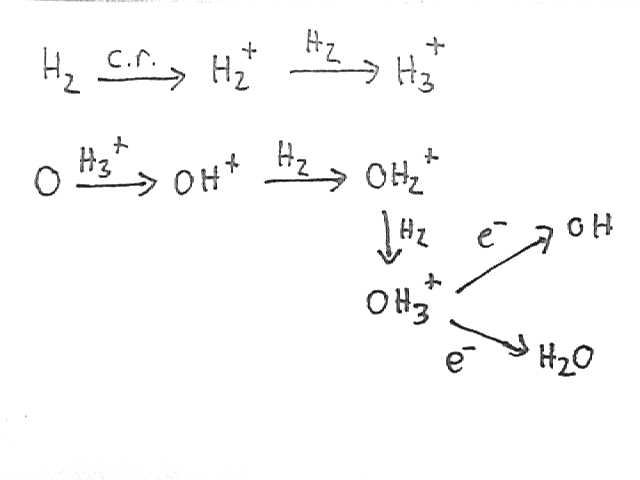
At low temperatures atoms of O, C, N do not react with molecular H.
Reactions of the H3+ ion with atoms of O and C take place. The ion
H3+ is
reactive and can donate a proton to many species. CH3+, CH
and CH2 will
form in analogy to H3O+, OH and H2O.
CH3+ + O => HCO+ + H2
HCO+ + e- => CO + H
Nitrogen chemistry is initiated in dark clouds by atomic N reacting
with
OH and CH to form NO and CN.
Diffuse Clouds: Chemistry by Starlight
Diffuse clouds are pervaded by starlight. UV radiation intensities
are
reduced by factors of 10 because of the dust but the
destructive effects
of the radiation remain powerful. Chemistry of
diffuse clouds is neither
as rich in variety, nor as abundant, as
in dark clouds. In addition to CH,
CN and CH+, H2, CO and OH are
commonly detected.
Excessive sunlight destroys the cells that make up human skin.
Sunlight
bleaches the curtains in our houses by altering the
structure of the dye
molecules in the fabric.
The average life of a molecule in a diffuse cloud is about 300
years, or
less than half an A-minute). Much of the description of
dark cloud
chemistry applies also to diffuse clouds. However, the
abundance of
electrons in now much higher because the radiation field ionizes C atoms.
O and N are not ionized. O+ ions are created
indirectly by cosmic rays
which ionize H to produce H+. If an O
atom and a H ion collide at 100 K or
more then it is quite likely
that the charge will transfer,
H+ + O => O+ + H. Successful diffuse
cloud chemistry is possible only
where much of the H is molecular.
Clouds in which H2 is a minor species
do not in general show many
other molecules. CH+ is however sometimes an
exception.
Dust
Without dust, molecular H could not be abundant in the Galaxy.
Interstellar
chemistry would then be rudimentary, and interstellar
clouds could not
evolve to form stars of a wide range of masses and
planets.
In dark clouds molecules other than H2 tend to freeze out on dust
grain
surfaces. There is nothing strange in this: in the lab it is
difficult to
keep any surface truly clean. In space the dust is
very cold, about 10 K.
Molecules tend to stick when they collide
with grain surfaces and icy
mantles accumulate on them.
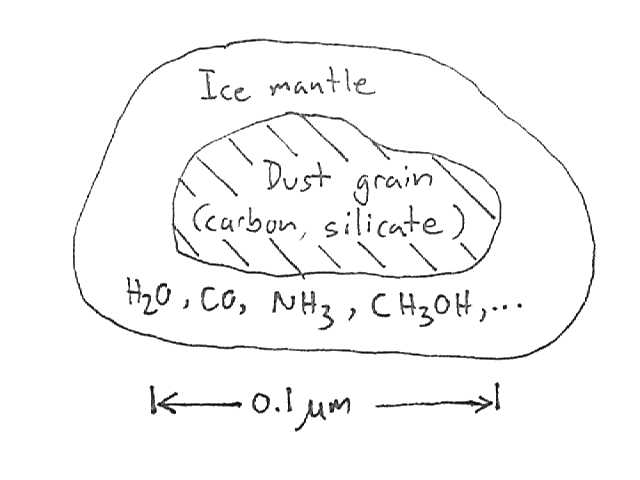 Even atoms such as O, C, and N
will stick and are probably
converted by H addition to water, methane and
ammonia. Such mantles
are detected by spectroscopy in the IR. In many dark
clouds much
more H2O is in ice than in the gas. Another molecule detected
to be
present in icy mantles is CO. Some process returns the ices to the
gas phase. Perhaps there is a continual evaporation of molecules
from the
mantle.
Even atoms such as O, C, and N
will stick and are probably
converted by H addition to water, methane and
ammonia. Such mantles
are detected by spectroscopy in the IR. In many dark
clouds much
more H2O is in ice than in the gas. Another molecule detected
to be
present in icy mantles is CO. Some process returns the ices to the
gas phase. Perhaps there is a continual evaporation of molecules
from the
mantle.
Substantial amounts of O, C and N are in various forms, locked up
in
mantles on grains. In dark clouds, perhaps around one half of
the atoms
of these elements are in solid form. Lab work has shown
that if such ices
are exposed to UV light then new chemical species
are formed. Methanol
CH3OH forms from a mixture containing CO and
H2O. When the icy mantles on
dust grains are energized by stellar
radiation the grains will become
warmer and the icy mantles may be
evaporated, populating the gas with a
greater variety of molecules.
The high abundance of ammonia, NH3, detected
in some dense regions
of dark clouds, probably arises as a result of
hydrogenation of N
atoms.
Icy mantles are not detected in diffuse clouds, so the solid state
chemistry energized by UV radiation does not seem to be operating
there.
It remains a possibility that atoms are converted to their
hydrides on
collision with dust. The detection of NH in a diffuse
cloud seems to
require the presence of chemically active
grains.
Interstellar Shocks
Shocks occur whenever a disturbance is driven through a fluid at a
speed
greater than the speed of sound. For example, the air ahead
of a
supersonic plane cannot be aware of the plane's approach and
the
consequence is an abrupt increase of density and temperature,
i.e. a
shock wave. In the interstellar medium the speed of sound is
about
1 km s**-1. Interstellar clouds often have random velocities
of
10-20 km s**-1. If they bump into one another then the collision
will probably be supersonic and shocks will occur. Novae and
supernovae
also generate very substantial motions of gas which are
always accompanied
by shocks.
The temperature rise behind a shock is abrupt and can be large. For
a
shock velocity around 10 km**-1 the postshock temperature would
be around
1000 K. Faster shocks with speeds of several tens of km
s**-1 or more will
create even higher temperatures, sufficient to
dissociate molecules.
Many chemical reactions require a temperature rise to start them
going.
Reactions of O, C and N with H2 are suppressed at low
temperature, less
than 100 K (generally found in interstellar
clouds). The reaction of O
with H2 has an activation energy barrier
of 1000 K (it is exothermic
- energy is released in the reaction).
In an interstellar shock of modest
velocity such temperatures are
readily achieved. We expect H2O to form in
shock of modest speed,
say 10 km s**-1. Reactions of C, C+ and N are
endothermic (energy
must be added). Also expect N to be converted to
ammonia, C to make
single hydrocarbons and C ions to make hydrocarbon ions
in
interstellar shocks.
If shock speeds and densities are high enough, collisions will
dissociate
H2 to form H atoms. Shocks with speeds much above 100 km
s**-1 will
dissociate and ionize most H in a medium of even low
density.
How Chemistry controls the Evolution of Clouds
Radioactive cooling dominates cooling in all molecular clouds, but
which
molecular species radiates the most energy depends on cloud
conditions.
If the lowest excited level of a molecule has an energy
that is much more
than a few times the average kinetic energy of a
molecule in a gas (which
is what temperature measures) then that
molecule usually does not play a
role in cooling.
CO, OH, H2O and H2 are coolants in some interstellar cloud
environments.
CO will be the most important coolant in cold (less
than several tens of K)
gas.
In general, the more collisions there are between H2 and CO the
more
cooling occurs. If the number density of H2 is too high (3 x
10**8 m**-3 or
higher) collisions often depopulate the excited
levels of CO before they
radiate. Also if a great deal of CO exists
throughout the cloud radiation
emitted by the decay of excited CO
in the cloud can be absorbed by
unexcited CO also in the cloud i.e.
the cooling radiation is trapped in the
cloud so the cooling rate
is reduced. Trapping effects of CO are not
common in diffuse
clouds, but they are common in translucent and dark
clouds.
As the temperature increases coolants other than CO can become
important.
H2 becomes an important coolant at temperatures over
several hundred K.
This is because radiative transitions between
the rotational and
vibrational levels of H2 are much slower than
those of other coolant
molecules.
Eventually, at sufficiently elevated temperatures, H2, OH and H2O
become
the dominant coolants. H2 radiates slowly, thus OH and H2O
compte with H2
as coolants. OH is usually a more important coolant
than H2O in diffuse
shocked regions where the temperatures are
about 1000 K. H2O is more
abundant and a more important coolant
than OH in shocked regions in dark
clouds. H2 is the dominant
coolant in shocks with temperatures of a
couple of 1000 K, as long
as the density is not too high.
The ejection of energetic electrons from grains as they absorb
stellar
light acts as a heating process in diffuse clouds. This
heating balances
the cooling in molecular regions of diffuse and
translucent clouds to
maintain temperatures in the range 20-30 K.
Some molecular gas in diffuse
clouds is warmer.
Magnetic Retardation of Cloud Collapse in Regions of
Stellar
Birth
The most diffuse interstellar clouds are confined by the pressure
of the
warm and hot gas around them. The more optically thick
interstellar clouds
are dense enough that their gravity binds them
together.
Thermal pressure plays a role in cloud support or
confinement.
The interstellar gas contains a magnetic field. Pressure arises
when a
force acts over a surface area, and the interstellar
magnetic field
possesses a corresponding "magnetic pressure" which
is always at least
comparable to the thermal pressure and which
sometimes greatly exceed it.
As for the gas pressure which is
affected by the presence of molecular
coolants, the effectiveness
of the "magnetic pressure" is controlled by
the chemistry. The
effectiveness of the magnetic pressure in many clouds
determines
whether collapse within them will lead to regions of stellar
birth.
The magnetic field can help support a cloud against gravity, so
that the
magnetic Jeans mass (ie. the minimum mass of a cloud with
a given density,
temperature and magnetic field strength that will
collapse due to its
gravity) is greater than the nonmagnetic Jeans
mass. The magnetic force
acts only on the
charged particles and tends to push them outwards. The
magnetic
force does not act directly on the neutral gas and gravity pulls
them inwards. This drift of neutrals relative to charged particles
is
called ambipolar diffusion and occurs on a timescale of 400,000
years in a
cloud in which the collapse is magnetically retarded and
in which the
fractional ionization (the ratio of the number density
of all ions to that
of H nuclei) is 10**-8. The ambipolar diffusion
timescale increased in
proportion to the fractional ionization and
is 4 million for a fractional
ionization of 10**-7. The ambipolar
diffusion time is the maximum
timescale for which a cloud can
remain nearly static. Then collapse leads
to the formation of
regions of star formation.
Ionization in Clouds - The Chemical Control of Magnetically
Retarded Collapse
Chemistry controls the ionization in a cloud.
At moderate depths in a cloud, the photoionization of C, producing
C+ is
the major source of ionization. At greater depths into a
cloud, the
dominant source of ionization is cosmic rays.
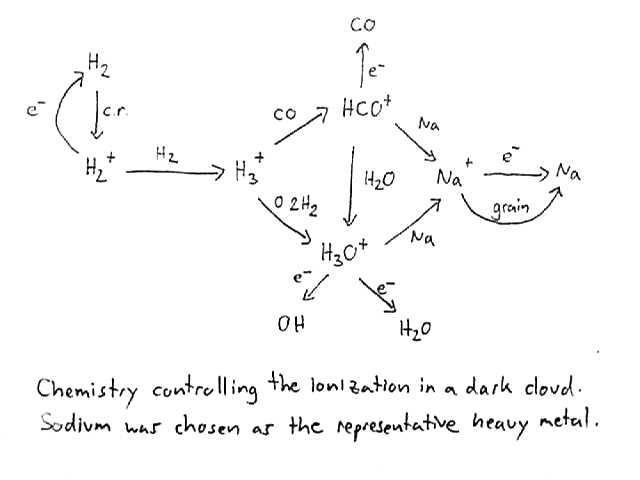 The ion HCO+ is often the
most abundant molecular ion in dark regions.
See above to see
how it can be removed.
The ion HCO+ is often the
most abundant molecular ion in dark regions.
See above to see
how it can be removed.
The length of time that magnetic support can retard the collapse of
a
gravitationally bound cloud depends on the fractional ionization
which,
in turn, depends on the cosmic ray induced ionization
rate.
The Inference of the Cosmic Ray Induced Ionization Rate in
Diffuse Clouds
We can use hydrogen deuteride, HD, in the inference of the cosmic
ray
ionization rate in diffuse clouds.
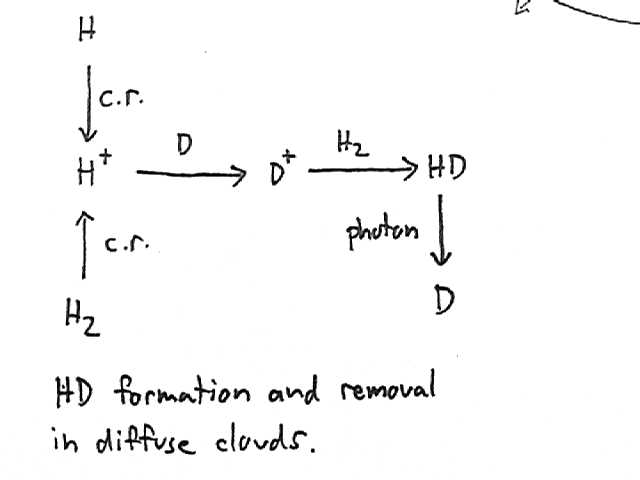 Cosmic ray
induced ionization rates inferred from diffuse cloud data for
OH
and HD are generally around 10**-17 s**-1.
Cosmic ray
induced ionization rates inferred from diffuse cloud data for
OH
and HD are generally around 10**-17 s**-1.
Although magnetic fields do provide support against gravity for
dense
clumps, this support is relatively short lived, and the
collapse cannot
ultimately be prevented.
The following shows the chemistry that controls the H production in a
dark
molecular region.
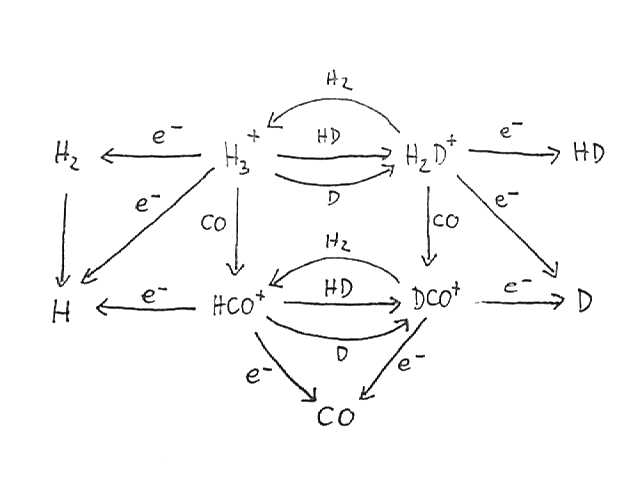 This network tells us that the equilibrium
abundance of H atoms is directly
proportional to the cosmic ray
induced ionization rate. For dark clouds
the ionization rate has
been estimated to be about 10**-18 s**-1 or ten
times lower than
the rate in most diffuse clouds. The lower ionization
rate in dark
clouds reduces the period of time that a magnetic field can
retard
the collapse of a cloud.
This network tells us that the equilibrium
abundance of H atoms is directly
proportional to the cosmic ray
induced ionization rate. For dark clouds
the ionization rate has
been estimated to be about 10**-18 s**-1 or ten
times lower than
the rate in most diffuse clouds. The lower ionization
rate in dark
clouds reduces the period of time that a magnetic field can
retard
the collapse of a cloud.
Go to Astrochemistry - Part 3