FREDERICK CHRISTIAN BAUMAN
Page 8
I left Tiffin June 28th to return to Iowa going home with my sister, Rosanna, and Rev. Spangler who came to Tiffin for me. after a two week's visit with my parents in Williams County I reached my field of labor in Iowa July 22nd, 1854, and at once began active work, preaching alternately at the school house north of Corners, fifteen miles southwest. A Sunday School was organized in the congregation and in due time a prayer meeting was started and conducted in various ways, sometimes by Bible study, sometimes by lectures, etc., and toward the last years in connection with Christian Endeavor Services.
I felt deeply impressed in the beginning of my work in Iowa that a wide field in every direction was missionary ground for the Reformed church, and that our Reformed people were scattered in different localities in the state. At that time those who paid subscriptions to our different church papers, as the Messenger, Christian World, and Reformierte Kirchen Zeitung were acknowledged in the papers. By this means I learned to know a good many names, and their post office address, which I recorded in a book for reference. I corresponded with a number, some of whom I afterward went to see, as Valentine Slife, at Boulder, Lynn County, Oldfather at Clayton County, Maquoketa, Jackson County and Cascade in Dubuque County. I regarded all of them in their localities a nucleus for missions for the Reformed church. I did not then anticipate the importance of money as a factor in missionary work. I thought that all that was needed was the workmen to find the people, and gather them and organize them into congregations, and live on what the people were able and willing to give them for their support. This was also the view of our people among whom I labored. We, however, found it necessary the first two years, when the amount of $150 a year for pastors' salary was insufficient, and we applied to the board of missions for an appropriation of $75.00 for a year or two. The board granted the amount for two years, and when the congregation raised the salary to $200.00, we informed the board that we could get along without further aid, and from then on the charge has always been self supporting.
ADDENDA:
God's blessing has rested on the feeble beginning of fifty-five years ago. The first and only pastor of the congregation is still in active service. The most of two generations have passed away, and the bulk of the congregation now is in the third generation. Conditions of growth have been unfavorable. Scores of members and families have gone out and are now factors in other congregations, engaged in doing the Lord's work. Four young men have gone out into the ministry. The hive is still active and united in doing church work. The seed sown fifty-five and more years ago has grown, and though not large in numbers, is still increasing and active.
The congregation has grown into a Classis; the Classis, with three others, have grown into a Synod, and the work of the Reformed Church is bright and hopeful for the future. For all which we bless God.
Frederick Christian Bauman wrote the above while in his middle seventies, apparently, as he says, still active in the ministry of the Reformed Church. Note: Rev. Bauman pastored the Zwingle church until his death in September 1909. The church was without a pastor from that date until November 1910 when J.E. Boomershine accepted their call.
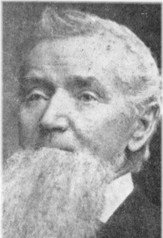
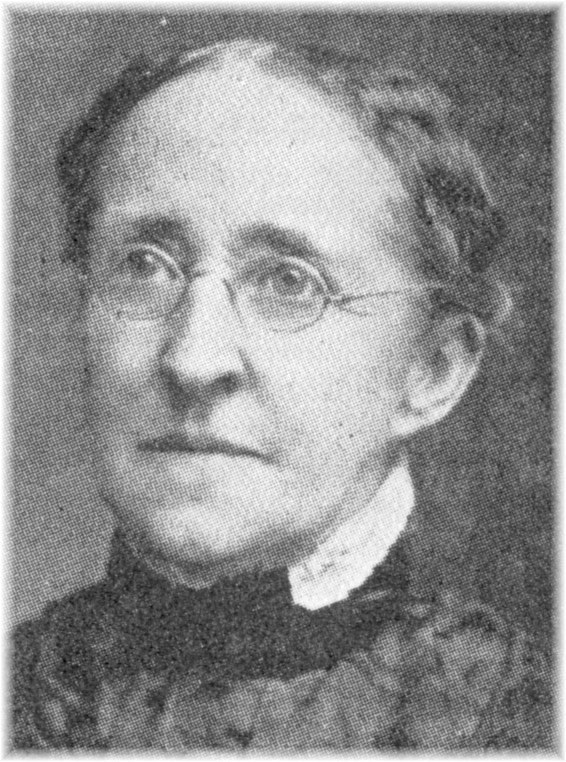 Frederick (left) and his wife, Elizabeth Jane Cort (right) raised nine children. The oldest was Samuel Henry Bauman, my great grandfather, whom I knew. He lived to be 100 years old. -- Sharon Workman
A daughter, Mabel (Bauman) Dauer, was the only one of the nine still living in 1961. For a family reunion held that summer, she wrote down and then spoke the following thoughts about her parents at that gathering. Mabel passed on June 24, 1963.
My father was a very earnest Christian minister and lived very close to his people, rejoicing with them in every joy and comforting them in every sorrow. If any failed in right living, he felt it was he who had failed - not they. His salary never exceeded $350 a year - Social Security? Nil. Federal Aid? Nil. How could this care for a family of nine, and with a definite goal of a college education for each child? Well, this was attained, partially through hard work, but I believe Faith was the main reason. My father taught classes in German and singing, taught school and even worked out his own poll-tax. As the first postmaster, my father sent in the name "Harmony Grove" - not accepted, this being a duplication. So, with a remark to Elizabeth, "I'll send a name which will not be duplicated," it became Zwingle.*
Such was the spirit of our home. A deeply religious spirit prevailed - not with many words, but a living breathing spirit of faith, deep trust, and helpfulness. By all modern standards, we surely were poor. However, good books and magazines were in that home. And however in all the world did our parents find $250.00, in 1862, to buy an organ? It was a beautiful organ, good tone, cased in lovely walnut wood, which filled our home with good music over the years. It now serves as a beautiful desk in Arthur Alspach's home.
Yes, we were poor, but I'm sure we never knew it.
Mt. Zion, VanBuren County, Iowa
August 17, 18, 19, 1961
*I have never seen any evidence of it, but I suspect that "Zwingle" was named after the Protestant Reformation leader, Ulrich Zwingli. Frederick was well versed in his teachings, which underlay the Reformed Church.
Adapted from the Workman-Sutherland Family Web Site - Sharon Workman, Click Here.