|
General:
Applications:
Bibliography:
|
What is radiation?
The microwave oven cooks food by using high frequency electromagnetic waves called microwaves at 2.45 GHz or 2,450,000,000 cycles per second. All electromagnetic waves have both an electric and magnetic field. This unique property allows them to exert force on electric charges and at the same time, allows it to exert force on magnetic poles. As well, all electromagnetic waves are found on an electromagnetic spectrum. This spectrum shows the different kinds of electromagnetic wavelengths. The shorter the wavelength, the more energy the wave carries. Microwaves can be found in between radio waves and light waves. Their wavelengths are about 1 millimetre to 30 centimetres, but the ones used for microwave oven cooking is about 12.1 centimetres. Not only are microwaves an asset in cooking, they are also used to carry information to satellites. As well, radars release microwaves to find and detect objects.
 How does a microwave oven use microwaves to cook food? Microwaves are absorbed by water, fats and sugars which allow these molecules to produce heat. The microwaves cause the molecules to vibrate by making them twist in each direction and therefore rubbing on other molecules. This twisting gets the molecules to absorb the microwave energy and convert it to thermal energy.
 Thermal energy is when heat is produced. How do the water molecules change electromagnetic waves into thermal energy? Water molecules are attracted to one another due to hydrogen bonding (Van der Waals forces). This hydrogen bonding allows water molecules to 'stick' together. Microwaves produce an electric field that oscillates back and forth. In the cooking chamber, the oscillating field applies oscillating torques (forces tending to cause rotations) on the water molecules. The molecules are rotating back and forth to align their dipole moments with the field direction. If the water molecules were paired, they would twist around the common bond to align themselves. The problem is since there is hydrogen bonding, there can be four hydrogen bondings instead of one. The molecules must break at least some of its bond to be able to rotate.
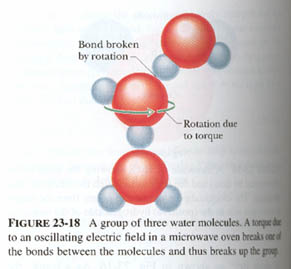 To break hydrogen bonding, energy must be added. The electric field from the microwaves breaks this bond and therefore the 'free' floating water molecules may form other groups. When they do form other groups, the energy that is gained through the breaking of the bonds is released as thermal energy.
|
 The microwave oven is known as a fast, quick and efficient way of cooking food. Its presence has changed the way individuals heat and cook their meals.
Langstaff Secondary School ISU
All images and graphics belong to their respectful owners.
By Lawren, Amie and Jade