|
Heat transfer is subdivided into three basic principles:
Conduction
What is Conduction?
 Conduction is the transfer of heat across a medium from a source of higher temperature to a source of lower temperature. It results from the physical contact of one body with another. The conduction of heat energy will always occur from a region of heat to a region of cold until both region temperatures reach a state of equilibrium. An example would be when a cooking pot is placed on the solid surface of a hot stove. When the pot comes in direct contact with the stove element, heat is transfered to the pot by means of the movement of molecules (kinetic energy).
Thermal conductivity is the method by which heat is conducted through different materials. Examples of materials that have high thermal conductivity are gold, silver, copper, and aluminum. Aluminum trays or pots are most often used in an oven or on the stovetop due to its high thermal conductivity. Conduction is the transfer of heat across a medium from a source of higher temperature to a source of lower temperature. It results from the physical contact of one body with another. The conduction of heat energy will always occur from a region of heat to a region of cold until both region temperatures reach a state of equilibrium. An example would be when a cooking pot is placed on the solid surface of a hot stove. When the pot comes in direct contact with the stove element, heat is transfered to the pot by means of the movement of molecules (kinetic energy).
Thermal conductivity is the method by which heat is conducted through different materials. Examples of materials that have high thermal conductivity are gold, silver, copper, and aluminum. Aluminum trays or pots are most often used in an oven or on the stovetop due to its high thermal conductivity.
The following is a modern mathematical relationship that can be used to predict the transfer of heat through conduction:
Qx = k * A (Th - Tc)
L
Where...
� Q = heat rate (Watts)
� k = thermal conductivity coefficient (W-K/m)
� A = surface area of the medium (m2)
� L = length/thickness of the medium (m)
� Th = hotter temperature (C or K)
� Tc = colder temperature (C or K)
This physical law states that the rate at which heat is conducted through a body per unit cross-sectional area is proportional to the negative of the temperature gradient existing in the body.
Back to Top
Convection
What is convection?

Convection is described as the process by which heat is transferred by the movement of a heated fluid. The fluid through which heat moves may be either gases, such as air, or a liquid, such as water.
Three types of convection may be observed in the world around us:
- natural convection
- forced convection and
- atmospheric convection.
Natural convection depends on the tendency of most fluids to expand when heated and thus undergo a decrease in density. As a result, the warmer, less dense portion of the fluid will tend to rise through the surrounding cooler fluid. If heat is continuously being supplied, the cooler fluid that flowed in to replace the rising warmer fluid will warm up and also rise. Thus a current, a convection current , becomes established. This convection current is due solely to the non-uniformity of fluid temperature.
Circulation caused by natural convection accounts for the uniform heating of water in a kettle: the heated molecules expand the space they move in through increased speed against one another, rise, and then cool coming closer together once again.
Forced circulation involves the transport of fluid by methods other than that resulting from variation of density with temperature. Examples of forced convection are the movement of air by a fan or of water by a pump.
Atmospheric convection produces currents, which are created by local heating effects such as solar radiation (which causes air to be heated and rise), or contact with cold surface masses (which cause air to cool and sink). Such convection currents determine the movement of large air masses above the Earth, the action of the winds, rainfall as well as ocean currents.
Back to Top
Radiation
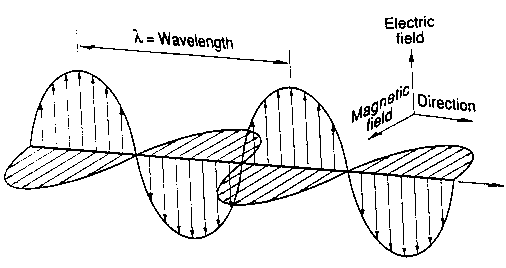
Radiation is made up of electromagnetic waves. Electromagnetic waves are produced when electric charges vibrate. Knowing this, the following are important points to recognize:
- An electric field will produce a magnetic field and changes to the electric field will cause changes to the magnetic field.
- As well, a changing magnetic field can produce a changing electric field.
What?
In summary, as the magnetic and electrical fields continuously change, an electromagnetic wave will form, which can travel through space.

The electromagnetic wave consists of a large and wide range of wavelengths and frequencies. Wavelengths are measured from one crest to the adjacent crest.
Click image to enlarge
�
The wavelength of any wave is related to the amount of energy the wave carries. The shorter the wavelength is, the more energy the wave will carry.
A frequency of a wave can be determined by the use of the following formula:
c=f
Which, by rearranging the equation, equals to:
f=c/
f --> represents the frequency of the wave.
c --> is the speed of light in a vacuum (299 792 458 m/s).
-->(called lambda) is the wavelength.
Electromagnetic waves can be found on the electromagnetic spectrum (also called a EM spectrum).
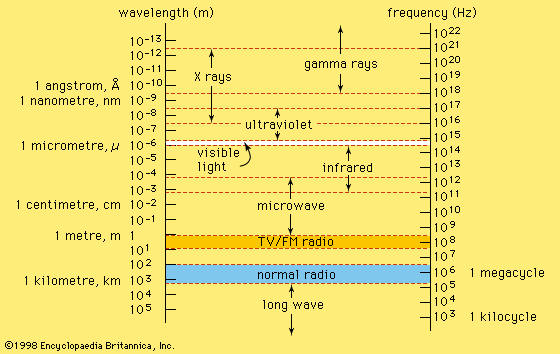
As seen from above, the visible part of the spectrum is represented by colours (red, orange, yellow, green etc..). The EM spectrum is designed so that as a person follows the chart, one can see that gamma rays are the shortest and most energtic of waves, while radiowaves are less energetic and longer in length.
What does this have to do with cooking?
As for cooking, only a certain part of the EM spectrum is used. Mainly the infrared and microwave regions. Infrared radiation is used during baking and barbequing while microwaves are mainly used by the microwave oven. More information on these topics may be found using the side links.
Back to Top
|