Glassware: Pyrex and Corning Cookware
Which types of glassware can be placed in an oven? Why?
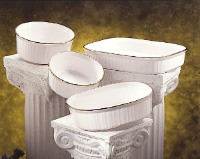 There are various types of cooking vessels that can be placed in a regular oven, depending on the thermal conductivity of the material.
Glass is defined as an amorphous substance consisting primarily of fused silica with borates and phosphates. It is neither solid nor liquid but exists in a vitreous or glassy state. The atoms in glass, although arranged at random, are frozen in position. Glass by itself cannot be placed in an oven because it has a high melting point, therefore not permitting shrinkage or expansion with temperature changes. However, both Pyrex and Corning are derived from glass and consist of a slight change in chemical composition which allows it to be placed in an oven.
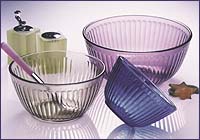 Pyrex is a borosilicate glass that contains borax as a major ingredient, along with silica and alkali. As alkali fluxes lower the fusion (or melting) temperature of silica, it gives way to shrinkage and expansion, consequently allowing it to be utilized in an oven. It is also noted for its durability and resistance to high temperatures, as it has a heightened thermal conductivity.
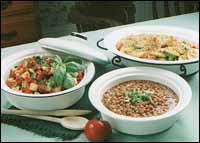
Corning is a glass-ceramic and is four or five times stronger and mechanically harder than glass. Glass containing certain metals will form a localized crystallization when exposed to ultraviolet radiation. If heated to high temperatures, the glass will convert to crystalline ceramics with mechanical strength and electrical insulating properties greater than that of ordinary glass. These properties allow Corning to be used in cooking.
Back to Top