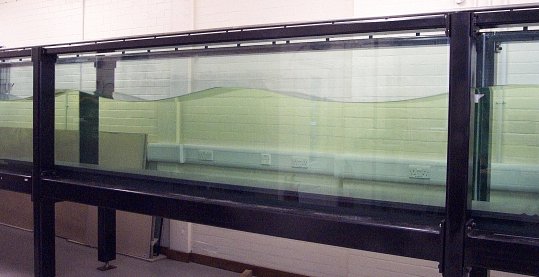
Hydraulics laboratory, Department of Civil & Environmental Engineering, Southampton University
Experimental set-up
Experiments were conducted in a wave flume (17 m long, 0.43 m wide) with a water depth of 0.56 m. The wave generator was of the flap type and had active absorption. The end of the flume was fitted with foam, in order to avoid wave reflection. The test section was approximately 9 m long, and composed of different plates, made out of PVC plastic sheets, some featuring ripples and others just being flat, all of them being smooth. Tests were carried out with 4 different ripple slopes (ripple height to ripple wavelength ratio), from a gentle slope sr = 0.05 to a steep slope sr = 0.175.
General view of the wave flume.
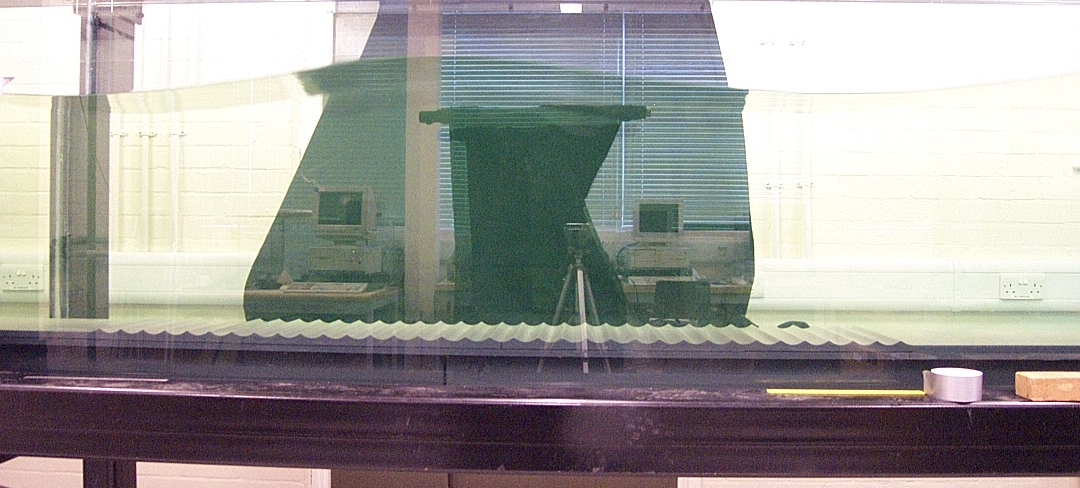
The rippled section; 1.8 m long, this case: ripple height hr = 9 mm, ripple wavelength lr = 51.4 mm.
A neutrally buoyant fluorescent mixture was released through a 1mm hole in a ripple trough located in the mid-section of the ripples. Flow visualizations were made using a digital camera and high-speed digital video camera.
>>> Go to flow visualizations examples <<<
>>> Go to flow regime classification <<<
>>> Go to comparisons Computer model // Experimental data <<<