Newsletter
Features
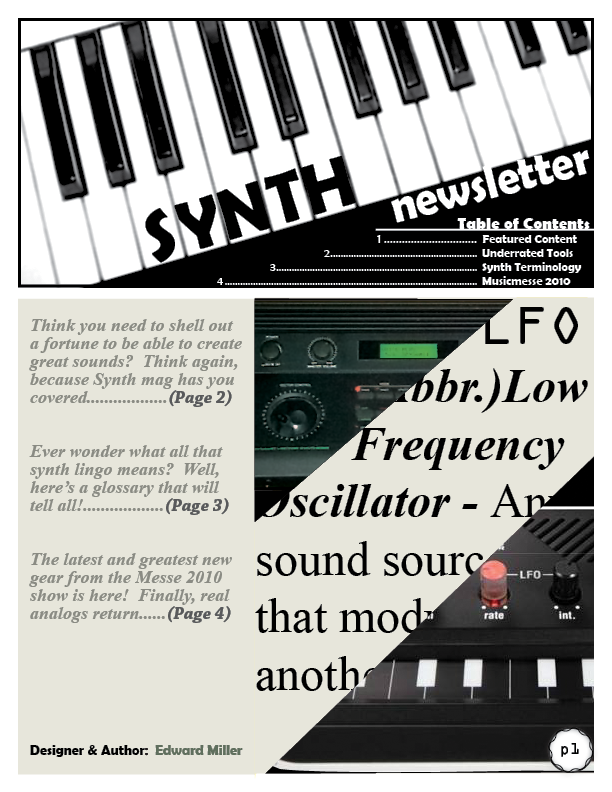
Purpose: Informative, EducationalThe newsletter would serve the electronic musician, collector's and hobbyist community, as product buyer’s guides and as an informative guide for upcoming products reaching the consumer market showcased at the MusikMesse Show during winter of 2010, in Frankfurt, Germany.
Here is the full content of the written portion:
Table of Contents
- 1.................................Featured Content
- 2.................................Underrated Tools
- 3.................................Synth Terminology
- 4.................................Musicmesse 2010
Designer & Author: Edward Miller
Page 2: Underrated Tools
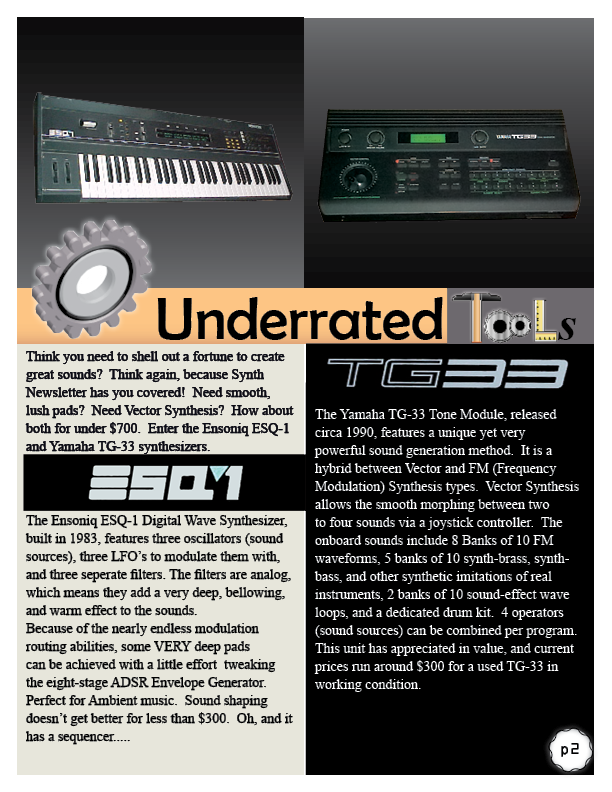
Think you need to shell out a fortune to create great sounds? Think again, because Synth Newsletter has you covered! Need smooth, lush pads? Need Vector Synthesis? How about both for under $700. Enter the Ensoniq ESQ-1 and Yamaha TG-33 synthesizers.
Ensoniq ESQ-1
The Ensoniq ESQ-1 Digital Wave Synthesizer, built in 1983, features three oscillators (sound sources), three LFO’s to modulate them with, and three seperate filters. The filters are analog, which means they add a very deep, bellowing, and warm effect to the sounds. Because of the nearly endless modulation routing abilities, some VERY deep pads can be achieved with a little effort tweaking the eight-stage ADSR Envelope Generator. Perfect for Ambient music. Sound shaping doesn’t get better for less than $300. Oh, and it has a sequencer.....
Yamaha TG-33
The Yamaha TG-33 Tone Module, released circa 1990, features a unique yet very powerful sound generation method. It is a hybrid between Vector and FM (Frequency Modulation) Synthesis types. Vector Synthesis allows the smooth morphing between two to four sounds via a joystick controller. The onboard sounds include 8 Banks of 10 FM waveforms, 5 banks of 10 synth-brass, synthbass, and other synthetic imitations of real instruments, 2 banks of 10 sound-effect wave loops, and a dedicated drum kit. 4 operators (sound sources) can be combined per program. This unit has appreciated in value, and current prices run around $300 for a used TG-33 in working condition.
Page 3: Synth Terminology
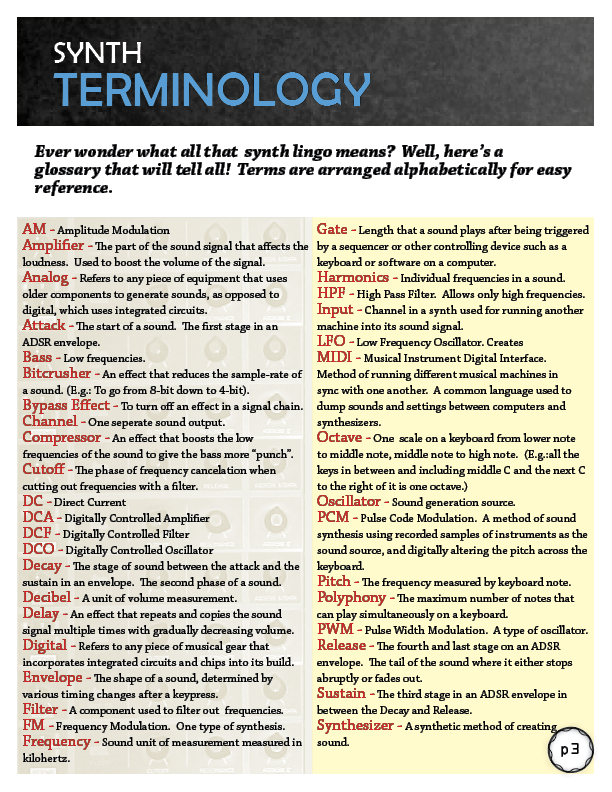
Ever wonder what all that synth lingo means? Well, here’s a glossary that will tell all! Terms are arranged alphabetically for easy reference.
- AM - Amplitude Modulation
- Amplifier - The part of the sound signal that affects the loudness. Used to boost the volume of the signal.
- Analog - Refers to any piece of equipment that uses older components to generate sounds, as opposed to digital, which uses integrated circuits.
- Attack - The start of a sound. The first stage in an ADSR envelope.
- Bass - Low frequencies.
- Bitcrusher - An effect that reduces the sample-rate of a sound. (E.g.: To go from 16-bit down to 8-bit).
- Bypass Effect - To turn off an effect in a signal chain.
- Channel - One seperate sound output.
- Compressor - An effect that boosts the low frequencies of the sound to give the bass more “punch”.
- Cutoff - The phase of frequency cancelation when cutting out frequencies with a filter.
- DC - Direct Current
- DCA - Digitally Controlled Amplifier
- DCF - Digitally Controlled Filter
- DCO - Digitally Controlled Oscillator
- Decay - The stage of sound between the attack and the sustain in an envelope. The second phase of a sound.
- Decibel - A unit of volume measurement.
- Delay - An effect that repeats and copies the sound signal multiple times with gradually decreasing volume.
- Digital - Refers to any piece of musical gear that incorporates integrated circuits and chips into its build.
- Envelope - The shape of a sound, determined by various timing changes after a keypress.
- Filter - A component used to filter out frequencies.
- FM - Frequency Modulation. One type of synthesis.
- Frequency - Sound unit of measurement measured in kilohertz.
- Gate - Length that a sound plays after being triggered by a sequencer or other controlling device such as a keyboard or software on a computer.
- Harmonics - Individual frequencies in a sound.
- HPF - High Pass Filter. Allows only high frequencies.
- Input - Channel in a synth used for running another machine into its sound signal.
- LFO - Low Frequency Oscillator. Creates a warbling effect.
- MIDI - Musical Instrument Digital Interface. Method of running different musical machines in sync with one another. A common language used to dump sounds and settings between computers and synthesizers.
- Octave - One scale on a keyboard from lower note to middle note, middle note to high note. (E.g.:all the keys in between and including middle C and the next C to the right of it is one octave.)
- Oscillator - Sound generation source.
- PCM - Pulse Code Modulation. A method of sound synthesis using recorded samples of instruments as the sound source, and digitally altering the pitch across the keyboard.
- Pitch - The frequency measured by keyboard note.
- Polyphony - The maximum number of notes that can play simultaneously on a keyboard.
- PWM - Pulse Width Modulation. A type of oscillator.
- Release - The fourth and last stage on an ADSR envelope. The tail of the sound where it either stops abruptly or fades out.
- Sustain - The third stage in an ADSR envelope in between the Decay and Release.
- Synthesizer - A synthetic method of creating sound.
Page 4: Musikmesse 2010 News
Roland Gaia
New to the electronic instruments division of MusikMesse, the annual showing of up and coming instruments in Frankfurt, Germany are two synthesizers by Roland and Korg. Roland announced its new product, the Gaia SH01, which promises 3 oscillators that function like three seperate synthesizers rolled into one according to Keyboard Magazine. All of the editing parameters are accessible from the front panel. They are broken down into easy-to-seperate blocks of Oscillator, Filter, and Amplifier, all with real-time sliders and knobs for instant tweaking. Up to five effects can be layered on a single patch. There is an onboard arpeggiator, which plays note sequences up and down the scales while only a single chord is being held down. It runs on 6 “AA” batteries, and links directly to your computer’s USB port via included USB cable. A flash port hub is built into the back of the keyboard, so sounds and parameters can be saved onto a standard flash drive. It will retail for under $700.
Korg Monotron
Truly a blast from the past, the Monotron features all analog components, including the legendary MS-20 filter. Controls have been streamlined as much as possible, with just one analog oscillator, filter, lfo, and envelope, so as to appeal to those new to synthesis.
Running on 3 “AAA” batteries, it’s the size of a Nintendo DS, and does, in fact, sound VERY analog. The best part of all, get this—It has a mono audio input, so any line source you can think of can be plugged in and processed with the onboard filter. It will retail for right around $60. That’s right, an MS-20 filter for a pittance of the cost of the original. Korg, we salute you.