 |
 |
 |
 |
 |
 |
FUR AND SKIN
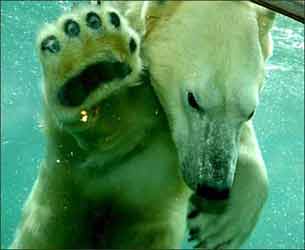
A polar bear's nose and skin are black and the fur is translucent despite its apparent white hue. The fur is good camouflage as well as insulation. Stiff hairs grow on the soles of its paws; these insulate and provide traction on ice.
Unlike other arctic mammals, polar bears never shed their coat for a darker shade in the summer . The fur absorbs ultraviolet light. The hair does not have fiber-optic properties nor does it transmit light or heat to the skin (an urban legend ). The thick undercoat does however insulate the bears to the point where they overheat at temperatures above 10 °C (50 °F) and are nearly invisible in the infrared ; only their breath and muzzles can be seen. Growing through the undercoat is a relatively sparse covering of hollow guard hairs about 6 inches long. These guard hairs are stiff, shiny and erect, and stop the undercoat from matting when wet. The water is then easily shaken off before it can freeze. The bear also rolls in snow to blot up moisture in the coat.
In July 2005, several polar bears in the Brookfield Zoo turned green as a result of algae growing in their hollow guard hair tubes. Chicago experienced an extremely hot, humid and dry summer that year. However, the zoo took no action since it has been shown the algae does not negatively affect the bears in any way. The staff believed that exposing the bears to chlorine or bleach would be more harmful than letting the algae run its course. Previously, in February 2004, two polar bears in the Singapore Zoo turned green due to algae growth. A zoo spokesman said that the algae had formed as a result of Singapore's hot and humid conditions. The bears were washed in a peroxide blonde solution to restore their expected colour. A similar algae grew in the hair of three polar bears at San Diego Zoo in the summer of 1980. They were cured by washing the algae away in a salt solution.