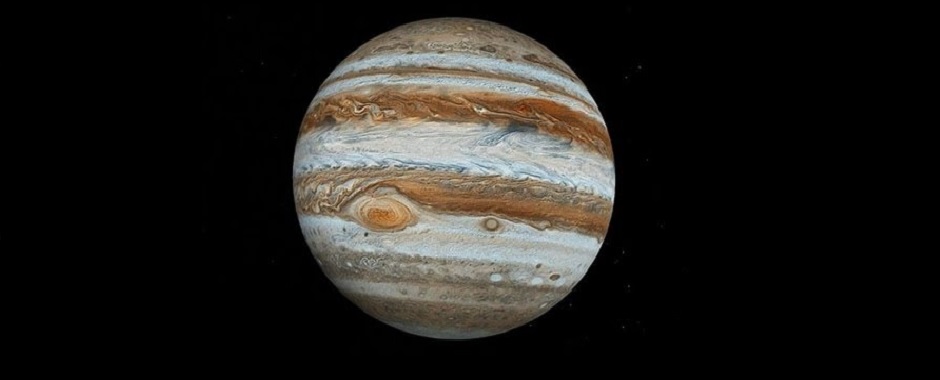
Jupiter
Overview
Namesake: King of the Roman gods
Type: Gas Giant
Distance from the sun: 5th planet from the sun; 5.2 AU (484 million miles)
Discovered: ancient times
Year: 12 earth years
Day: 10 earth hours
Effective temperature: 234° F
Diameter: 546,000 miles
Size: More than 1,300 Earths can fit inside this planet
Atmosphere: mostly hydrogen & helium
Rings: 3 (thick inner ring called a "halo", thin outer rings called "gossamer rings")
Moons: 67 moons (17 of which are unconfirmed)
Other Information:
- While most gas giants don't have a solid surface, Jupiter may have a solid core about the same size as Earth.
- The Great Red Spot is a swirling oval cloud, twice the size of Earth, that can be seen moving around on Jupiter's surface. It is a storm that has been raging for hundreds of years.
- Jupiter has the largest ocean in the solar system because the pressure and temperature deep inside it's atmosphere increase, causing the hydrogen gas on its surface to liquefy.
- Most of its clouds are composed of ammonia and ammonia compounds.
- Because of Jupiter's fast rotation (once every 10 hours) it's clouds are smeared into bands on it's surface.
Find out how much you would weigh if you moved here.
Try this formula to see how much you would weigh:
(Your weight x 2.54)