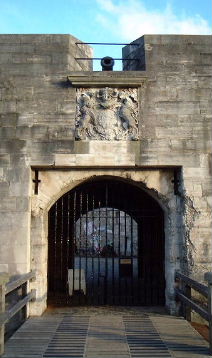
Southsea Castle
Solent Landmarks Southsea Castle Facts and Dits
| A
Quick History
This castle has been modified, enlarged and adapted over the years. Evolving as the technology of warfare changed. Its strategic position secured its survival until the 20th Century. The walls that saw the sinking of the Mary Rose also saw the sailing of the D Day Armada. Despite the changes ,the original layout and features of Henry VIII's castle are still visible. |
|
||
| A Time Line | 5 Centuries of Military service | ||
| Tudor period, the
castle is built
1544 The castle is built , on the orders of Henry VIII 1545 Henry the VIII watches from close nearby as the Mary Rose sinks in front of the Castle |
Caused by a divorce
The castle was built , among with many others,to defend against a combined French and Spanish threat. A threat caused by the Kings conflict with the Roman Catholic church over his divorce. |
||
| Civil war and restoration.
The Castle takes part in its only action. 1627 The keep is gutted by a large fire 1642 The Castle surrenders to Parliamentarian forces in the Civil war. 1665 Major improvements made by the military engineer De Gomme. A Gun platform was added in front of the Castle and earthworks behind . 1759 Another mishap, castle is damaged by a gunpowder explosion. |
Sir Bernard De Gomme,
Built by a Dutchman against the Dutch
De Gomme was a Dutch born engineer who employed many modern European ideas in the Fortification design. These ideas included broad moats and complex earthworks arranged to provide interlocking firepower. His other works include Tilbury fort and Plymouth Citadel. He was employed by Charles II as a result of a threat from Dutch Naval power. |
||
| The Victorians, Industrialization
of warfare
1813 Castle again reconstructed, extra troops accommodation built within the walls Counterscarp gallery built. 1863 Large gun batteries added to the East and West of the castle. 1899 Modern 6" and 9.2" guns fitted |
A Survivor of change.
The great changes of technology in the 19th century made most of the existing Portsmouth fortifications redundant. But Southsea Castle was in a strategic position and with additions and upgrades it survived active into the 20th Century. |
||
| 20th Century, end
of the castle's military service
WWI Coastal Artillery manned but no action WWII Guns manned again but only antiaircraft guns fired shots in anger. 1956 Coastal artillery abolished 1960 Portsmouth council obtain the site. 1967 Opened as museum |
The old enemy returns.
In the WW11 the nearest the guns got to action was against the French Navy Destroyer Leopard. It had anchored of Spithead after the fall of France in 1940. The castle's guns had been trained on the ship to prevent it, and the rest of the fleet leaving. Eventually the ships were boarded by British boarding parties without a shot being fired. |