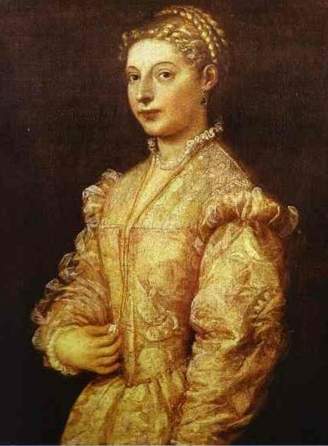
A Step Through Time
"Conspicuous Consumption with Elegance"
Reconstructing
History
Venetian Noble Women's Dress
Late Sixteenth Century
Accessories
The accessories chosen by a lady would add to the over all effect of her ensemble. This was a way of showing not only her fashion sense but her wealth and position. Accessories could be as simple as a string of pearls at the neck or a glass beaded girdle at the waist.
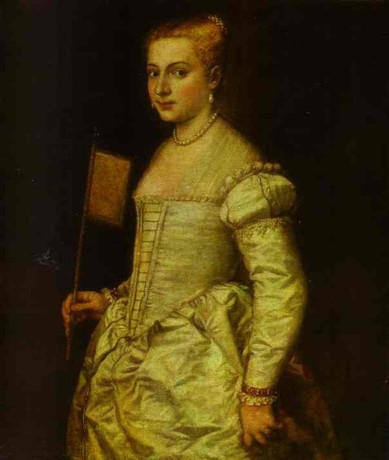
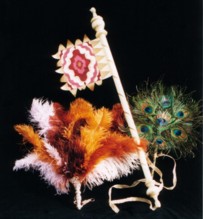
The flag fan while not restricted to Venice became synonymous with the region. This design appears to have had its origins in the East. The earliest evidence of a flag fan seen in art work is 1342 in a painting by Piotro Lorenzetti, Birth of the Virgin. This fan in this painting has very strong geometric decoration. Other examples of flag fans can be seen later in portraits by Titian, Veronese and Bassano. The flag part of the fan seems to be fixed.
 |
 |
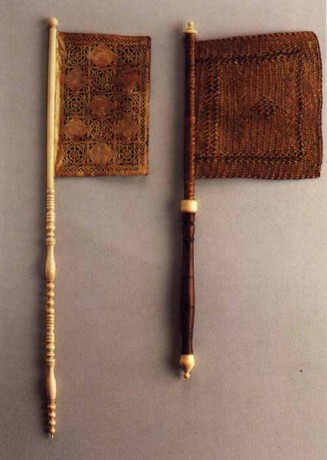 |
| VENETIAN FAN HANDLE. About 1550 Gilt brass with openwork decoration and engraving. Victoria and Albert, London | A collection of recreated fans including a flag fan and a feather fan. | Two Weathercock Fans Venice, 16th Century. The first fan is of Perforated Parchment, the second of interlaced plant fibre (Venice, Collection G Marsiletti) |
Feather fans with ornate handles were not restricted to Venice at this time, and enjoyed wide spread usage throughout the world.
|
|
 |
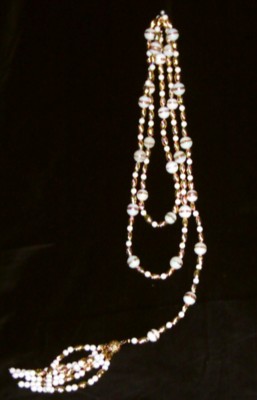 |
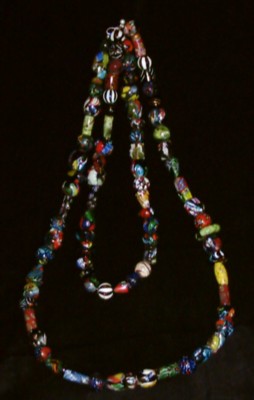
| Detail from La Bella Nani 1555 | Detail from Portrait of a Woman 1560 | Recreated Millefiori glass short girdle | Recreated long girdle in white Venetian glass |
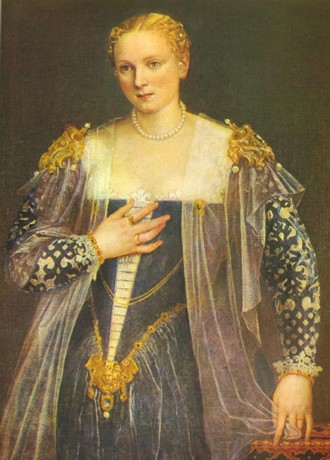
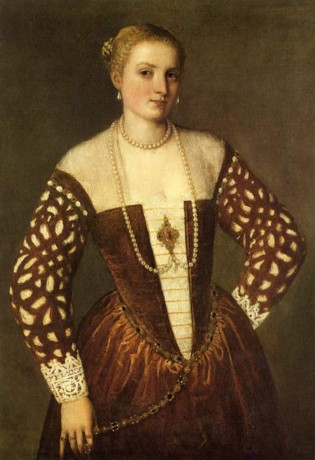
Historically this style of girdles can be seen in many portraits of the 16th century. While they are a lavish addition to a dress they are not always necessary, occasionally a cord or tie can be seen at the waist. Some times the waist is left completely unadorned.
Girdles are constructed in one single length with a hook or catch of some sort at one end and an ornament at the other end, usually a tassel or slightly larger ornament possibly a pomander. They can be a sequence of beads or of a chain and jewels. When worn they usually have a small length that hangs below the join of the girdle.
There are also shorter girdles that have no extension on the end. These sit in neatly at the waistline of the frock and add a nice finish to the outfit without being overbearing.
Necklaces
The most common neck adornment seen in Venetian portraiture is a simple strand of pearls. Although there have also been accounts of strings of enamelled beads and expensive glass beads also from the Venetian glass works of the time. Millefiori glass beads were exquisite and expensive. Gold chains with pendants and lockets are also part of a patrician woman's adornments.
Earrings
As with necklaces, pearls were the most common ornament suspended from ears. A single hoop of wire in gold or silver on which a single large pearl was suspended. There were some more ornate fashions in earrings, these were in the minority.
Bracelets
Bracelets were commonly worn as a matching pair. Made from gold and set with precious gems or exotic glass or enamel.
Brooches
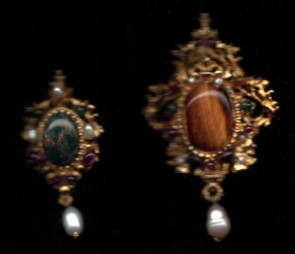 |
| A pair of recreated brooches set with semi precious gems and pearls |
Brooches were worn centrally on the bodice. Sometimes there would be a long strand of pearls caught up by the brooch for an interesting effect. Apparently always large as yet another display of wealth and position. There are examples of multiple brooches being worn on the large standing neck ruffs seen in the later part of the sixteenth century. These were places close to the neck and may have been used to attach the ruff to the partlet.
Rings
Fingers then as now were the subject of more adornment in the manner of rings. Set with gems or glass, they appear to have been worn on any finger that they fitted.
Footwear
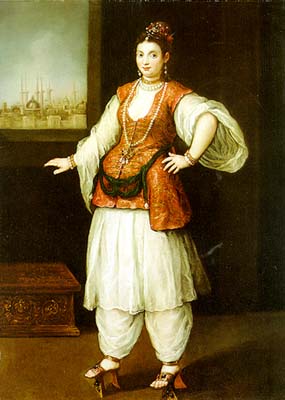
 In some portraits the skirts appear to be
extremely long, so long that it would be unnatural for the wearer to have such
height. This would accredit the
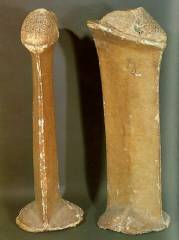
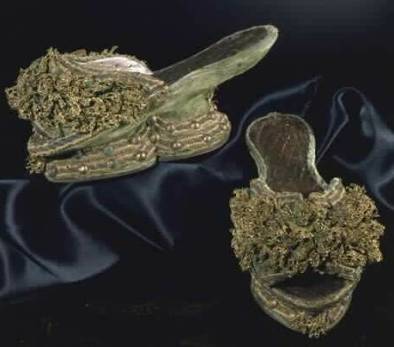
wearing of chopins, a high platform style of shoe. These shoes gave the wearer added height, and they did not
appear to be worn for the practical purpose of keeping the skirts out of the mud
or dirt of the streets, as the skirts length matched the added height given by
the chopins. Chopines therefore
would have been to make the wearer more visible, to be noticed.
In some portraits the skirts appear to be
extremely long, so long that it would be unnatural for the wearer to have such
height. This would accredit the
wearing of chopins, a high platform style of shoe. These shoes gave the wearer added height, and they did not
appear to be worn for the practical purpose of keeping the skirts out of the mud
or dirt of the streets, as the skirts length matched the added height given by
the chopins. Chopines therefore
would have been to make the wearer more visible, to be noticed.
It would seem that some Venetian women were as much fashion victims then as we are today in our choice of footwear.
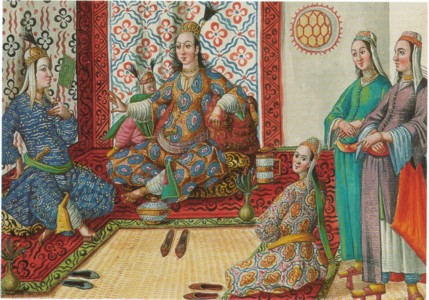 from the Austrian National Library
Vienna, we see a group of women. To
the right are two women wearing the eastern version of chopines.
from the Austrian National Library
Vienna, we see a group of women. To
the right are two women wearing the eastern version of chopines.
Chopines
were by no means exclusive to Venice.
There are references to them in English texts of the time and they were known
in Spain also. The Spanish chopines
were more block shaped while
the Venetian Chopines were hour glass shaped.
While
the chopine was undoubtedly a fashion item, this is not to say that more
comfortable shoes would not have been worn for every day use, merely to explain
and display one of the extra ordinary and extreme forms of footwear worn at this
time.
 |
 |
| Pair of Venetian chopines 1600 Victoria and Albert, London | Chopin reproductions, wooden base covered with leather. Made by Katrina Hunt |
Handkerchiefs
For practicality as much as for show. Handkerchiefs were large pieces of linen edged with lace and carried openly. Occasionally there was so much lace as to make them impractical for their would be use.
All recreated accessories not other wise noted made by Deborah Lane
Front Page Introduction Principles of Design 1555 Titian 1560 Veronese 1570 Veronese 1580 Vicellio Accessories Lace Textiles Patterns About the Designers Further Reading
All intellectual content, composition, layout, designs and photographs, unless otherwise noted are copyright 2007 to Deborah Lane ©, or, copyright 2003 to Deborah Murray © also known as Mistress Oonagh O'Neill ©. All Original renaissance art works and artefacts are not copyright to Deborah Murray, and are shown for educational use only . If you see something you'd really like to use, please contact me!