History Of The Morris
In more recent times Morris
underwent a revival in Kingston for the coronation of King George V and Queen Mary in 1911 (Source: Kingston Museum leaflet
"The Stained Glass Windows in Kingston Museum - The Betley Window), see the ongoing investigation here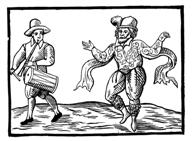 Morris Dancing is considered to be part of our English
heritage and one of the most ancient of our customs surviving. For a well written summary of the historical evidence please
visit the The Morris Ring. Wisely The Morris Ring avoids a foray into the unknown
ground that is history without evidence. So, from what we do know, how old is Morris dancing and where did it come from?
Morris Dancing is considered to be part of our English
heritage and one of the most ancient of our customs surviving. For a well written summary of the historical evidence please
visit the The Morris Ring. Wisely The Morris Ring avoids a foray into the unknown
ground that is history without evidence. So, from what we do know, how old is Morris dancing and where did it come from?
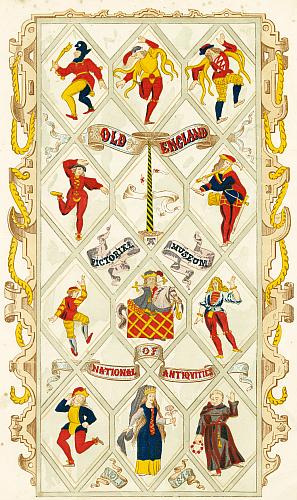 Legend associates Morris with fertility, the
Spring and good luck; and there is evidence that Morris dancers were paid to perform at events that occured during Spring, as
well as at other times. Whether Morris was ever danced to improve fertility I cannot say, and there is no evidence to
support the idea.
Legend associates Morris with fertility, the
Spring and good luck; and there is evidence that Morris dancers were paid to perform at events that occured during Spring, as
well as at other times. Whether Morris was ever danced to improve fertility I cannot say, and there is no evidence to
support the idea.
The oldest historical reference is on 31st October 1448 in the inventory for Caistor Castle, Norfolk that has a reference to
a tapestry depicting a morris dance. It has been suggested that Morris has a European origin, and there is evidence around
the mid 15th century that Morris was being danced in France, Germany and Switzerland, as well as Wales and Scotland. Sadly
there is no diary entry that states "Invented Morris today!" or "Brought Morris Dancers to teach the English" So for answers
we are left with are - How old is Morris Dancing? At least by 1448. Where did it come? It was a pan-northern European
dance, including Britain, that survived in the Cotswolds of England.
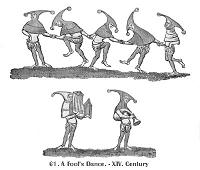 We have established that Morris Dancing was first
recorded in our area in the Summer of 1507 over 500 years ago, during the reign of King Henry VII. For more information see
an excellent investigation of the evidence here.
We have established that Morris Dancing was first
recorded in our area in the Summer of 1507 over 500 years ago, during the reign of King Henry VII. For more information see
an excellent investigation of the evidence here.
Morris Dancing and other folk dance, song and arts declined in popularity until an event often viewed as pivotal in the
revival of Morris that occured on Boxing Day 1899 when a folk song collector, Cecil Sharp, saw the Headington Quarry Morris Men dance. Cecil Sharp and Mary Neal, a voluntary social worker
amongst the poor of Soho, dedicated themselves to find, note down and teach dances where ever they could. Gradually morris
dancing has revived from a hand full of active sides to over a thousand active today and Morris men are once more a familiar
sight. Today when Morris men meet, a tankard of ale is always raised in memory to Cecil Sharp.
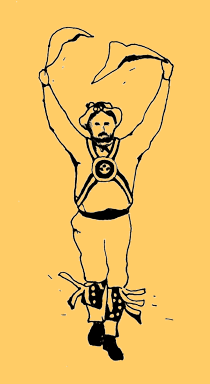
 Morris kit is decorative and practical.
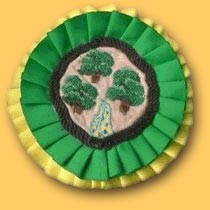
Bells give a percussive sound to leg movements, handkerchiefs accentuate hand movements and baldrics show where the Morris
man is from - in our case the trees and stream represent Spring Grove, an area of Kingston. Most sides dress in white and the
colours, badges and flowers are purely decoration.
Morris kit is decorative and practical.
Bells give a percussive sound to leg movements, handkerchiefs accentuate hand movements and baldrics show where the Morris
man is from - in our case the trees and stream represent Spring Grove, an area of Kingston. Most sides dress in white and the
colours, badges and flowers are purely decoration.
Spring Grove dance handkerchief and stick dances in the Cotswold traditions. We were formed in 1977 and in 1984 we joined and
danced into the national organising body - The Morris Ring.
In the winter months we practice at St Johns Church, Bloomfield Road, Kingston-upon-Thames every Monday evening from 8.00pm.
We always give a warm welcome to new members so if you know of anyone who may be interested then please send them along.
Remember, no experience is necessary.