1911 Revival of Maypole and Morris Dancing in Kingston-upon-Thames
An investigation in progress
One further reference is in a book by Walden in 1783 of a commentary on The Sad Shepherd by Ben Johnson. Page 255 that
lists Additions and Corrections has the following refers back to a comment on the nature and use of a bladder on a stick by
a fool.
"Mr. Waldron has informed us that he saw in the summer of 1783, at Richmond in Surrey, a Company of Morrice-Dancers from
Abington(sic), accompanied by a fool in a motley-jacket, who carried in his hand a staff or truncheon, about two feet long,
having a blown-up bladder fastened to one end of it; with which he either buffeted the crowd to keep them at a proper
distance from the dancers, or played tricks for the spectators' diversion. The dancers and the fool were Berkshire
husbandmen taking an annual circuit, collecting money from whoever would give them any; and (I apprehend) had derived the
appendage of the bladder from custom immemoriall; not from Old Plays, or the commentaries theron."
There is no evidence of Morris Dancing around Kingston and Richmond from 1783 until 1911.
Though not in kingston, it is interesting to note that between 1900 and The Great War only two Morris sides are recorded as
having been founded. Thaxted Morris Men [website] started in 1911 and danced at
thier local coronation celebration, and Cambridge Morris Men [website] also started in 1911. Other Morris activity
has been noted, for example from the Oxford University Morris Men's history [here].
"15 March 1912. The inaugural meeting of the Oxford Branch of the EFDS was held in the Corn Exchange. William Hamilton
Fyfe of Merton occupied the Chair, and Mr Sharp gave a short lecture. He said this was a red-letter day in his life, as on
it he welcomed the first child in the provinces born to the London parent society, and a fine large child it was. He
considered it highly creditable that it had already turned out a Morris of men that could dance a jig that was very good
Morris."
Morris stayed at part of the Oxford University Dance Society until 1926 when the Morris separated off to form OUMM.
From this point on the Morris revival takes hold in Surrey with independent Morris sides starting up around Kingston.
More significantly to Morris in Kingston is Curfew Morris that was based 10 miles west of Kingston in Chertsey. It isn't
clear when the side was founded but they were sufficiently competant to dance into the Morris Ring in
September 1938. It is likely that Curfew Morris danced in Kingston though there is no
evidence of where they performed. There is no information about Curfew Morris after September 1938
except that Thames Valley Morris Men (TVMM) note that "Curfew Morris last danced in the 1930s."
"Forced to abandon meetings owing to enemy action etc."
Greensleeves did continue though not for six years before they met as a side again, read their side's history here.
"On Whit Monday 25th May at Tiffins(sic) School, Kingston, on a sweltering hot afternoon we performed the Morris."
The log book of the first 25 years of TVMM is here.
TVMM continued to visit Kingston and in 1977 they helped to start Kingston's own Morris side, the Spring Grove Morris Men, who regularly appear at Kingston's fairs, festivals and carnivals.
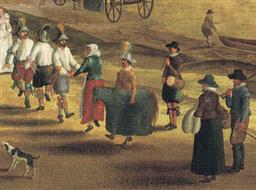 Morris
was not danced continuously from 1507 to the present day. After the Church Wardens records in the first half of 14th century the next
evidence is around 1620 from a painting "Morris Dancers along the Thames near Richmond".
Morris
was not danced continuously from 1507 to the present day. After the Church Wardens records in the first half of 14th century the next
evidence is around 1620 from a painting "Morris Dancers along the Thames near Richmond". The evidence that a revival of Morris Dancing
took place in Kingston is from the text at the bottom of Kingston Museum's copy of the Betley Window that reads as
follows
The evidence that a revival of Morris Dancing
took place in Kingston is from the text at the bottom of Kingston Museum's copy of the Betley Window that reads as
follows
"This window (founded on a 16th Century window) was unveiled by Alderman George Huckle, JP, Mayor, to commemorate the
coronation on the 22nd June 1911 of King George V and Queen Mary, and the revival on that occasion of the old Kingston-upon
-Thames may-pole and morris dances."
Edward J Nicol M.B.E. records that the window was made in 1901
in an article in the Journal of the English Folk Dance and Song Society, Vol VII No. 2 (1953). Does this indicate that Morris was being danced in 1901, or that there was sufficient confidence that Morris would be danced in 1911 that the statement was made.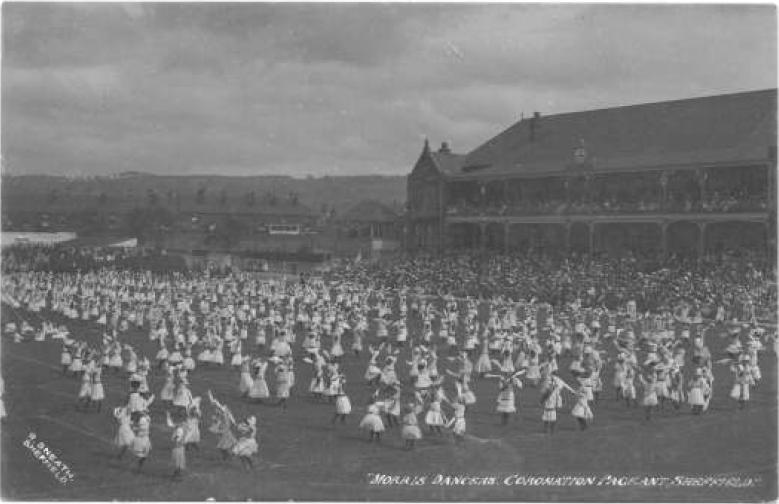 It is by no means certain that a revivial of Morris Dancing meant a side of adults
dancing. At the Coronation Pegeant in Sheffield 1500 children from local schools danced a programme of morris, maypole and
country dances in Bramall Lane football ground - the home of Sheffield United FC.
It is by no means certain that a revivial of Morris Dancing meant a side of adults
dancing. At the Coronation Pegeant in Sheffield 1500 children from local schools danced a programme of morris, maypole and
country dances in Bramall Lane football ground - the home of Sheffield United FC.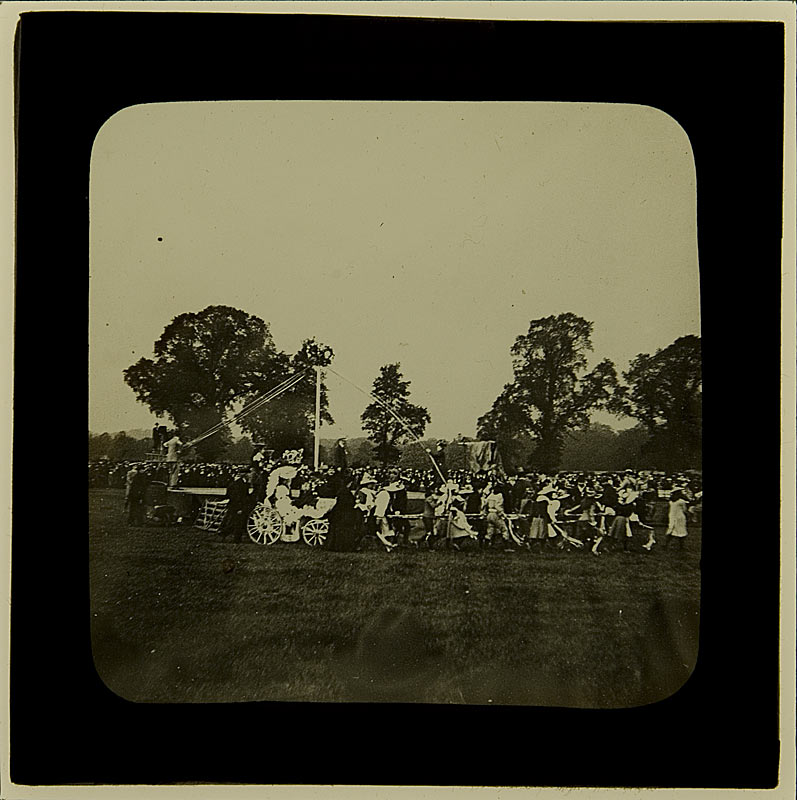 A picture that has recently come to light is print from a Magic Lantern slide labelled
"Maypole Procession at Kingston-upon-Thames".
A picture that has recently come to light is print from a Magic Lantern slide labelled
"Maypole Procession at Kingston-upon-Thames".
In the foreground is a May Queen dressed in white in a white four wheel trap pulled by 10 costumed people and preceded by at
least one more person in costume.
In the midground is a four foot high, 50 foot wide stage with a 20 high maypole erected in the middle and two people holding
ribbons.
In the background a crowd of perhaps 200 people and a seven foot high, six foot wide stage behind the crowd, on which there
is a man and what might be a camera.
It would be nice if I could also find evidence of Morris, but at least this picture supports the evidence that maypole
dancing was taking place in Kingston around 1900. In 1926 East-Surrey Morris Men, started 7 miles south-east of
Kingston in Sutton, and in the same year Greensleeves Morris Men started 4 miles east of Kingston in Wimbledon. Read the story of how East
Surrey started here.
In 1926 East-Surrey Morris Men, started 7 miles south-east of
Kingston in Sutton, and in the same year Greensleeves Morris Men started 4 miles east of Kingston in Wimbledon. Read the story of how East
Surrey started here. Many sides suspended their activites at the end of the 1930s due to
the Second World War and were then unable to restart once the war was over. The log book of Greensleeves has this towards the end of 1940:
Many sides suspended their activites at the end of the 1930s due to
the Second World War and were then unable to restart once the war was over. The log book of Greensleeves has this towards the end of 1940: In 1952 four ex-Curfew formed the core of a new Morris side 5 miles south of Kingston in Claygate, Thames Valley Morris Men, who provide the next evidence of Morris in Kingston. The next time Morris is danced in Kingston is in 1953 by TVMM in their second year of existance.
Their log book entry under 1953 is written as follows:
In 1952 four ex-Curfew formed the core of a new Morris side 5 miles south of Kingston in Claygate, Thames Valley Morris Men, who provide the next evidence of Morris in Kingston. The next time Morris is danced in Kingston is in 1953 by TVMM in their second year of existance.
Their log book entry under 1953 is written as follows: