Knowledge-based Society
calls for Innovation 2.0
-The 2nd mGov
Seminar China "Innovation 2.0 in a Knowledge-based
Society" is held at Peking
University
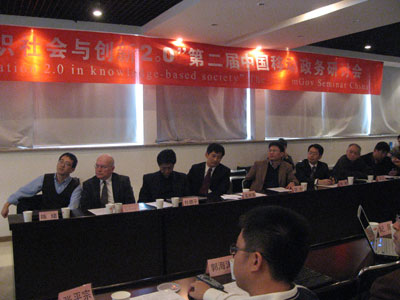
“Innovation 2.0 in a Knowledge-based
Society” the 2nd Mobile Government Seminar is
held at Peking University on 23 November 2008.
Focusing on innovation 2.0 in a knowledge-based
society, the 2nd Mobile Government Seminar is
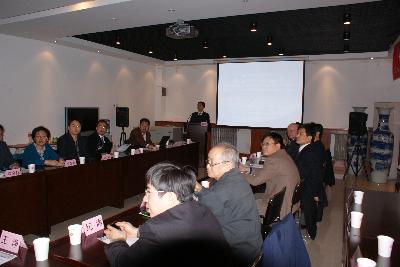
sponsored by mGov Lab China. Up to 50 participants
from academia, government and business attended
this seminar.
The First mGov Seminar China in
2006 has raised the hot discussion on the impact
of mobile and ubiquitous technology on public
management, organizational change and social
change - the traditional organizational boundary
is "dissolving". “Innovation 2.0 in
a Knowledge-based Society” the 2nd Mobile
Government Seminar this year further discusses the
impact of technology development on the
traditional boundary of innovation. It is the
first ever academic discussion on Innovation 2.0
in China.
The emergence and convergence of
ICT enables a knowledge-based society and dissolves the traditional boundary
of science labs and R&D activities. The
ordinary people and the users will have more say,
and will be a main player in the innovation
process. Focusing on application innovation,
featuring user-centric, demand-driven, open
innovation and co-innovation, Innovation 2.0 is
emerging in the knowledge-based society.
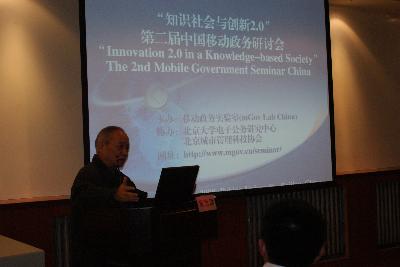
The Seminar is composed of three
parts. Part one “Innovation 2.0 as Paradigm Shift
of Innovation Mode” is chaired by Professor WU
Lun, Deputy Dean of Digital China Institute,
Peking University. Part two “Sharing Innovation
2.0 Practice and Cases“ is chaired by Professor
MENG Qingguo, Deputy Dean of School of Public
Policy and Management, Tsinghua University.
Researchers and practitioners from Peking
University, Tsinghua University, Chinese Academy
of Sciences, Renmin University of China, Agder
University Norway, Beijing Municipal Government,
Intel China, China Mobile, Timeloit Technology,
etc. shares researches and practices during the
two presentation session. (Click
here to download presentations at this
seminar.)
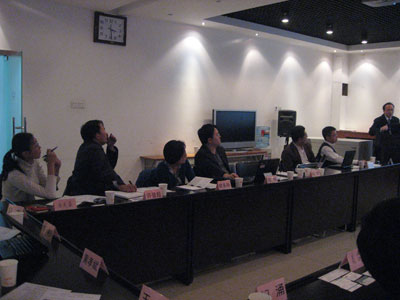
Part three “Brainstorming and
Discussion” is chaired by Dr. SONG Gang, Director
of mGov Lab China and Professor CHEN Rui from
Institute of Policy and Management, Chinese
Academy of Sciences. Typical Innovation 2.0 cases
such as web 2.0, open source, digital
fabrication are
discussed. Innovation modes of AIP,
Living Lab, Fab Lab are also discussed as typical
Innovation 2.0 modes.
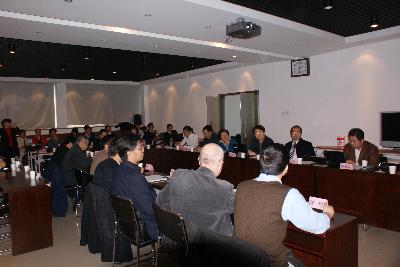
Participants in this seminar
agree that the exploration of innovation 2.0,
which involves all parts of the society in
innovation, is very important to the improvement
of the national science and technology innovation
system for an innovative country in a
knowledge-based society. Further researches and
practices are needed in this area.