18 June
Yangon General Hospital
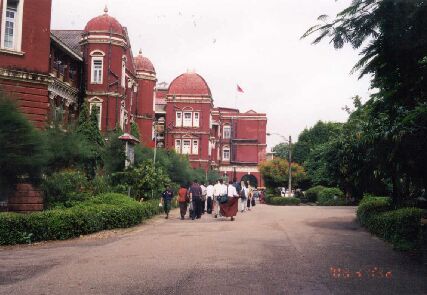
The first place of our visit is Yangon General Hospital. I reckoned most of us would expect to see a building similar to Singapore General Hospital and were taken aback when our Hino bus drove into a narrow track lined by low-rise huts and quarters resembling squatter settlements. Dr. U Aung Gyi explained to us that they were the mortuary and nursing training center and to our relief, a three-storey building rich in colonial flavor greeted us soon enough.
The colonial-style architecture of the Yangon General Hospital.
The hospital was built in 1899 by the British when Burma, as Myanmar was then known, was still a part of the British Empire in the Far East. It's amazing how it manage to survive intact over all these years. Strongly nationalistic and bitter about its colonial past, it is perhaps an irony that the Yangon General Hospital is a legacy of the colonial heritage, a sombre reminder of the progress the country has made since gaining independence from its colonial masters. General Ne Win, who ruled Burma with an iron fist from 1962 to 1988, pulled Burma out of the Commonwealth, severing whatever ties it left with England. But yet, the presence of the British was felt everywhere in Yangon, from the architecture of its government institutions, the paved side-walks, and even the M.B.B.S course are distinctively British. I half suspect that the Burmese are still in a state of denial over its colonial past, unable to accept it and refusing to make peace even after so many years.
We were welcomed into the Medical Superintendent's Office who gave us a rousing welcome and a brief introduction to the Hospital. Unlike Singapore, the Hospital makes no distinction in the various ward classes and accept all patients regardless of whether they can are able to pay their medical bills. He appeared to be optimistic about the Hospital's future development and expansion plans while I reserved a certain degree of scepticism whether there will be sufficient funds to finance such grandiose projects. As we posed one question after another to him, the juniors were cuddled together at the back, seeping tea and talking amongst themselves. I wished they can be more spontaneous and active in the discussion. There are many students who are interested in humanitarian work, but few are willing to spend time to find out more about the country they are working in and its healthcare system. Without such an understanding, how can we hope to help and contribute in a way that is beneficial, practical and sustainable?
The wards of the hospital consist of a large room lined at both flanks by beds, an uncanny resemblance to SGH in the 1950s. The walls are blackish and tainted patchily by molds and there is a stench of medication about the place. The nurses are dressed in the traditional attire and head-dress and they hurried about their chores without taking much notice to us. We were reminded more than once by the Deputy Medical Superintendent, who is accompanying us, not to take any photographs of the wards or patients.
We were led to the Office of the Head of the Medical Ward, Professor Ne Win, whom I doubt was informed of our visit. He is a specialist and like most high-flying achievers in Myanmar, obtained his postgraduate degree in Edinburgh, Scotland. He described in great detail to us the common conditions seen here, much to the delight of the clinical year students though the year 2s looked lost at one time or another during our conversation. He showed us in his ward some of the patients he has successfully cured of their ailments which include cerebral malaria, blackwater fever and meningitis. Unfortunately, all the spectacular signs you read often in the books have disappeared when we examined the patients. There were a few medical students who joined us in the impromptu ward round and like us, they were dressed in standard clinical attire with stetoscopes around their neck.
The Professor presented us with a memento - a framed photograph of the Yangon General Hospital and we were embarrassed that we did not bring along any gifts for him. He offered to assistance us in the application to be attached to his Department should any of us intend to do so during our 4th year overseas elective. I was quite keen to be attached here though I questioned the wisdom of staying in Yangon for the entire 6 weeks. I would love to visit the Township hospitals of other States such as the Shan, Kayin and Rakhaine. I was curious of the monthly pay of the Professor and I presumed he must have his own private clinic elsewhere to supplement his income. We were later told that government hospitals lacked funding, medication and supplies and most specialists run private clinics which are in fact the focus of their attention.
Maternal and Child Care
After lunch, we went immediately into preparation of our programme for the Sunday School Children and their mothers. Mahasantisukha runs a Sunday School for children living in the vicinity and our hosts have informed them of a "free health screening" we will be conducting for their children and a "health package" consisting of multi-vitamins, iron and folate tablets will be given as an incentive for their participation. The health education team were learning some Burmese phrases from the doctors. Yong Pey and I set up our booth for the anthropometric studies. Our partner is the Maternal Child and Welfare Association (MCWA), a voluntary organization dedicated to serving the Myanmar society in promoting the health and well-being of mothers and children with the aim of improving the quality of life of people. We have a number of lady volunteers who will be helping us with the translation, explanation of our programme to the mothers and the anthropometric studies.
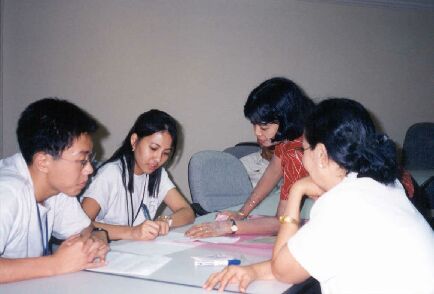
Dr. Nu Nu Swe giving Peiling and Pin Soon a crash course in Burmese.
The mothers and their children are gathered in a classroom. The children are all younger than 5 years of age and I was quietly concerned whether they will be able to understand what we are doing. Putting expectations aside, it will be a good run-through for the health education team for future performances in the day ahead. The skid started off on an encouraging note thanks to the efforts of the team and our translator, Venerable U Korska, who is able to capture the attention of the crowd and get the message across in Burmese. The question-and-answer session involved more of the audience, with children clamouring to answer in order to win the lollipops put on offer for each correct answer.
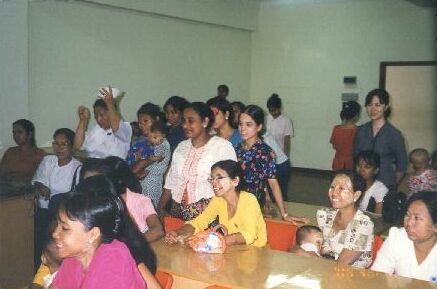
The mothers and children who were captivated by our health education skids and songs.
Songxin's "coconut song" was really an ingenious method to teach dental hygiene. There was sporadic laughter and claps of approval from the audience and towards the end, there is crowd surrounding Songxin, who has invariably become the darling of the children. It really takes somebody with personality to woo the crowd and to make them listen. I doubt I will be able to do the same if I was on stage instead!
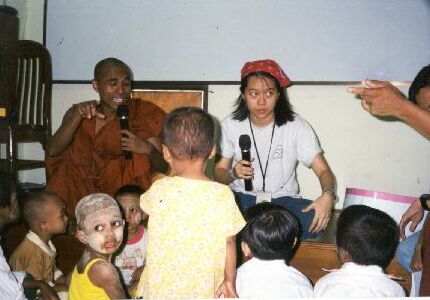
Songxin exhorting to the kids: "Remember to brush your teeth hor!"
Anthropometric studies
The next station is the anthropometric study which we are conducting on a modest scale using a Seca Bodymeter and a normal bathroom scale. A Burmese volunteer from the MCWA assisted us in recording the weight, height and mid-arm circumference of each child. We had originally intended to conduct it amongst the children in Bilin and now we have to adapt it for a urban population. The data we collected may not be useful, but it will give us the experience of conducting such a study and to bring to our knowledge its inherent limitations and possible problems encountered during the process.
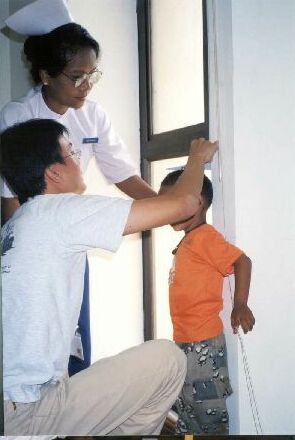
Taking the height
The mid-arm circumference is a fairly accurate indication of malnutrition for children less than 5 years of age, with 12cm as a cut-off point. Burmese children are generally of a small-built and we detected some with a circumference of less than 12cm, but otherwise appeared healthy and without any signs of malnutrition. The children come from the middle class of Yangon and are well provided for as compared to the children we met in Bilin. They are attending schools and can speak and understand simple English. The younger children are more difficult to deal with and tend to cry when they meet face-to-face a stranger. A child burst into tears when I was attempting to put the measuring tape around his arm. I was hesitant about continuing but his mother was adamant that his child go through the "full medical check-up". I do not think that the mothers are able to have a glimpse of insight of what we are doing. They are merely concerned about their children and interpret whatever "examination" we did on their child as assurances that they are healthy. At the end of study, they were given the "medicines" which they MCWA volunteers gave them instructions for usage. Health knowledge and awareness amongst the mothers are few and seldom based on the scientific basis of medicine.
A Lost Generation
We soon realized that Mahasantisukha also organizes evening English classes for working adults and we were invited to have a cultural-exchange session with the Burmese youths after our programme. They were mostly young people ranging from the late teens to middle-age. They were obviously enthralled by our presence and treated us like VIPs on stage being interviewed, posing us one questions after another. We had an interesting discussion on the World Cup, Burmese cuisine, the educational system in Singapore and Burmese culture.
I see in these youths an insatiable thirst for knowledge of the outside world and a hunger to learn more and improve themselves. They understand that English is the key to new frontiers in this millennium and are eager to practice their conversational skills with us. There are limited opportunities available here for them to use the language unless they are working for a foreign firm. Like Khun Sa Sa, the 15-year-old boy I met in Kayin State, they are not very proficient in expressing themselves in English. After World War II, Myanmar has one of the highest literacy rate in Asia and English is the official medium of communication. It is a pity that the younger generation today are struggling to learn English.
In 1988, the Universities and Colleges are shut down for 2 years following civil unrest. In 1996, they were again closed for reasons only known by the military junta itself. The educated elite has always been frowned upon and suspected of being collaborators with the "neo-colonialists" to undermine the authority of the State. English education therefore, receives little official support or funding. At one stage in time during General Ne Win's rule, even the sciences are taught in Burmese! I loathe to think of the future of these Burmese youths, can it be brighter than what they already have now, being endowed with the opportunity to learn English in evening schools while thousands of their brethren are leading the buffalos out in the sun, planting rice with their ankles soaked in the monsoon-laden soil, selling Burmese fried tapioca along the road-side or making a living by selling illegal petrol. I feel a lot more humble about my perceived "achievements" in life. I am not any smarter than the average Singaporean or Burmese. I am in medical school merely because I was given the opportunity and there is a career awaiting me upon my graduation. You can be gifted and willing to work, but with nobody to pave the path for you, there is nothing much you are able to do. And we are seeing this in Myanmar such a waste of precious human talent and resources which can be channelled towards rejuvenating the nation and spearing-heading its progress. Instead, there is stagnation, regress and deterioration, an inevitable consequence of the country's political and economic woes. There are people who are willing to work and serve, but in the light of the malaise afflicting the entire the nation, the future is bleak.