19 June
Hlegu Demonstration Center
The Hino bus was a comfortable vehicle to travel in. Small and swift, its cool air-conditioned interior formed an effective barricade against the external elements that threatened to engulf us. Oh Singaporeans, we are so used to the comforts and ease of a modern lifestyle, that we have grown to become allergic to the pleasures of nature, the sun, the rain and the land. Have we forgotten that we are all children of Mother Nature that a step back from modernity would mean a return to its fold?
We have left the familiar urban surroundings of Yangon as a pristine green landscape beckons to us over the horizon. The sky was gloomy and there was a slight drizzle, otherwise there is little to obscure our view. Straw-made huts littered a landscape richly cultivated with padi. Buffaloes plough the field, moving their feet agonizingly in the thick mud. A small stream meanders its way across our path where a rickety bridge laid bare for us to continue the journey. Our destination: Hlegu Township, 28 miles north of Yangon.
I do not know what exactly the purpose of our visit or what the center is. Dr. Daw Mya Thein told me it is a "place for health education projects" as I have requested. In my correspondences to them, I have stressed repeatedly that we intended the June tour as a study tour for the medical students to learn more about rural health and community medicine practices. It is meant to be an extension of the Special Study Module (SSM) we did last year for the students to see for themselves what they have read on paper. I have learnt to trust the Burmese in spite of my initial misgivings. They are efficient and resourceful and do get things done fast according to your desire as far as the "official channels" allowed. I have a gut feeling that Dr. Daw Mya Thein and Thuzar must have gone through a lot hassles to arrange for our visit to the Demonstration Center. The students are enjoying our first sojourn into the rural wilderness of Myanmar. There was some commotion behind and Dr. Daw Mya Thein told me we are allowed to stop and take photographs if we wanted to. I supposed she knew, as I do, that they were fascinated by the pristine beauty of rural Myanmar as much as me. As we near the end of the journey, some of them complained of motion sickness and that the travel was too tiring. Well, they will fancy travelling 18 hrs by bus to Mandalay! I sincerely hope they will realize and appreciate what our hosts have done for us to put this program together.
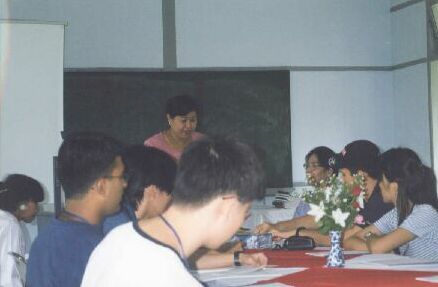
The Demonstration Center consists of no more than a few one-level buildings. Knowing we must be feeling hungry, we were treated to a variety of Burmese delicacy: fried sweet potato, rice cakes and glutinous rice with tea. Prof Nwe Nwe Win, the Director of the Center gave a presentation from which we knew that the Center provides field training to House Surgeons (the equivalent of House Officers in Singapore) for a period of two weeks. They were required to conduct a community health study amongst the villages in the three townships covered by the Center. Amongst the reports we were shown are prevalence of TB infections and knowledge, childhood diarrhoea diseases and malaria control.
Prof. Nwe Nwe Win telling us more about the Demonstration Center.
The emphasis of the field training is on community development - to enhance the trainee's understanding of the common healthcare problems faced by a community and to educate them on their prevention and treatment. Instead of a one-way traffic, it entails plenty of interaction with the community. The doctors are seen to be facilitators, rather than "specialists" which the villagers turn to for help. The paternalistic doctor-patient relationship is relegated to one in which the community is involved in the decision-making processing and is given the power to take charge of their own communal health. I wished I was able to stay on longer to study the training programs they have!
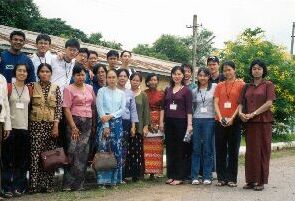
Group photo outside the Center.
The Township Market
I was hoping they can show us the House Surgeons in action, but we were brought to the Township Center instead for reasons only better known to our hosts. Maybe like us, the House Surgeons are having a holiday or they thought we wanted to go shopping, a well-known Singaporean past-time. Those harboring this intention will surely be disappointed for there is little, if any to shop around in the Township market. It resembles no more than a typical wet market in Singapore in the good old days, with hawkers, street vendors, shopkeepers all vying for potential customers at the same time.
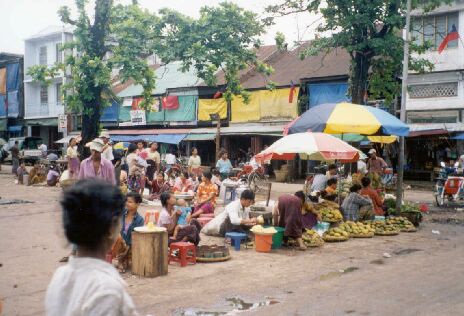
Outside the Hlegu Township Market
There were shops selling spices, longyis, rice, meat, vegetables and other basic living accessories. It is the "flies season" in Myanmar and there were swarms of flies over the meat store. The lady boss picked up a block of meat and gestured me to me with the other hand. I muttered to myself: "Thanks, but no thanks!" Not exactly an ideal time to go down with "LS" when there are still 7 days to go! As a compensation, I offered to take a snapshot of her. She broke out into a laughter and turned her head towards her assistant, covering her face with the fan she was using to ward off the flies. There was no need to seek any permission. So far, all the Burmese I have taken photographs of are more than willing to oblige me. The girls are especially shy, but they do relent eventually to my pleas though I doubt they will understand. The Burmese are such gentle and friendly people. Imagine a Caucasian man taking photographs of passer-bys along Orchard Road? I enjoyed taking shots of ordinary people in their daily lives, for it is a fairly accurate reflection of their lifestyle and culture. That is a more meaningful way of keeping memories of a foreign land, rather than spoil it with "personal intrusions".
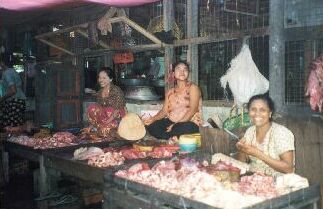
Selling meat in open air - a hotspot for the flies.
I strolled by the road till I reached a small river where a "ferry terminal" stood. Passengers were loading into motor boats that were parked idly at its banks. Where on earth are they going? Amidst the cacophony around me, I stood almost grasping for my breath, hold my longyi up to prevent it from being stained by the muddy ground. There were strong men carrying gunny sacks of rice on their shoulders, women with their basketful of groceries, some executing a fine-balancing act on their heads while they held two children with their hands. There was a strong stench of decaying meat in the air stemming from a rubbish dump besides the river-bank, the brackish waters swirling precipitously around it. An avalanche is imminent, I thought, a rather unorthodox way of waste disposal.
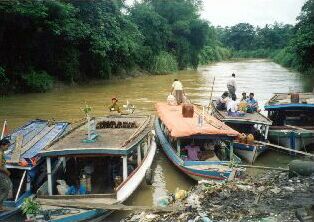
The "ferry terminal" and the rubbish dump.
Institute of Medicine (I)
I had visited the medical school in March during the reconnaisance trip, but that was a "personal tour" while this is an "official visit". I was flattered that the Rector of the Institute was there to welcome us personally and gave us, as usual, a presentation of the Institute's history and training programme. Dr. Daw Mya Thein whispered into my ears that the Rector had requested for an official letter of visit from our school, which of course, we were unable to provide. I explained, quite in an apologetic fashion to her that our Dean wasn't supportive of our project and we were in fact going here on a personal premise as a "group of friends who happened to be medical students studying in Singapore" and not representing the faculty, the Medical Society or NUS. She stressed to me again the importance of "going through the proper channels". I presumed she is as much as frustrated as me with all these bureaucratic regulations and administrative hassles, but it will be expecting too much of her to understand the restraints I'm facing. Medical students from NUS yet not declaring themselves as so; anybody else in her shoes will be baffled by this aberrance. That's NUS.
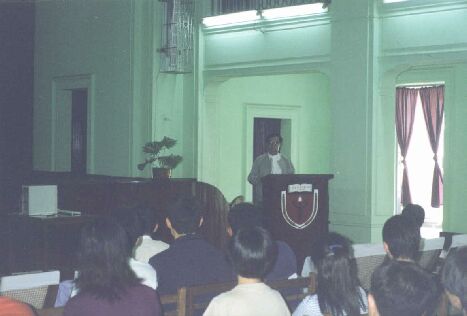
The Rector of the Institute and his opening address to a "group of medical students from Singapore".
There are 4 medical schools in Myanmar, Institute (I) and (II) in Yangon, one in Mandalay and one in Magway. The undergraduate curriculum is based on the British system, similar to ours - 5 years to a M.B.B.S degree and one year of apprenticeship. There weren't any medical students around this time. They are having a study break to prepare for their common test next week and the school was deserted. The Rector was proud to show us the new library block built recently by a Japanese firm. There must be the only addition ever to the Institute since its opening many many years ago. Thuzar's younger sister, who is currently a 4th year student attends lectures from the same lecture halls as her mother. Enough said.
One look and you will know why the library block is "new", a modern concrete building if not of monotonous design, in the middle of a "sea" of colonial-era buildings. The library also houses the Pathology Museum in a large hall which is far more impressive than our limited number of displays tucked in an isolated corner of the NUH Department of Pathology. The exhibits are labelled and there are full-colored summarized nformation slides side by side with full elucidation of the pathology, pathogenesis and clinical symptoms of the disease shown. That is definitely a more productive way of studying gross pathology compared to the static displays we are used to back home. The crowd favourite was the section on venomous snakes. It comes with exhibits of each species of venomous snakes found in Myanmar, their common location, how their poison kills and the proper management which can save a life. I didn't encounter a snake in Bilin, but that was the dry season, they should be be coming out from their hideouts now in the rainy season!
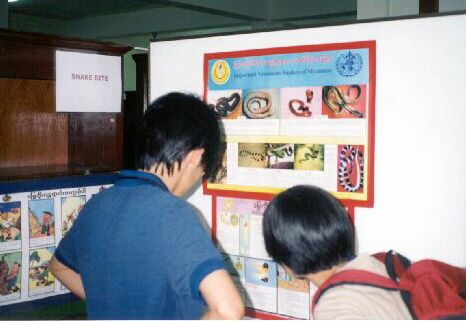
"Hmm....so that is what I should do if I see a snake?"
The Vice-Rector was there to explain painstakingly every single exhibit and chart to the enthusiastic students. The next highlight was a masterpiece of art - a model of a typical Burmese village house, an exact replica of those I had seen in Khemauk and Daukyat village in Bilin. Built entirely of wood, it has no doors and windows, some with a compound surrounded by fences and a gate. Maybe in the village, there is no need for any security measures either because there is nothing valuable to attract burglars in the house anyway or everybody knows each other in the village and there is no escape for the potential burglar unless he chose to leave for good. Lifestock were reared in the compound which also lies the tube-well, toilet and garden, a totally different concept of living for somebody who have spent his whole life in HDB flats. It will be good idea to stay a few days in the village and have a taste of what life in the rural areas is like.
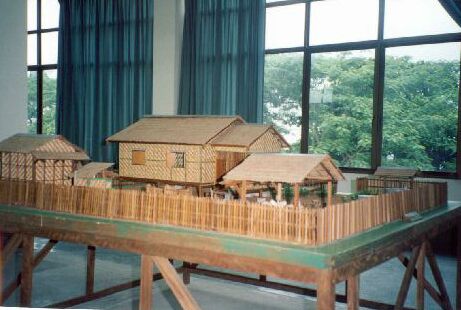
A typical Burmese village house.