17 June
Loading the Goods
A meditative air of calm and serenity descended upon the temple courtyard as monks swept the ground clean of fallen leaves, totally oblivious to our impending presence. Kareen just drove in as she manoeuvred her way around a parking lot. Jensen had opened the library and gestured to us to proceed with the loading. The previous day, Alex, Raj, Yong Pey, Jensen and I had packed the collected drugs and surgical instruments into boxes, 19 in all for delivery to Myanmar. They are a pittance compared to the number of boxes we need to manage last year. But then, we had the support of a few big organizations and there were much more manpower available at my disposal. Though this year's project is on a comparatively smaller scale, we were still over-stretched due to the limited resources we have. There are many who question my wisdom of doing the project independently on our own bereft of support of any organization. Though it is exceedingly tough on us in the beginning, I believe this initial setup will serve us better in the longer run. We have a dedicated team which is organizing the project and we are now in the process of registering our own society to take charge of the project in the future. The potential for future development and expansion is tremendous. We must not lose our focus in exchange for some short-term benefits.
Somehow or another, with only 4 people, we managed to load all 19 boxes into a Mercedes and Nissan. I'm really disappointed that both Kareen and Jinghui are not going for the trip with us. Kareen had been a very capable and efficient administrator, handling all the administrative hassles of the Project from the beginning right down to the last minute before our departure. Jinghui is equally committed and she is instrumental in bridging the natural divide between us and the juniors. Without their contributions and that of so many others, we will not even be going to Myanmar this summer. I'm thankful and grateful to the amount of trust and support they have given me even though I've made many mistakes along the way and there were times when it appeared the whole project will fall apart. I would not have the confidence or courage to go on this far without them.
At the Airport
We arrived early at the airport. The stipulated meeting time is 10.30 am, but as usual, people will always be a couple of minutes late and the extra allowance we gave is a necessity after all. We were still short of cash on hand and Jinghui had to drive Raj and me to a nearby POSBank to withdraw the money. There isn't much money left in the Project fund and I want to be stringent about using it since they are collected from the public and we had a moral responsibility to ensure that they are put to good use as intended by the intentions of the donors.
The participants of the trip are paying the full cost of it save for our lodging, food and traveling in Myanmar which is kindly provided for by our hosts. We would have enough resources to sponsor half the expenses of everybody, but I firmly believed they should be used to purchase drugs for the Bilin Medical Center and other needy institutions in Myanmar. I'm sorry that my team members have to fork out their own money. After all, we are going on a sort of humanitarian mission and not a social visit. They deserved to be sponsored at least partially. I can only hope that once we are a legitimate organization, we will be able to ask openly for sponsorships for our cause.
By the time we returned, the entire group has assembled. I distributed the name-tags and the Project booklet I have prepared for the team members the night before. It contained essential information about our Project, itinerary and programme in Myanmar. I have also included a few topics and questions for everybody to ponder over to make the trip more educational.
It's sincerely my wish that the juniors will learn something from the trip that will be useful to their studies in the new term and not just go through the entire trip without learning anything. We should have a discussion session every night on the selected topics, but without a tutor accompanying us, it will be difficult for me to enact my proposed plans ahead on my own.
The general mood is quite upbeat filled with earnest anticipation. Maybe I do not feel it as strongly as I have been to Myanmar before. Myanmar still remains an enigma to Singaporeans, the only things we know about it from the papers are filtered through a political wind-screen, telling us nothing at all about its people, culture and society.
There were jokes going around of whether we will be stranded in Myanmar, not exactly an auspicious thing to say, but in reality, it is a literal interpretation of the current state of affairs in Myanmar which has enshroud our project in much uncertainty. We had to abort our plans to travel to Bilin due to "bad weather" after being given the go-ahead initially. The press has given Myanmar a bad image following its latest spate with Thailand over armed insurgencies along its borders. There were rumors that the war may spread even to Yangon. A few people have asked me about security in Yangon, but I can't vouch for anything. We can only find out when we arrived.
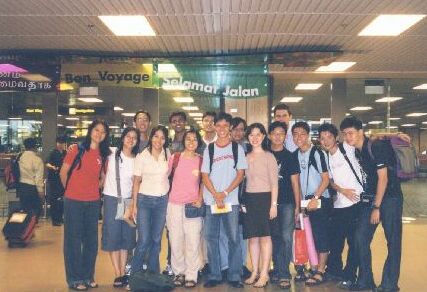
The Project Team at the airport.
Fears and hopes
I heaved a sigh of relief when we are welcomed at the airport by familiar faces of the Mahasantisukha. U Zaw Win Zaw, the feisty 81-year-old Chairman of the Foreign Relations Committee and U Sein Than, our General Service Manager, were there to ensure that we go through the customs without any glitches. U Zaw Win Zaw showed me the programme our hosts have arranged for us. I'm amazed at their efficiency and resourcefulness in getting so many things done in such a short span of time.
Our initial plan has been to travel to Bilin and stay at the Kyaikyto Mountain View Hotel for three days. However, one week before our departure, I was informed to postpone the Project Mission to December as the present bad weather and road conditions does not permit us to travel to Bilin without jeopardizing our safety.
Our plans were thrown into disarray immediately as it is quite meaningless to go to Myanmar now that we are unable to visit Bilin and to compound matters, we have already booked the tickets and we'll have to pay the full sum should we decide to withdraw.
I hammered out a last-minute programme with Dr Daw Mya Thein and her daughter Thuzar Chai, our co-organizers in the Mahasantisukha in Yangon so as to allow us to achieve the same objectives we had originally wanted in Bilin. I can imagine the worst scenario - a team of 14 people stranded in Yangon for a week, doing nothing except visiting pagodas and markets.
I was unrelenting and unreasonable at times in my demands on our hosts. I understand their limitations given such a short notice, but I have to account to my Project mates too. It has been a trying period for both parties. I can imagine Dr. Daw Mya Thein and Thuzar running from one place to another, making endless phone calls and writing letters in order to secure permission for us to visit the selected institutions such as the General Hospital, Medical Institute and Rural Health Center. Now we have finally arrived in Yangon, let's make it a worthwhile and enriching experience for everybody!
A Show of Nationalism
Along the way from the airport to Mahasantisukha, we were welcomed by endless streams of Myanmar flags hanging from the windows, doors and rooftops of every single household and shops. I didn't notice a similar scenario last year and neither is Myanmar's National Day approaching soon. I later learnt that the flags were a tirade of patriotic fervor that has gripped the general populace, whether willingly or imposed on by "external elements" to protest against Thailand's support for armed insurgents along the Thai-Myanmar border which are fighting against the ruling military junta.
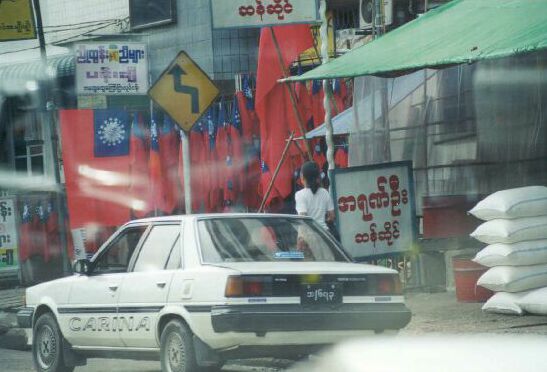
The red-blue Myanmar flag hanging from the shops which lined along a busy road in Yangon.
Myanmar has a long history of civil unrest since obtaining independence from the British in 1948. There were 15 armed ethnic minority groups fighting for autonomy from the central government for the past 40 days and all but 14 of them have signed a truce with the government lately. The recent border tensions arose when the SURA (Shan Union Resistance Army) seized Burmese outposts along the Thai-Myanmar border while the KNU (Karen National Union) launched assaults on military positions in the south. Myanmar has accused Thailand of housing the rebels, providing them with lodging and food and allowing them to use their land as a base to launch attacks on Myanmar. Matters come to a head when a bus of school children was bombed in Kayin State, killing 10.
This recent thaw in Thai-Myanmar relationship is not of mere coincidence, but more of a reflection of the deep-seated enmity between the two neighbors for centuries which has breed an unhealthy distrust and suspicion of each other's motives. Throughout its bloody history, Burmese Kings had the propensity of invading Thai territory, ransacking their capitals and enslaving the population as a show of their might and prowess, and few Thais would have forgotten the latest Burmese forays into Thailand by Kings Hsinbuyshin and Bodawpaya in the early 17th century, which has forced them to move their capital from Ayutthaya to Bangkok on a permanent basis to evade Burmese incursions.
Though Myanmar and Thai people and culture do resemble each other in many ways, they are in fact two different races altogether. The Burmese are migrants from Tibet while indigenous Thais hailed from Yunnan province in South China. Burmese and Thai are two different languages with their own script and alphabets. The Thais are more closely related to the Shans living in Northeast Myanmar which may explain their sympathy towards the Shan rebels seeking refuge with them. At the moment, Thai Premier Thaksin Shinawatra's business-like attitude in dealing with Myanmar has soften the strong underlying nationalistic undercurrents which can spiral out of control. At stake is a yearly billion dollar trade that Thailand enjoyed with Myanmar. Neither can afford to allow the conflict to evolve into a full-scale border war. Thailand's economy is still on the road of recovery while the Burmese economy is on the verge of collapse. While Thaksin is eager to use diplomatic means to resolve the problems plaguing both sides, Myanmar has closed border outposts with Thailand, sent back Thai workers and slapped a ban on official visits from Thailand. The longer the current situation is allowed to continue, the greater is the risk of it becoming untenable. At the end of the day, it will be the common folks who suffer.
Allocation and Re-packing
After the Team was settled down, we proceed to unpack the collected medication. The Burmese doctors in the team advised us to allocate the type and quantity of medicine to the various institutions as accordingly to their needs. The beneficiaries are: Mahasantisukha Medical Center, Myaing Thar Yar Rural Health Center, Arasamaj & Gurunath Free Dispensaries, Thanlyin Parahita Orphanage and the Social Welfare Girls Training Center.
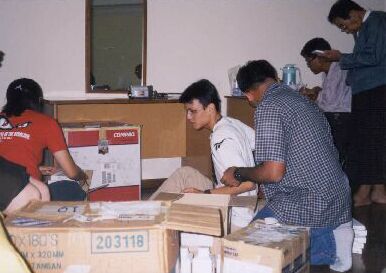
Sorting out our 'barang-barang' can be both an onerous and enjoyable experience.
None of the medicines we brought over this time were given to Bilin. The reason being that many of them are near expiry and since the Bilin Medical Center will only be operational next year, they can be put to better use elsewhere instead of leaving them untended at the Mahasantisukha. The second reason being that we need to write in officially to the Bilin Township Hospital to inform them of our intention to make a donation to the medical center which is under their charge and we may have to send somebody to personally transport the medicines to Bilin, which none of us are able to do so now. The medication most urgently needed in Bilin is anti-malarials and we were contemplating whether to make a purchase of 500 mefloquin tablets for the Medical Center. However, we decide to leave it for future missions when we will be able to visit Bilin and official permission be granted.
Teaching children health practices
We had a debrief at 9 am to make sure everybody in the team has settled down with no complaints whatsoever with regards to the lodging, food and service. We had a final rehearsal for the health education programme we have drafted up for the children. It consists of a skid on wound management, a question-and-answer session involving the use of pictures on basic hygiene practices and teaching children how to brush teeth using a model and songs.
I must commend the efforts the junior put into this. Many of the ideas are original and creative and they should be effective if not for one major constraint we faced: Language. We are unsure whether the children will understand our message with our rudimentary Burmese. We will have to rely heavily on our translators, which will no doubt, diminish our impact, yet nevertheless are critical to our project's success.
It's almost mid-night now as I'm writing this in the comforts of my room 611 which we stayed in March. Jensen, my room-mate is already fast asleep. I do admit I feel a bit of apprehension as we moved into high-gear tomorrow into the unknown. I'm keeping my fingers crossed and lips tight. After so many ups-and-downs, I should not be at least surprised if the most unexpected happened.