SUSPENSION OPERATION
&
WEIGHT TRANSFER
The purpose of any suspension system is to isolate the rider from
the terrain while still allowing for complete control of the
vehicle. A snowmobile rear suspension has the added requirements of
providing weight transfer and maintaining correct track tension.
Weight transfer is essentially the shifting of weight to the
track for better traction during acceleration, and to the skis for
positive handling during cornering.
The physics that apply to all rear suspensions are basically the
same. As we apply torque from the engine to the drive axle, the
torque is transferred to the track and pulls it for forward. That
energy enters the suspension system at the rear axle and tries to
pull it forward (force "C" in the following illustration). The rear
arm is a pivoting or sliding linkage that only provides vertical
forces at the rear of the chassis, therefore, none of force "C"
enters the chassis at the rear arm.
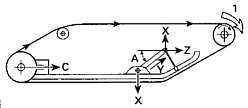
The front arm is mounted with a pivot to both the runners and the
chassis. It is through this arm that the major reaction to the
engine torque is applied. As the front arm begins to swivel from the
load of force "C", it pushes down on the front of the track (force
"X" in illustration). This reduces weight on the skis and applies
more weight on the track for better traction. The rest of the force
"C" enters the chassis through the front arm and accelerates the
vehicle (force "Z").
If we keep force "C" constant, we can then vary the size of the
vertical and horizontal forces at the front arm by varying angle
"A". As angle "A" is made smaller, force "X" decreases, and force
"Z" increases. This reduces the amount of torque reaction and more
weight stays on the skis. As angle "A" is increased, force "X"
increases. The skis then tend to lift more during acceleration and
more weight is placed on the track.
We can vary angle "A", within limits, by adjusting the length of
the limiter strap. The limiter strap is just that, a strap to limit
the extension of the front of the suspension. Shortening the strap
decreases angle "A" and is what we would do to set up a machine for
more ski pressure. For more track pressure we would want to lengthen
the strap to increase angle "A". The limiter adjustment has the
largest affect on controlling the amount of weight transfer.
NOTE: Track tension must be checked whenever a major change is
made to the limiter length.
�


