|
CORNERING DYNAMICS
The ideal situation, while going through a turn, is to keep the
snowmobile as flat as possible without the skis or track losing
Contact with the driving surface.
As you enter a corner and
turn the skis, the rest of the vehicle will want to
continue straight ahead. If the skis do not bite the surface,
they will start slipping and the vehicle will not turn as
tight as the skis are turned. This is called "understeering", "pushing"
or�being "tight". If the skis bite well and the track starts sliding out,
then the vehicle is "oversteering" or is said to be "loose".
If the ski and track traction is balanced, then the vehicle will
maintain a good "line" though the corner.
Because the center of gravity of the vehicle wants to continue
straight ahead and because the center of gravity is above ground
level, weight will be transferred to the outside of the vehicle.
This causes the machine to roll to the outside. As the radius of the
corner gets tighter and/or speeds increase, the machine rolls more,
and more weight is transferred to the outside of the vehicle until
the front or back loses traction or the vehicle tips over.
Roll can be reduced by instatling stiff
springs on the front suspension and/or a lot of preload, but this
will cause a harsher ride than necessary. Lowering the center of
gravity will also reduce roll but there are practicat limits as to
how low the center of gravity can go.
Most vehicles are equipped with an antiroll bar or "anti-sway" bar. The
bar is mounted to and pivots on the chassis. The ends of the bar
have lever arms from 3" to 7" in length. The ends of the levers are
connected to the front suspension.
|
�
As the outside suspension is compressed during a
corner, the bar is twisted and forces the inside spring to compress
also. The bar is "borrowing" spring pressure from the inside spring
and adding it to the outside spring. The suspension can now resist
more chassis roll (see following illustration).
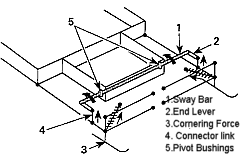
By having a sway bar in the suspension,
softer springs can be used to achieve a good ride and the bar will
help control roll in a corner. The bar has no affect on ride when
traveling straight ahead over bumps that are even from side to side.
However, if only one ski encounters a bump, then the bar will
transfer energy between the springs. This leads to another design
decision. The diameter of the sway bar determines how much spring
pressure will be "borrowed" from the opposite spring.
A smaller bar
will twist more and not transfer as much energy. A larger diameter
bar will transfer more energy which will reduce chassis roll, but
will produce a harsher ride on uneven, bumpy terrain. A smaller
diameter bar will give a more compliant ride on the nasty bumps but
it will allow the chassis to roll more in corners. A cross country
sled will use small to medium diameter bars while oval and lemans
racers will use large diameter bars.
|


