Geography ||  Climate ||  People  ||  Religion  ||  Language  ||  Food & Fruits  ||  Hill tribes  ||  Thai Boxing
 

              "SongKran" is the Thai traditional New Year and occasion for the family reunion. At this time, people from the rural areas who are working in the city usually return home to celebrate the festival. Thus, when the time comes, Bangkok temporarily turns into a deserted city.
           The word Songkran has its origins in the Pali language of the Therevada Buddhist scriptures.In Pali, the work Sankhara (Sankranti in Sanskrit) means a shift of the sun from one side of the Zodiac to another. In this case it means the movement of the sun from Aries to Taurus.The word later became Songkran in Thai meaning the begining of a new Solar year

          The festival falls on April 13 and the annual celebration is held throughout the kingdom. In fact, "Songkran" is Thai word which means "move" or "change place" as it is the day when the sun changes its position in the zodiac. It is also know as the " Water Festival" as people believe that water will wash away bad luck.

          This Thai traditional New Year begins with early morning merit-making, offering food to Buddhist monks and releasing caged birds to fly freely into the sky. During this auspicious occasion, any animals kept will be set free. Paying homage to one's ancestors is an important part of the day. People will pay their respects to the elders by pouring scented water over the palms of their hands. The elders in return wish the youngsters good luck and prosperity.

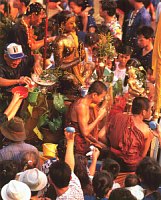
         In the afternoon, after performing a bathing rite for  Buddha images and the monks, the celebrants both young and old, joyfully splash water on each other. The most-talked about celebration takes place in the northern province of Chiang-Mai where Songkran is celebrated from April 13 to 15. During this period, people from all parts of the county flock there to enjoy the water festival, to watch the Miss Songkran Contest and the beautiful parades.

The Northern Thai people, however, have their own folklore to explain the word and the holiday.Songkran day itself is called Wan Sangkran Lohng, and the day of the new year Pavenee Pee Mai. According to local legend, Wan Sangkran Lohng is 'the day that Lady Sangkran passes by' as the word Luang means to 'go away' or 'pass by'.Technically its is the last day of the Lanna lunar year and the start of Pavenee Pee Mai. 

Although Songkran is officially set of April 13th, the festival stretches over four days, each with its different focus and activities. 

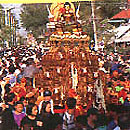
April 13th--Wan Sungkran Lohng. On this day the people clean their houses and engage in preparations for the new year festival.The Chiangmai Songkran parade takes place on this day with Buddha images, floats, contingents from the province's different districts,musicians and local beauties in traditional costume,all of whom are liberally drenched by the spectators as they march. 

April 14th--Wan Nao. On Wan Nao people prepared cooked meals and preserved food of the Buddhist merit-making activities that occur the next day.This is also the day that people go down to the river and gather buckets of sand which are used to construct molded sand chedis, decorated with flowers and paper streamers, in temple courtyards.This practice is an old practice intended to raise the level of the temple grounds. 

April 15th--Wan Payawan. On this day the new year begins with early morning merit-making at the temples where the people offer preserved and cooked foods, fresh fruits,robes and other offering goods to the monks.Traditionally this was the day when gentle water play began but this has developed into the aquatic free-for-all that stretches across the entire festival. 

The free-for-all of water throwing that greets the visitor to Thailand for his or her first experience of the Songkran Festival represents a development of customs related to the celebration of the Thai astronomical new year that some would say has gotten out of hand. 

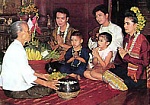
In the old days people might sprinkle a bit of scented water over your shoulder and wish you a good new year rather than drench you with a plastic bucket of ice water. But one of the important customs of the festival was to take an occasion to pay respects to family elders and persons of influence worthy of respect through the ceremony of rod naam dum hua, or paying respect through the pouring of Songkran water. 

According to old Lanna custom, the family and subordinates would approach the elder to be paid respect with a vessel khun oh of water scented with dried flowers, cumin and other herbs. These small heartfelt offerings of lustral water would be poured into a large red lacquerware bowl that was placed before the seated elder. On the table were presents of mohom shirt, multipurpose length of colorful cotton call pa-khao-mah, flowers and useful items. 

A representative of the persons paying respect to the elder would then speak on behalf of all the gathering asking the elder to forgive misbehavior and improper attitude on the part of the younger members of the family during the prior year. The elder would then dip his or her hands in the large offering of scented water and rub them over the sides of his head, pronouncing blessings for the new year to the group assembled to pay respect. At the conclusion of the ceremony, the group, led by the elder, would then proceed to the temple of sueb cha-dta or 'life prolonging' ceremony., 

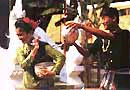
Nowadays, the focus of Songkran is the wholesale throwing of water. While inside the city limits of Chiangmai this is allowed by law only on the three days of the festival, rural children indulge in this amusement for as long as two weeks in the time surrounding the festival. Readers who want to enjoy the beauty of the rural countryside around Chiangmai on motorcycle be warned and dress appropriately. Also be warned that Songkran revelers will frequently aim their water throwing at a motorcyclist with the face as a target or at the spark plug in order to kill the engine and drench their immobilized victim at leisure. Train travellers in non-air-conditioned coaches might want to watch the open windows, as these are favored targets of water throwers and hurlers of giant water balloons. 

While the gentle customs of former times may have changed, or even gone ballistic in present-day Songkran celebrations, get into the spirit of things. Get wet, stay cool, and enjoy one of Thailand's most frenetic and fun festivals.

Back

Hosted by www.Geocities.ws

1