STANCE AND MOVEMENT STANCE AND MOVEMENT
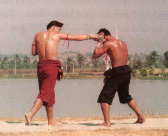
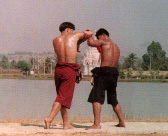
There is only one stance in Muay Thai and every technique is performed from this fighting position. One leg is placed in front of the body with the foot of that lead leg facing straight towards the opponent while the other is placed behind with the foot of that rear leg facing at about 45 degrees away from the lead foot. The rest of the body is also turned at about a 45 degree angle in syncronization with the rear foot. Half-facing is much more advantageous to the fighter than front-facing or side-facing because it minimizes the target areas by half. Front-facing exposes most of one's vital points while side-facing makes it extremely difficult to effectively deliver any of Muay Thai's most powerful techniques. The distance between each foot should be about shoulder-length and shoulder-width apart from each other. The Thai boxer stands upright while keeping the bodyweight on the balls of both feet. There are 2 variations on the basic fighting stance that depend upon which leg is in lead, which one is the rear leg, which leg contains most of the bodyweight, and which heel is raised higher than the other. If most of your bodyweight is in the lead leg, then the heel of your rear leg should be higher than the other. A good Thai boxer knows how to fight from both the left-lead (or left-guard) and right-lead (or right-guard) stances since transitions between the two are needed to be made at times. Full-committment power kicks can be performed a bit more quickly from this variation. If most of your bodyweight is in the rear leg, then the heel of your lead leg should be higher than the other. Push kicks can be performed at a slightly accelerated speed from this variation. The shoulders
are raised and the forearms are lifted in front of the face. Most, however, prefer to leave their shoulders down and raise them only when a technique is being executed as keeping them up all of the time tends to reduced a combatant's energy levels. Always keep your chin down, though, and focus your eyes on your opponent's torso area.
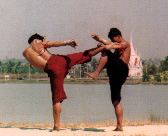
Observing your opponent's hips and shoulders should help you determine when that individual will strike next as well as which limb your adversary will use. Hip movement usually indicates the execution of a kick or knee strike while shoulder movement usually indicates the execution of a punch or elbow strike. The hands can either be in an open or closed position depending upon the personal preferences of the boxer in question. Some choose to bounce their lead legs up and down in order to be able to execute a push kick at any given moment. Others prefer to shift their bodyweight between left and right legs while lifting them up and down alternatively. The body swings back and forth in a rocking sort of motion during this alternate lifting of the legs so as to be ready to execute techniques from either leg. The lead arm should also swing back and forth slightly in front of the head for the purpose of blocking any attacks to that area. One should always inch forward slightly as opposed to backward while doing this motion. The bouncing of the lead leg can be combined with the alternate leg-lifting motion, body swinging, and basic turning movements (i.e. "Clockwise" and "Counterclockwise" right angle turns) for the purpose of confusing the opponent. This tricky and deceptive working of the legs is known as the HORSE style Boxing Walk because it resembles the galloping movements of that animal. The HORSE is one of three types of Boxing Walk including the LION and TIGER styles. The concept behind both the LION and TIGER styles of Boxing Walk is to use two weapons at the same time. The LION style from Muay Chaiya emphasizes using two weapons on the same side of the body (i.e. left and left OR right and right) while the TIGER style from Muay Khorat emphasizes using two weapons on opposite sides of the body (i.e. left AND right). The power behind the LION style is explosive because the body opens out when performing the technique(s) like a lion pouncing on its prey. The power behind the TIGER style is implosive because the body closes in when performing the technique(s) like a tiger stalking its prey. For the LION style, you want to learn how to move fearlessly and forcefully like a lion pouncing its prey in the open plains. For the TIGER style, you want to learn how to move slow and stealthily like a tiger stalking its prey behind the camouflage of the grass. In order to perform some of the offensive leg techniques from the lead leg, the Thai boxer rapidly switches to the opposite stance (where the lead leg becomes the rear leg and vice versa) beforehand so that the technique is given maximum leverage for maximum power. Leg techniques delivered from the rear leg will be much more powerful than from the lead leg. The footwork prevents the legs from being crossed during combat as doing so places the element of risk to the Thai boxer in terms of balance.
|