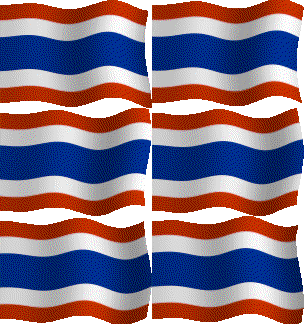
Flag Of Thailand: red = Thai people; 
white = Buddhism; blue = Thai king

A Page From


Smartchai's MUAY THAI Database
-INTRODUCTION-

[ MAIN | INTRODUCTION | PRELIMINARIES | PUNCHES | ELBOWS | KNEES | KICKS | RAMAKIEN I | RAMAKIEN II ]


What Is Muay Thai ?

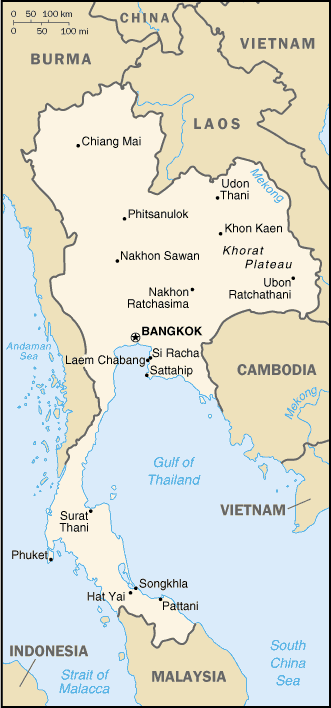
map of Thailand

MUAY THAI, commonly referred to as the "science of eight limbs", is one of the most powerful styles of martial arts because Thai boxers apply maximum power in every technique which is generated by the turning of the hips followed by body. Bone-strength, endurance, and stamina must be achieved in order to become a proficient Thai boxer. It is an ancient Siamese art of self-defense where the elbows, feet, fists, and knees are used to pummel the opponent into submission. The fists and feet are used for long-range combat while the elbows and knees are used for short-range combat.


Muay Thai is sometimes called "Thai Boxing" or "Thai Kickboxing" because the techniques of this style are not practiced in sets of choreographed movements commonly referred to as "forms" which can be found in other martial arts such as KARATE, KUNG FU, PENTJAK SILAT, and/or TAE KWON DO. They are, however, practiced in the same manner as in regular two-fisted ENGLISH BOXING which allows the practitioner to develop power, speed, and a spontaneous reaction to attacks. The practice of "forms" does not properly develop these qualities which are the most essential elements in becoming a good combatant. It is incorrect to use the term "kickboxing" to describe Muay Thai because there are other styles of kickboxing out there such as SAVATE (also known as "Boxe Francaise", "French Boxing", or "French Kickboxing") which uses only the fists for punching and the feet for kicking.


It is also inappropriate to say "Muay Thai Boxing" and/or "Muay Thai Kickboxing" because the word "muay" already means "boxing" in the Thai language. The simplicity of the footwork and techniques are some of the main reasons why Muay Thai is considered to be one of the most effective styles of martial arts. Also, techniques that were believed to contain less destructive power such as finger strikes and "snap" kicks were completely removed increasing its efficiency and practicality levels. Crouching stances where the body is kept exaggeratingly low and close to the ground have been entirely avoided in the practice of this particular fighting style because these types of on-guard positions make it difficult to evade quickly enough from the attacking opponent.


Muay Thai, for the most part, does not contain kicks of an acrobatic nature as found in fighting styles such as CAPOEIRA which can considerably reduce one's energy levels and put one in very vulnerable positions. There are many types of grabs which can involve the arm(s), body, leg, neck, and/or shoulder(s) of the opponent. Clinches can aid the Thai boxer in maintaining balance while striking with the knees, in maximizing the force of a blow by pulling the target area closer to the striking weapon, and in preventing one's adversary from getting away while offensive techniques are being executed. Balance. Power maximization. Escape prevention.


A Thai boxer usually delivers a(an) elbow, knee, punch, or "round" kick while grabbing rather than a "straight" kick which is mainly used for defense and/or creating distance. No other fighting art on Earth specializes in close range combat as well as in the use of the elbows and knees more than Thai Boxing. In order to know Muay Thai in its completion, one must study all of the existing "GKON" (or TACTIC) and "CHERNG" (or TECHNIQUE). "GKON" is the defense and counterattack method used against the opponent. "CHERNG" is the method of how an individual limb is used for offensive purposes which can include a combination of two or more of either the same or different weapons, alternatively or simultaneously.

There are two types of "GKON", defensive and offensive, within the five existing sets. Four of those sets include ways of how to defend against either a punch ("MUHDd" 29), elbow ("SAWK" 4), knee ("KHOW" 3), or kick ("TAHW" 23). The remaining set ("JjOO JjOHM" 23) includes techniques for surprise attacks and strike prevention. The length of time needed for a person to acquire the self-defense capabilities found within Muay Thai is far less than compared with most other styles of "hand-to-hand" combat. If you're looking for a truly no nonsense style of fighting that punishes your opponent, then Muay Thai is the way !
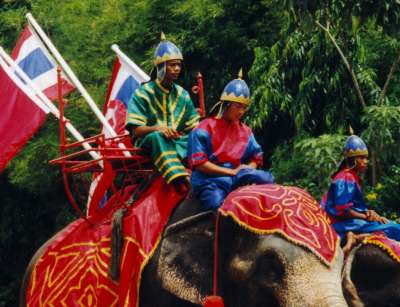

Thai warriors on elephants

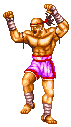
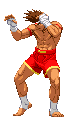
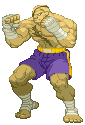
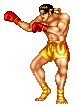
Pictured below are popular video game characters who fight in the style of Muay Thai:
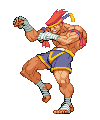
Adon of STREET FIGHTER Hwa Jai of FATAL FURY Joe Higashi (not Thai) of FATAL FURY Sagat of STREET FIGHTER Shura NaiKanom Tom of WORLD HEROES


Interesting FAQs About Muay Thai:

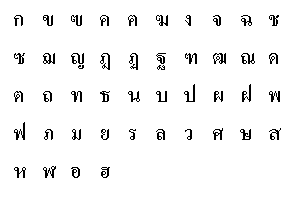
44 letters (all consonants) of the Thai alphabet

  1. Before it was called "Muay Thai", this Siamese fighting art was known simply as "Muay" which means togetherness, harmoniousness, or oneness. It is the "oneness" of the practitioner's mind and body as well as "oneness" with the opponent(s) in order to achieve victory.
  2. MARCH 17th IS "MUAYTHAI DAY" !
  3. "Lerd Rit" is the military style of Muay Thai which contains various open-handed attacks as opposed to closed-fists. This is so because Lerd Rit fighters did not want to risk breaking their hands during a confrontation.
  4. The nineth, and most important, weapon in Muay Thai is the head which acts as the command center that controls all 8 limbs. Over the years, some people have misunderstood this concept thinking that the head was also used for physically attacking the enemy. In Muay Thai, the head is too sacred for that kind of abuse which is why the hands are usually held up high enough to protect it.
  5. The GKON known as "Hermit Dives Into The Pond" is Thai Boxing's official flying headbutt. It's the only known use of the nineth weapon as a striking limb.
  6. "Nai Khanom Dhom" is a famous Thai boxer from ancient days who earned his freedom and retained Siam's Independence by defeating all of the 12 Burmese fighters that he was forced to do battle with.
  7. Before the "Queensbury Rules" were established in Thai boxing, fights were originally fought with bare fists, no weight categories, and in a circular ring. Later on, the fists were bounded with rope in which broken glass was, sometimes, glued on to increase their effectiveness as lethal weapons.
  8. Some ancient training methods include kicking banana trees, focusing one's vision on a lemon attached to a string, and splashing water into the eyes while keeping them open.
  9. In Thai culture, the foot is considered to be lowest in relation to its level of holiness as opposed to the head which is deemed the most sacred of all bodyparts. So the foot of one touching the head of another (as in one of the 15 Minor Techniques known as "Foot Touches Face") for any reason is considered to be a great insult to the one who's head is being affected.
  10. One of the most popular Hindu epics known as "Ramayana" (or "Ramakien") inspired many of the techniques found in Muay Thai. It is the tale of the preserver god, Vishnu, who descends to Earth as a mortal man named "Rama" (or "Pra Ram") in order to end the ravages of a supremely powerful ten-headed demon king named "Ravana" (or "Tosakan") who has taken over the world.
  11. Much of the old style footwork which focuses on fighting opponents from the other three main directions such as the sides and back were eliminated to compensate for the one on one ring battles of modern-day sport Muay Thai.
  12. In the Chaiya style of Muay Thai, the fighting stance requires that both the lead foot and rear foot are angled about 45 degrees from the opponent. The legs are bent instead of almost being straight allowing the knees to become passive weapons of offensive defense while standing in the guard. This creates a low stance as in other fighting styles such as Karate or Kung Fu.
  13. There are two types of names for each individual technique in Thai Boxing, technical and poetic. (i.e. technical name= REVERSE ROUND kick; poetic name= "Crocodile Swings Its Tail")
  14. Sometimes, the name for a GKON can be repeated in a CHERNG. (i.e. GKON = "Hanuman The Monkey King Presents The Ring" = CHERNG)
  15. "Cutting Off Ravana's Head" and its MAE MAI counterpart of "Quail Enters The Nest" are techniques where four bodyweapons are used... simultaneously !
  16. Some of the old styles (i.e. Muay Chaiya) contain groundfighting maneuvers and limbbreaking techniques.

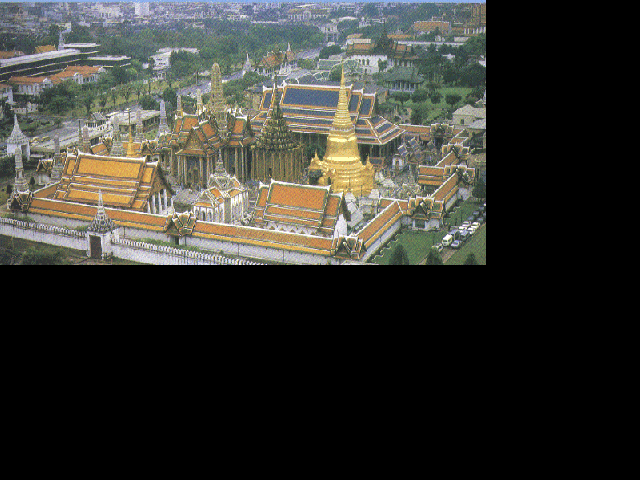
a famous temple in Bangkok, Thailand


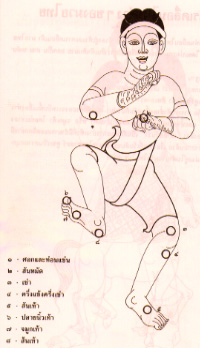
The Striking Surfaces Of The Body

The Striking Surfaces Of The Body:

  1. ELBOW AND FOREARM
  2. KNUCKLE
  3. KNEE
  4. HALF-SHIN, HALF-KNEE
  5. INSTEP
  6. TOE
  7. BALL OF THE FOOT
  8. HEEL


Muay Thai's Limitations and Ways To Conquering Them

Although one can develop a virtually invincible body and become a virtually invincible fighting machine by studying and training in the art of Thai Boxing, there are some negative aspects that one should be aware of while undertaking such a journey. First of all, there are age limitations which means that the elderly are more likely than others to be physically incapable of effectively using Muay Thai during combat situations despite the ease with which most of the techniques can be learned and/or performed. Particularly, techniques involving the shin to block incoming attacks which could lead to a devastating outcome if one's opponent has stronger shinbones. Unlike in AIKIDO and/or TAI CHI CHUAN, this fighting style uses too much of one's own limited physical strength instead of the limited physical strength of one's opponents which can lead to one's eventual defeat no matter how long one can last in a fight. An opponent with larger bones and muscles is more likely able to defeat one with smaller ones.

As a person passes the peak of one's prime, one begins to lose the ability to defend one's self using Muay Thai because one's own limited physical strength has begun the natural deterioration process. This process occurs within all human beings regardless of race, gender, ethnic origin and/or any other physical factors. The human body is like a machine and, like all machines (whether it be artificial or natural, biological or technological, organic or inorganic), it will eventually breakdown with wear and tear over a period of time. Back problems are likely to arise because of the constant backward and forward bending of the back during technique execution.

Joint problems such as 'arthritis' may occur due to the accumulation of too much "callus" upon the bones. Neck problems are also a possibility due to the constant bending of the head forward which is meant for keeping the chin protected from attacks. Also, there aren't many ground-fighting techniques found in this style which can make a Thai boxer vulnerable on the ground. Although the length of time needed for a person to acquire the self-defense capabilities of Muay Thai remains far less than in most other combat styles, its usefulness is only short-term due to its undue dependence upon the body's limited physical strength.

However, there are techniques in Muay Thai that don't necessarily depend upon muscle power alone. Blocks similar to those from Chinese internal fighting arts such as "Bird Peeps Through Its Nest", "Cross Stitch", and "Sweeping The Enemy" which involve yielding to as well as parrying the incoming force of an attack can be used by the elderly without the need of physical strength. One must learn how to fight with Thai techniques without using too much force against force if one wants to continue being a Muay Thai stylist. As long as the practitioner maintains a good level of health and, perhaps, takes the time to study life energy ("chi" in Chinese, "ki" in Japanese, "prana" in Hindi) development exercises from other fighting styles which include them, one can still be a great Thai fighter past his prime.


This page hosted by Get your own Free Home Page

Trademark and Copyright 1997, 2008 SMARTCHAI. All Rights Reserved.

Hosted by www.Geocities.ws

1