Day Three - From Iveragh to Dingle
We crossed back over to Portmagee and headed east along the top edge of the Iveragh peninsula. If it were summer, we could have taken a ferry from Valentia directly to Dingle, which would have been nice, but I'm not willing to concede that it would be worth having to put up with the summer crowds. I honestly think that the “shoulder seasons” (March, April; September, October) would be nice times to go, because more stuff would be open and operating. But it wouldn't be so dreadfully crowded as summer. I'm really only imagining what it would be like in the high season, of course, and I'm sure that it would have it's own kind of social charm, but the isolation of the place held a huge appeal for us, and I don't think I'd like it as well thronging with tourists. But maybe someday I can try it and compare. I'd go back in a New York minute, any time of year!
  |
||||||
|
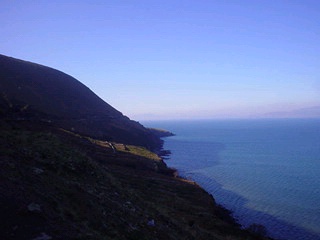
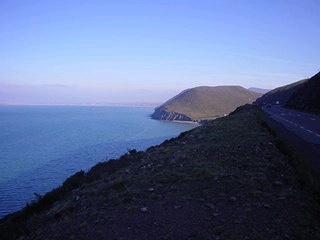
A nice spot along our route across the top of Iveragh, called King's Head.
|
||||||
|
By the time we got to Dingle, it was almost dark, but we figured we had time to take in the Dunbeg Fort, which was just a few miles further on. Dingle was a bit larger town than we'd been in since arriving on the peninsulas. Most towns there are just a row of buildings for about a mile on either side of the main drag. There are no turns, and it's pretty hard to get “lost”. But Dingle was actually quite large, and we had to drive around a bit to figure out how to get through the town and in the right direction toward the fort. Here, as other places, the Irish make use of “roundabouts”. These are wonderful, once you get the hang of them. You just merge into the traffic as in any roundabout here, only going the other way round, of course. They are a really, really useful way to avoid a four-way stop or a traffic light (traffic lights in Ireland, we noted, tend to stay red for a long, long, agonizing time!) Another advantage of the roundabout: they are usually ringed by signs pointing out destinations (usually in English and Gaelic). If you're not sure which way to go, just stay in the roundabout and read the signs as you go around, until you figure it out!
We finally got headed toward Dunbeg, and arrived shortly before “closing” time. As usual, there was no one there but us. The fort itself was less impressive (after Staigue!) than the view from it. It did have a neat underground passageway that we couldn't figure out how to get into, but you could sort of peer down into it through some cracks in the rocks.
 |
 |
|
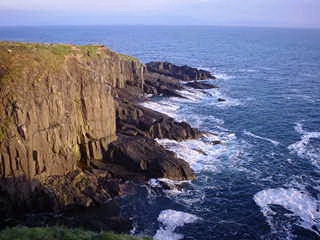
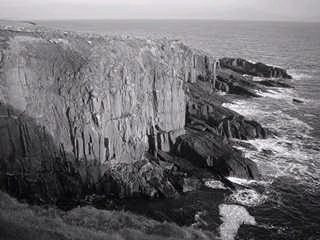
View from Dunbeg.
|
Annie's digital camera switched easily from color to black and white. Annie, did I thank you for the camera?.
|
We left Dunbeg Fort and headed back to Dingle. We had more trouble finding lodging here than we had previously, partly because it was a bigger town with more to choose from, and partly because we had begun asking tough, probing questions like “is there heat in the room” and “will hot water be available in the morning?” We took turns going in to enquire about rooms, and Thierry was the one who found our lodging for the night. It was more like an inn than a B&B, but it was nice and warm, and the shower turned out to be just fine. However, we made a note to add another question to our list for the next night's room search: “Does the room reek with the unmistakable odor of vomit?” Thierry was actually shown the room before he took it, by the daughter of the household, a tall, giggly teenager in a midriff top. I don't know why he failed to notice the smell...
Lodging fees in Ireland are per-person, not a flat “double-occupancy” rate. So a room with a €27 rate will be €54 for two people. This irked us a bit, because it seemed so strange to charge double what they would charge a single person sleeping in that same room. I would hate to travel with three people, though, because three people sharing a room is, you guessed it, 3 X €27. It's a strange policy, but I guess it's a pretty good plan if one is traveling alone. The giggly teenager did knock €10 off our room rate, because we did not plan to stay for breakfast. This was partially because I was tired of eating the same thing every day, and partially because we wanted to get on the road before 10:00. Breakfast here, as everywhere, was not served before 8:30. And winter in Ireland offers only so many hours of daylight.
After checking into the room, we headed out to find some food. We ended up eating at a table surrounded by women. I don't know if there was some kind of chick convention in town, but it was noticeably estrogen-heavy in there. We had another good meal of fish, broccolicarrotscauliflower and boiled potatoes. And Guinness. Did I mention the Guinness?
This place was more of a restaurant atmosphere, and we really wanted something pub-like, so we headed off to see if there was something else down the street. We ended up at a place with a real strange vibe. I couldn't put my finger on it, but Thierry said it was like an Irish pub that had been picked up, put down in America, and then moved back to Ireland. That was exactly it. It was like an American attempt at a pub. And we didn't like it. So we didn't have the traditional two pints, but rather, moved on after one. We found another pub and had another pint, but we were having trouble finding a good vibe, so we soon gave up and just went back to the vomit room and went to sleep. So ended the night in Dingle Town.
 |
|
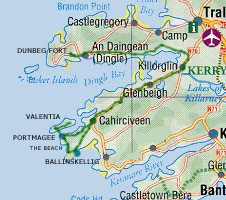
Day Three: From Cahirciveen, down to Ballinskellig, through mountain passes to Portmagee and Valentia, then across top of Peninsula, through Killorglin and down Dingle.
|