The major limestone quarry is 18 km advanced from the cement factofy at Beochin (Yougoslavia). The transportation costs are 74% of the production costs!
A feasibility sutdy find out that the change from truck to conveyor overland transportation would result in substantial savings of transportation costs. However, this would require a relocation of the crushing plant from the cement works to the limestone mine in order to produce conveyable particle size.
In a further study different models of mining and in pit preparation for further conveyor transportation were studied:
1. In pit mobile crusher
A front-end-loader feeds ripped and dozed material to the mobile crusher. The crusher hands over the material to a shiftable conveyor.
2. Semi-mobile crusher
Blasted limestone is loaded to trucks. The trucks transport the material from the mining faces to the semi-mobile crusher located at the mine mouth.
3. WIRTGEN Surface Miner
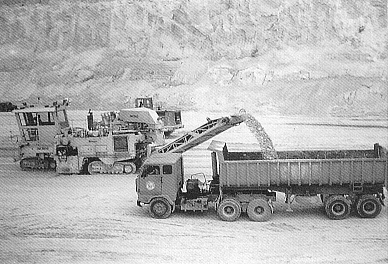
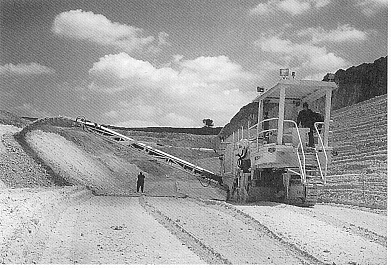
WIRTGEN Surface Miner cut, crush and load the material to trucks. The trucks transport the material to a hopper, fitted to the overland conveyor and located at the mine mouth.
The operation no.3, using the WIRTGEN Surface Miner, came out as the most economical solution. Since 1989 a WIRTGEN Surface Miner 2600SM produces appr. 600 t/h of limestone with average uniaxial compressive strength of 25Mpa. Appr. 90% of the particles are smaller than 16 mm. The maximum particle size is appr. 150 mm.
In this operation the WIRTGEN Surface Miner is the key link for production of conveyable particle size.
And so the high flexibility of the trucks in the mine area during mining could be combined with the cost effective overland conveying.