| Tiger Subspecies |
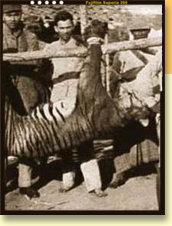
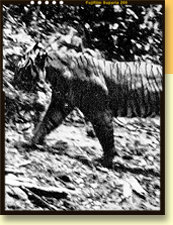
| Balinese Tiger Panthera tigris balica Like its neighbors on the islands of Java and Sumatra, the Bali tiger benefited, to a degree, by virtue of its geographic isolation. These tigers were only found in the wild on the tiny Indonesian island of Bali. They were smaller, darker, and had a greater density of thinner stripes than other tigers. The Bali tiger has been the very first tiger subspecies to become extinct. The last specimen of the subspecies is believed to have been killed by hunters in 1937. None others survive, not even in captivity or in zoos. The only thing that remains of the Balinese tiger is one photograph. The Bali tiger is extinct. Bengal Tiger Panthera Tigris Tigris Perhaps the most commonly known tigers - the prototypical tiger- are those of the Bengal subspecies. This is the animal most of us picture when we think of a tiger. These days there are more Bengal tigers roaming in the wild than any of the other subspecies. Estimates range between 3000 and 4,500 individuals, spread across India and several of its neighboring countries, including Bangladesh, Nepal, Burma (Myanmar), and Bhutan. There are also several hundred Bengal tigers in captivity, primarily in zoos throughout India. One reason for the singularly large number of surviving wild Bengals is attributable to the aggressive projects undertaken by the government of India. In an effort to preserve what they saw as a national treasure, the leaders of India were quick to take action as soon as it was learned that other tiger subspecies were threatened. During the early 1970's, when a national census indicated that the Bengal tiger itself was falling subject to habitat degradation and poaching, India embarked upon the most comprehensive tiger conservation project initiated anywhere in the world. Known as "Project Tiger," this program dedicated numerous ranges for the Bengal tiger as protected habitat and worked toward limiting, to the greatest degree possible and not without controversy, the amount of human infiltration into those areas. Soon after the implementation of Project Tiger, the success of the program seemed evident due to the apparent resurgence of the wild Bengal tiger population. Unfortunately, the method used to count the tigers sighted in the censuses came into question, and it remains controversial to this day. Known as the "Pug mark" technique, the method involves tracing and analyzing only the footprints of tigers in an attempt to identify individual animals - strictly through their footprints - and then using those individual sightings to calculate the likely total number of tigers in a given area. Many felid biologists feel that results collected through this method are not at all reliable when it comes to collating a total number of tigers in a given population. Nevertheless, within a decade of the launch of Project Tiger, it appeared the Bengal subspecies was well on its way to recovery in the wild because of the "inflated" statistics of subsequent censuses. Shortly thereafter however, in the late 1980s, evidence of aggressive poaching and smuggling arose coincidentally as tigers became conspicuously absent in ranges where they had previously been abundant. India proclaimed that it had a Second Tiger Crisis; a proclamation that continues to this day. Despite the valiant efforts of the Indian Government and many conservation organizations, poaching and habitat loss continue to be severe problems in India. Caspian Tiger Pnthera Tigris Virgata This curious subspecies was once the western-most of all wild tiger subspecies. Its home range included Afghanistan, Iran, Iraq, Turkey, and portions of Russia. These are the tigers that lent their imagery to the many tiger-laden artistic representations of the mighty Ottoman and Persian Empires. The Caspian subspecies is also considered unusual because it inhabited a terrain as unique for its arid characteristics as the Siberian tiger's northern regions are for their snow and the Sumatran tiger's home is for its densely overgrown forests. Sadly, the last formally documented observation of the Caspian tiger occurred in the 1950s, and the animal is therefore now universally presumed to be extinct. There have been recent reports of large cat sightings close to the Caspian Sea coast, where the border of Iran and Turkmenistan meet. Some believe these are tigers; others are sure they are Persian leopards. Officially the Caspian tiger is extinct. Indochinese Tiger Panthera Tigris Corbeti While little is known about this subspecies of wild tiger, they perhaps offer one of the greatest hopes for the survival of wild tigers everywhere. Centered in Thailand, this subspecies, can also be found in Myanmar, Cambodia, Vietnam, Laos, Malaysia, and southern China. Though estimates are based almost exclusively on secondary evidence such as paw prints and remnants from their kills, it is believed that as many as 1000 to 1500 members Indo-Chinese tigers survive in the wild. (There are about 60 living in zoos throughout Asia and the USA.) There are two primary reasons why so little is known about the Indo-Chinese tiger. First,the areas in whichthese tigers live include extremely remote forests and terrain that is not hospital to researchers. In addition, several of the governments in charge of these territories are either unwilling or unable to allow foreign nationals into their countries to conduct detailed studies. Even so, such pioneering felid biologists as Dr. Alan Rabinowitz of the Wildlife Conservation Society have managed to assemble a modicum of crucially important data regarding this subspecies. Aside from the sheer quantity of surviving wild members of this subspecies, the Indo-Chinese tiger has special prominence because it is thought by some scientists to be the most closely related animal to the original ancestors of all tigers. (The South China tiger is also thought by some to hold this distinction.) These animals, therefore, may posses genetic components that are especially important and unique with respect to the viability of any and all surviving tigers. Unfortunately, much of the sparse information that is known about this subspecies comprises information about threats to its long-term survival. Specifically, human encroachment into formerly pristine tiger habitat is severe. In certain countries such as Vietnam, this has involves the wholesale destruction of habitat as a consequence of war. Poaching is also a particularly threatening problem for the Indo-Chinese tiger, promoted to a large extent by the regressive economic situations in several of the countries where wild Indo-Chinese tigers roam. The animals simply offer too large and tempting an incentive on the black market for villagers who might otherwise be able to ignore the animals presence or at least tolerate its cohabitation. Those same economic forces often lead both individuals and governments to plunder the natural resources associated with Indo-Chinese tiger habitat, including forests, water supplies, and the prey on which the tigers feed. The one bright spot with respect to these threats is Malaysia, where efforts to reduce poaching and smuggling have been exceptionally effective. In addition, the relative political and economic stability in Malaysia has produced an atmosphere more conducive to the cohabitation of tigers and people. Javan Tiger Panthera Tigris Sondaica Similar to the Sumatran and Bali subspecies of tiger, the Javan tiger was uniquely isolated in both geographic and political terms to a single water-locked island. Even before research escalated regarding the viability of the Sumatran tiger, significant and original research had been conducted regarding the status and viability of the Javan tiger. In particular, John Seidensticker and his Indonesian colleague Ir. Suyono conducted the first comprehensive field research on the island of Java in the mid-1970s. Unfortunately, the picture revealed by this early research was bleak; few tigers could be found on the island, and trends in the decline indicated the likely extinction of the subspecies within a decade-due completely to the corruption of their habitat by the infiltration of human beings. (Java, with an area of 132,000 kilometers and a population in excess of 130 million people, is the most densely populated island on Earth). Unfortunately, here the worst case scenario developed for tigers. Along with the Caspian and Bali tigers, the Javan tiger is now extinct - none exist in either the wild or in captivity. All that remains are photographs and pelts. The last observation of a Javan tiger that was formally documented occurred in 1972. (Two important related points must be observed here: First, there have been recent anecdotal reports of Javan tiger sightings associated with the wildfires that raged across Java in 1997 and 1998; these incidents, however, were later determined to have involved leopards. Second, the term "extinction" is formally recognized among scientists to mean the absence of any official sightings of an animal for no fewer than 50 years. Hence, while the Javan tiger is universally presumed to be extinct, it cannot yet be technically categorized as such.) In genetic terms, the Javan tiger could have supplied an opportunity for research as valuable as that of the Bali and Sumatran subspecies, had any of its progeny survived. The classifications used to categorize tigers by subspecies were implemented long before the details of genotyping were refined to the degree they have been today. Furthermore, the burgeoning field of genetic analysis had not achieved the techniques necessary to take full advantage of the animal's uniqueness before its demise. The relational proximity between the Sumatran, Javan and Bali tigers might have provided unique insights into the effectiveness of our subspecies identification techniques; techniques essential in the application of conservation strategies. The Javan Tiger is extinct. Siberian Tiger Panthera Tigris Altaica This is the largest of all the tiger subspecies, and in fact, the Siberian tiger is the largest cat on Earth. From the tip of its nose to the tip of its tail, it can exceed three meters in length, and males have been known to grow toweights in excess of 350 kilos. While the Siberian tiger did indeed originally roam across much of the Russian territory known as "Siberia," members of this subspecies can now be found only in a thin strip of land in the farthest eastern reaches of Russia, right along the coast of the Sea of Japan. Perhaps as many as four hundred Siberian tigers still make a home there, with another few dozen or so possibly still inhabiting the very northern portions of Korea and China - a region historically known as "Manchuria." This limited territory is the largest contiguous tiger habitat in the world, unfortunately due to its frigid climate and low prey densities it can only support a limited number of tigers. Due to this newly reduced territory, the Siberian tiger is often referred to as the "Amur" tiger because the Amur River runs through this area, and occasionally as the "Manchurian" tiger. Scientifically, this subspecies is known as Panthera tigris altaica. Coincidentally, with the demise of the Soviet Union and the ensuing lawlessness that spread through much of the land, an onslaught of relentless tiger poaching took place in the Russian Far East, during the early to mid 1990s. The number of Siberian tigers is believed to have collapsed to near catastrophic levels in a few short years. Fortunately, a coalition of Russian and international scientists, conservationists and law enforcement agents reacted quickly and aggressively. A courageous war on wildlife crimes led to a dramatic decline in poaching. Recent reports indicate that they have succeeded in preventing the almost inevitable extinction of the Siberian tiger, which is reported to be making a comeback. Recent estimates peg their number at more than 500. Today there are still far more Siberian tigers in captivity than in the wild. South China Tiger Panthera Tigris Amoyensis This subspecies finds itself on the very brink of extinction. There have only been a few anecdotal reports of sightings in the wild over the last ten years. Only very little secondary evidence-pug marks, feces, remnants from a kill, etc.- have been reliably reported during this period. The most optimistic estimates place the number of surviving South China tigers at around two or three-dozen at most. Even if protected completely, such a small wild population is unlikely to survive. Only half are liable to be of breeding age, and only half of those are likely to be females-a mere handful. The probability of such a small number of tigresses finding mates and then raising cubs to maturity is simply too small to be considered a viable subspecies. Even if they could be brought together and bred freely, the effect of inbreeding would eventually take its toll. Even in zoos there are only a few dozen animals identified as members of the South China subspecies (all in China), and the ancestry of all these animals remains to be proven pure. In addition, neither formalized studbooks nor breeding programs have been established to preserve the genetic viability of these animals. The dire circumstances in which this subspecies finds itself is particularly unfortunate, since only 40 years ago the South China tiger was believed to be one of the most abundant surviving subspecies, represented by an estimated 4000 individuals in the wild. Regretfully, the government of China declared them to be pests, and they were hunted without restriction. Cash bounties were often paid in return for a dead South China tiger. Despite its rarity, efforts continue to detect and monitor this subspecies. In addition, important contacts have been made with the zoos in China that hold captive specimens, with plans to involve genetically pure cats in a dedicated program of conservation breeding. Given the small number that survives, we can only buy them time. The only way to preserve the remaining South China tiger gene pool appears to be by interbreeding it with that of other similar tigers such as the Indo-Chinese race. A Sino-UK team is proposing to do just that in the coming years. Tragically, the South China tiger, as it is currently defined, appears doomed to extinction, if it isn't already. Sumatran Tiger Panthera Tigris Sumatrae The Sumatran tiger is the smallest of the remaining five tiger subspecies. It has lived exclusively, for over a million years, in the once extensive moist tropical jungles of the island of Sumatra, Indonesia. Their population in the wild is now heavily fragmented and is estimated to range between 400 and 500 individuals. Groups of between a few and several dozen tigers can be found principally in and around Sumatra's national parks. The Sumatran tiger represents a uniquely hopeful opportunity for the survival of an individual subspecies of tiger in the wild. Specifically, the animal is isolated geographically to the island of Sumatra in Indonesia. Thisis important for many reasons. First, the animal has been genetically isolated. This offers felid biologists the opportunity to study the effects of such genetic isolation on a particular subspecies, unlike other surviving subspecies, which until the beginning of the last century, could roam among and between the realms of neighboring subspecies. Wild Sumatran tigers have survived within the isolated and somewhat continuous political environment of the Island of Sumatra. This has afforded researchers, such as The Sumatran Tiger Project team, an opportunity to study these animals' genetic status in their natural habitat over an extended period of time. As a result, important first-hand field data has been generated which is relevant to all the surviving tiger subspecies. Sumatran tigers are especially well represented in zoos around the world, most of which participate in sophisticated global conservation breeding programs. More than 270 Sumatran tigers are now documented in formal studbooks and are involved in captive breeding programs aimed at preserving their genetic uniqueness. This captive population is occasionally supplemented by wild Sumatran tigers, which are captured when they come into conflict with their surrounding human populations, or are rescued from situations that preclude them from living in the wild. Thanks to the presence of a one-of-a-kind research facility at Taman Safari on the island of Java, these tigers and their extremely rare genes can be preserved instead of being exterminated like most other problem tigers. Through an important scientific, community and political collaboration, these tigers have been spared so that their precious genes may bolster breeding programs for the Sumatran subspecies. Unfortunately, the political stability that has benefited Sumatran tiger research has been interrupted recently by the violent demise of the Suharto regime. Foreign nationals conducting tiger-related research in Indonesia were forced to flee for the sake of their personal safety. The Indonesian researchers left behind faced tremendous obstacles in perpetuating their delicate work, even to the point where many of the tigers involved in the conservation breeding program at Taman Safari could not be properly fed. In a happy turn of events, the civil unrest associated with the destabilization of the Indonesian political situation has been largely settled. Negotiations are underway to establish a new framework for the conservation efforts and scientific research that has been conducted by The Sumatran Tiger project. Back Main Page Cats Home |
 |
 |
 |
 |
 |
 |
 |
 |