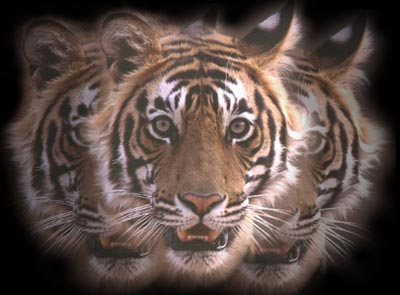
Tiger Tigers are members of the cat family, and everyone knows that tigers are the striped ones. Beyond that, however, things are not so clear. Scientists need to identify the animals specifically according to genetic makeup in order to study them clearly and completely. With tigers, that has been difficult to achieve, because while the animals exhibit some differences depending on where they live, all of them demonstrate many similarities - and all of them can interbreed with one another to produce fertile offspring. As a consequence, scientists have struggled with the details of exactly how to classify tigers. As a result the agreed upon standard separates all tigers into eight subspecies, known according to their common names based on the regions in which they can be - or once could be - found: Bali, Bengal, Caspian, Indo-Chinese, Javan, Siberian, South-China, Sumatran. Two interesting myths related to tigers are worth noting. First, we often hear the term "saber-toothed tiger." However, scientists agree that there never was a member of the tiger species with saber teeth. So, these prehistorical beasts - which roamed through many areas in which wild tigers never have been found (North America, for example) are now referred to as saber-toothed "cats." Second, white tigers are often mistakenly identified as an entirely separate subspecies, as albinos, or as the tigers that inhabit snowy regions. White tigers are known to occurr naturally only among the Bengal subspecies, when a genetic anomaly occurs in such a way that the orange pigmentation in the skin and fur fails to appear. Other than that, white tigers were originally nothing more than a set of special individuals within the Bengal subspecies - no more genetically unique than people who have blond hair. Today, white tigers have been raised in captivity and interbred with other subspecies of tigers as a result they can no longer be identified specifically as members of only the Bengal subspecies. Tigers share many behavioral traits, regardless of which subspecies they belong to: they are largely solitary and independent creatures. Tigers do not form large groups the way lions do. Occasionally tigers will form small family units, especially when a mother is raising her cubs. But aside from that, adult tigers of all the subspecies prefer to spend most of their time alone. All tigers are carnivorous predators, they all hunt live prey and eat mostly meat - an average of between 4 and 7 kg per day. But the subspecies do differ in size, and therefore, have different requirements in terms of both territory and food. After a gestation period of approximately 105 days, female tigers of all subspecies typically bear a small litter of between one and five cubs every few years, and then spend between one-and-a-half to two years raising the cubs to maturity. A life span of a wild tiger is around 15 years in the wild. Captive tigers have been known to live for 20 years or more. This is due to the fact that life is much harder for a tiger that has to hunt to survive as opposed to one that is regularly fed a balanced diet. |
 |
 |