What are "liver spots" or "age spots"?
The lentigines that develop in older adults are often called
"liver spots" or "age spots." Both terms are misnomers. While
freckles do tend to appear over time, they are not in themselves a
sign of old age. Instead, they appear on sun-exposed areas in
people who have a genetic tendency to develop them. So, they are
by no means purely a function of age.
The term "liver spots" is entirely misleading. These spots have
nothing whatsoever to do with the liver. They are just the lentigo-type
freckles that are commonly seen in older people who are or who
have been out in the sun without sufficient sunscreen.
Sometimes, older people who have these lentigo-type freckles
also have raised, brown, crusty lesions called seborrheic keratoses. Seborrheic dermatoses are also benign (not malignant)
growths of the skin. Although they are most often brown, they can
differ in color and range anywhere from light tan to black. They
occur in different sizes, too, ranging anywhere from a fraction of
an inch (or centimeter) to an inch (2.5 cm) in diameter.
The telltale feature of seborrheic keratoses is their waxy
look. They look like they have either been pasted on the skin or
may look like a dab of melted brown candle wax that dropped on the
skin. Seborrheic keratoses may occur in the same areas as freckles
but, since they are not caused by sunlight, they can also be found
on covered areas. When they first appear, the growths usually
begin one at a time as small rough bumps. Eventually, they thicken
and develop a rough, warty surface.
Almost everybody eventually develops at least a few seborrheic
keratoses since, like the lentigo-type of freckles, they tend to
become more common with age. They are sometimes referred to as the
"barnacles of old age."
How do dark freckles develop?
The sun and
sun-tanning lights emit ultraviolet (UV) rays. After
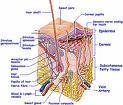
exposure to sunlight, the outer layer of the skin (the epidermis)
thickens and the pigment-producing cells (the melanocytes) in the
skin produce the pigment melanin at an increased rate. (This gives
some protection against future sun exposure.)
People differ of course a great deal in their reaction to
sunlight. To take an extreme example, there is no pigmentation in
the skin of an albino because of a defect in melanin metabolism.
On the other hand, people with dark complexions are relatively
less sensitive to sun exposure than fair-skinned persons. However,
persons with dark skin are not entirely resistant to the effects
of the sun, and they, too, can become sunburned with prolonged
exposure.
Persons with blonde or red hair are especially
susceptible since they tend to be the fairest skinned.
Irrespective of skin color, it is the uneven distribution of
the melanin pigment in the skin that results in freckling.
A
freckle is nothing more than an unusual heavy deposit of melanin
at one spot in the skin.
How can freckles be prevented?
Many people would rather not develop freckles or, if they already
have freckles, they would like to get rid of them.
Freckle prevention is obviously better than developing them and
then needing to treat them. Therefore, anyone with an hereditary
tendency to freckle -- who freckles easily -- should wear
sunscreen whenever appropriate and also minimize their sun
exposure. The aim here is twofold -- to suppress their tendency to
produce freckles and, much more importantly, to reduce their risk
of developing skin cancer.
The tendency to freckle easily goes along with the tendency to
sun-sensitive skin cancer. Freckles are a warning to people who
have them that their skin is highly vulnerable to sunburn and to
skin cancer.
How can freckles be treated? or How dark freckles may be removed altogether?
To treat freckles that are already present, several safe and
effective methods are available:
- Bleaching creams -- Products containing hydroquinone and
kojic acid can be purchased without a prescription. Higher
concentrations of hydroquinone (over 2%) require a prescription.
These products can lighten freckles if they are applied
consistently over a period of months.
- Tretinoin -- Sometimes used in conjunction with other
bleaching creams, tretinoin (vitamin A acid, Retin-A) also helps
to make freckles lighter when applied over a period of time.
- Cryosurgery -- A light freeze with liquid nitrogen can be
used to treat freckles.
- Laser treatment -- Several lasers, especially ones that
produce a green light, can lighten and eliminate freckles safely
and effectively. Like cryosurgery, this is a simple and safe
procedure with a high success rate and a low risk of scarring.