 |
 |
| In June of the same year, the school opened with thirty-five ( 35 ) kindergarten pupils. Sister Maria Pilar Prospero, who was the Superior, headed the group of pioneer Sisters. With her were Sister Victoria Dormido, Sister Matilde Cuevas and Sister Ma. Dolores dela Coronacion. Because the construction of the four-storey was not yet finished, classes were held under the roof of an old, wooden house which was surrounded by talahib grass while catechism classes were conducted under the shade of upo vines. A house was built in advance to serve as temporary residence of the Sisters. The La Consolacion School Caloocan helped in the initial construction expenses of the Academy and provided support to the Sisters.
On October 28, 1964, feast day of St. Jude Thaddeus, the papers of donation were turned-over to the OSA Congregation through Sister Pilar. Consequently, the school was formally named St. Jude Academy. The school�s first Principal was Sister Simpliciana de San Agustin ( SY 1964 - 1967 ). As principal she supervised the curriculum. Sister Matilde Cuevas , on the other hand worked on the school permit and other recognition. Because of the increase in the enrolment, ten lay teachers were hired. In school year 1965 - 1966, the Academy showed its strength in athletic and extra-curricular competitions. The Judean Volleyball girls ruled the Regional Meet and eventually became the National Champion for Secondary Level in the 13th National PRISAA held in Baguio City. Likewise, the school won a gold medal and a trophy in its first participation in the 13th BULPRISA ( Bulacan Private School Association ) English and Filipino Declamation Contest. During the school year 1966 - 1967, Sister Manuela del Redentor took over as administrator. Once again, the school represented Central Luzon and got the Gold Medal for Secondary Level in the 15th PRISAA Tula Contest. These enriching experiences of the clientele were more deepened by the leadership of Sr. Manuela del Redentor whose tenure of service started in 1967 to 1969. Sister Soledad Eamilao was appointed as Superior-Principal in school year 1969 � 1970. Under her term, the Homeroom and Grade / Year level assemblies were organized. Furthermore, the creation of the Supreme Student Council ( now Student Coordinating Body ), the Parents - Teachers Association ( now Home and School Association ) and the Alumni Association were initiated. It was also during this school year when the school paper was initially published. During the summer vacation of school year 1970 - 1971, the entire school ground was cemented. The construction of the Sto. Ni�o building and the stage was started. Moreover, new facilities and equipment were procured to improve the science laboratory. With the declaration of the Martial Law in 1972 and limitations in the budget, the construction was deferred. The school turned its attention in the upgrading of academic standard through faculty development seminar-workshop. The students were also encouraged to participate actively in cultural, athletic and spiritual activities. In the year 1971 to 1974, Sister Andrea de la Paz, was named as Community Coordinator ( Superior ) while Sister Soledad was assigned as High School Principal. Sister Thelma Catig and Sister Fidelis Paderes served in the Grade School Department during this period. Sister Andrea had to leave the Academy for a year due to (respite ) so that Sister Raquel de San Agustin took over the position of community coordinator ( 1974 - 1975 ). In the 1975 to 1977, the former sister assumed the same post and continued serving the Religious Community. As school year 1977 - 1978 started, Sister Flor A. Cordis replaced Sr. Raquel as community coordinator, at the same time the new grade school principal. While Sister Soledad continued serving the high department assisted by Sister Mercedes Rivera. With the increase of the student population in 1977, the left wing of the main building, the bungalow-type Home Economics building and the multi-purpose shed were constructed. These projects were made possible through the support of the Alumni Association, which was headed by Atty. Carmen Bautista-Lozada. In school year 1978 - 1979, a new set of administrators took over. Sister Flor A. Cordis was appointed as Directress while attended also into the needs of the religious community. Sister Mercedes Rivera became the Principal of the High School while Sister Eduarda de San Jose was assigned as Grade School Principal. During their term, the construction of the other half of the Sto. Ni�o building was started Meanwhile, Home Economics building was converted into two-storey residence of the Sisters in the Religious Community. In line with the Congregation�s acceptance of the Catholic School Systems Development ( CS-SD ) Program, the school adopted the CS-SD in 1980. The following school year, the plan to have one principal for the Elementary Department and High School Department was gradually implemented. This was also the time when the school�s Board of Trustees ( BOT ) started to function. Sister Mercedes Rivera took over the principalship. � Setting goal � had been the very words of Sister Teresita Villaluz, then religious community coordinator from 1983 to 1986. Through her motivation and creativity, together with Sister Mercedes and Sister Flor, the school underwent the First Congregational Evaluation Visit ( CEV I ). As a result, the Academy�s program had to focus more in the areas of Faculty, Instruction and Administration. In school year 1983 - 1984, a new principal was assigned by the congregation in the person of Sr. Ermelinda Sales when the CEV recommendations were in the process of growing and implementation. But due to the fast turnover of personnel in the Congregation considering greater needs in other schools another re-shuffle happened. In consonance with the achievement of relevant education and the articulation of the Charism and Mission Statement of the Congregation, a dynamic and seasoned academician � educator came by the school year 1984 - 1985 in the person of Sister Adelina Segismundo. A thorough review of the highlights and weaknesses of the CEV I gave a new direction to the goals and objectives of the school. The following became more evident: Outreach Program through catechetical instruction in the nearby public school, jail visitation by students, teachers and non-teaching personnel. Rapport between the home and the school was strengthened, continuing growth and development of the teaching staff through seminar-workshops and attendance in the graduate school was programmed. For school year 1987 - 1988 another group of OSA sisters was assigned. Sister Natividad Valera as the new principal, and Sister Brenda Fullon as the religious community coordinator. More Promising projects were at hand in line with the SJA�s celebration of its Silver Jubilee. At the disclose of the 90�s, February 11, St. Jude Academy celebrated its 25th years of existence with the theme of � SJA�s 25th years of Service for Christian Value-Oriented Formation �. This was the same year when the school attained its program for building expansion due to the increase in the students and personnel population. In the school year 1990 � 1991, another change of administration took place, Sister Maria Annunciata Piella one of the evaluators of the CEV I (1983), was assigned to be the Principal, while Sister Natividad became the community coordinator. Hand-in-hand she introduced more innovations in some areas of operation as a prelude to her vision of a good if not better assessment of CEV II. The groundbreaking of the north-wing portion of the main building (now Mother Rita building) ended her term of office as SJA Principal. In 1992 - 1993, through the given thrust of rendering a Filipino-Christian education and inspired by the total quality management (TQM) of Sister Francisca Montesa as the new principal, SJA gathered enough courage and determination to work for voluntary accreditation. On February 14-15, 1994, the school successfully passed the Congregational Evaluation Visit (CEV II). Sister Esperanza Marasigan as the community coordinator joined Sister Francisca in exercising the concept of transformational leadership. Because of the fast turn-over of personnel in the Congregation, school year 1995 - 1996, Sister Rosalinda Bayla came in as the new school principal where the ground-breaking of the Sto. Nino building started. Sister Patricia Martinez was then the community coordinator. In year 1996, the immediate supervision of the school was entrusted to Sister Celia Bayona who since her appointment in that year up to 1999 had proven the veracity of the Congregation�s appointment through the improvement undertaken in the different areas of school operation. With her strong leadership, different physical renovations had been done: the completion and blessing of the new Sto. Nino building, the school chapel, comfort rooms, Instructional Media Center and the new Home Economics building. Sr. Ester Maria Alunan the newly assigned religious community coordinator and OIC � MRBCC was also tasked to continue the work of the school�s outreach program. SJA had redirected a new leadership concept where its management style is team approach, which at the same time focused on lay empowerment � as provision for training of lay administrators. Through their leadership too SJA held its PAASCU Preliminary Survey Visit on November 1997. The school received satisfactory results of the said visit and was given a period of one year to work on the accreditor�s recommendations. In school year 1999 - 2000, Sister Celia left for Rome for a mission work. A set of re-assigned Religious came over to attend on the continuity of the growth and development of the school. Sister Flor Cordis assumed again the responsibility of a school head of SJA ,Sister Ma. Salvacion Taton as the community coordinator and school treasurer, and Mother Teresita Villaluz, ( the seventh Mother General of the ASOLC ) assigned as OIC of two offices - Physical Plant and MRBCC, and at the same time as school consultant. With their first term of office the high school department had its first PAASCU Formal Survey Visit on November 16-17, 1999, while the grade school department held its First Formal Survey Visit on November 21-22, 2001. Their teamwork was the force behind that motivated everybody to work harmoniously for PAASCU accredited status of SJA. With that enthusiasm and commitment to service shown by the school constituents, the school passed the First Formal Survey Visit successfully. One of the highlights to be put into action was the Jubilee 2000 Agenda. In school year 2001 - 2002, Sister Salvacion had to leave the school due to needs in other school. Mother Teresita is the current community coordinator. Religious administrators come and go, yet the primary aim of SJA for quality education must develop continually through a very strict selective admission and retention policies. By the turn of the Third Millennium and with the government�s vision of Philippine 2000, SJA as a Catholic institution is challenged with the task to improve its objectives. The advancement and redirection of SJA could be attained through the commitment of personnel. |
 |
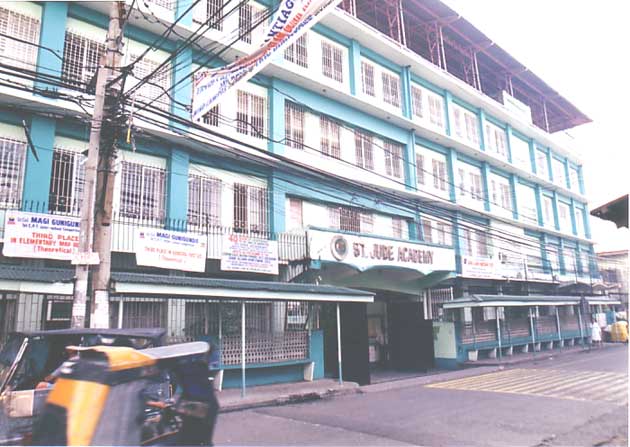 |
| In 1963, Don Pastor Constantino of Polo, Bulacan ( now Polo Valenzuela City ) donated a 3, 000-square meter lot to the Augustinian Sisters of the Philippines. The lot is located in Malinta Village Subdivision. From this donation, the Congregation acquired four more lots adjacent to this at eight pesos per lot. This generous gesture of Don Pastor Constantino unknowingly marked the beginning of a relevant institution that was to become the instrument of God to sow the seeds of living faith of the compassionate Christ in a community of friends. |