 |
|
Fitting Hyperopia into The Congruency Theory
Why are
some people myopic while others are hyperopic?
As stated elsewhere, I believe that the root cause of refractive errors in human beings and animals alike is tension. This is the short answer. Tension in and of itself, however, is a complex issue that touches many aspects of our lives. Improper use of the body, for example, leads to physical tension, and physical tension leads to mental tension. Likewise, improper use of our emotional and spiritual bodies leads to emotional and spiritual tension, which in turn, leads to physical tension. You can see how all these things are interconnected and interrelated. Like a person's right hand -- you only have one right hand (I hope), but a closer looks shows that there are five fingers attached, and this hand is attached to an arm, and the arm is attached to the shoulder, and the shoulder is attached to the body, etc. Panning back from tension shows a wider and much more complex issue.
Everyone is Beautiful
Like the songs says, everyone is beautiful in their own way, and this is because we're all unique. I'm continually amazed at the fact that with more than 6 billion people on the Earth, no two people have the same exact set of fingerprints or ears or retinas or personalities. Even identical twins, who share the same DNA, have different fingerprints. (And no, I'm not addressing the issue of clone in all this!) Sure, some people have similar looks or personalities, but no two are exactly alike. And this goes for the billions of people who have lived on the Earth since the beginning.
As a result of our unique individuality, I would guess that no two cases of myopia or hyperopia are exactly the same, either. Though the root cause (tension) and the root cure (complete relaxation) may be the same, each person has a different combination of factors that leads to refractive errors.
For example, some people may experience less emotional tension because they're able to "vent" their feelings more freely than someone else. Because of their particular line of work or the way they use their body, however, this same person may have a great deal of physical tension. On the other hand, another person may internalize all of they're negative emotions which thus leads to a great deal of latent mental tension. On the outside, however, this person appears to be carefree and otherwise very "relaxed", but inside there is a different story being told.
In addition to this different combination of factors, all of our bodies come in different sizes and shapes. Some are big, some are little, some are wide, and some are narrow. Not surprisingly, though, we all have a tendency to look somewhat like our parents. In other words, physical traits are passed down the line.
So, why is it, then, that some people become myopic while others become hyperopic? I pick up the story where Dr. Bates left off.
Dr. Bates taught that refractive errors are caused by tension in the extraoccular muscles (EOMs), which control the movement of the eye. The EOMs are three pairs of short but strong muscles that are attached directly to the outside of the eyeballs and allow you to move your eyes in all different directions.
Remember that myopia results when the eyeball is elongated, and hyperopia results when the eyeball is shortened. If, according to Dr. Bates, the eyeball is elongated by tense EOMs to create myopia, what about hyperopia? Is the eyeball somehow being contracted or otherwise shortened by the EOMs? Not in my opinion. Personally, I don't believe that the EOMs affect eyeball shape in anyway. I believe that the EOMs may experience residual tension from disuse as opposed to misuse.
In my opinion, the overriding determining factor of eyeball shape is the shape of the orbicularis oculi. If this muscle is round, then your eyeball will be round. Conversely, if this muscle is oval, then your eyeball will be oval, too.
Bates addressed eyeball shape along the X-axis -- from the front of the eye to the back of the head. But what about the Y and Z axes? As we don't live in a one-dimensional world, clearly there is eyeball shape distortion along the Y-axis, from the top of the head to the bottom of the chin, and the Z-axis, from one side of your head to the other. This is important to understand.
As stated above, body makeup and body shape is passed down from generation to generation. Generally speaking, my physical body looks like a combination of my parents' bodies. When I look at my eyes, I think, "Wow, I can see my Mom" and when I look at my hands, I say, "Wow, I can see my Dad", etc. This goes for face shape, as well -- though not a duplicate of my parents, the shape of my face developed within certain genetic boundaries that were passed down from my parents.
 Depending on the shape of one's face, I believe a person is predisposed to develop either myopia or
hyperopia. Again, generally speaking, myopic parents have myopic children, and the same is true for hyperopia. It's rare that myopic parents have hyperopic children, and vice versa.
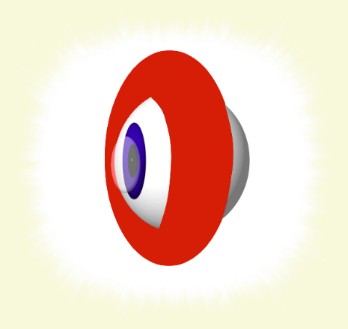
Imagine that the image to the right is that of a person who doesn't need glasses. This is their left eye. Notice the roundness of the eyeball, and notice how the eyeball protrudes through the middle of the orbicularis oculi muscle.
When there is chronic tension in the face and upper body, specifically the mouth, jaw, neck and shoulders, then the face is not completely relaxed or at rest. When this happens over a long period of time, the muscles are shortened and the round shape of the orbicularis oculi muscle is altered. Such a change occurs primarily along the Y-axis, along an imaginary line from the top of the head down to the feet.
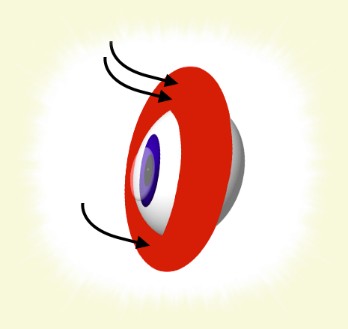
It is important to understand, however, that in either case, muscles tension is downward for both myopes and hyperopes. Hyperopia contains a downward-inward tension, whereas myopia contains a downward-outward push. This is why hyperopes benefit equally well from relaxation, as do myopes. Their eyeballs have been pushed in a different direction (inward instead of outward), but the root cause of their refractive error is ultimately the same. 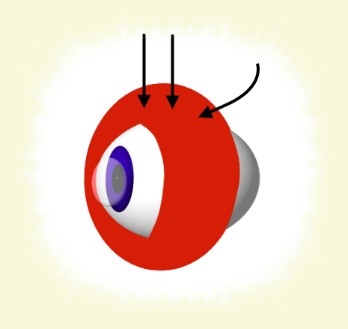
Likewise, the ultimate solution is the same, as well -- change the shape of the orbicularis oculi, and you will change the shape of the eyeball.
Continue to check back for
updates.
DISCLAIMER: The
information presented on this website is for
informational purposes only.
|


