 |
The Five Principles of Myopia
Principle
#1: Problems in the eye do not originate in the
eye.
The key to
understanding the mystery of myopia begins by
looking for it in the right spot. If we're not
looking in the right spot, then we'll never find
the complete problem. To illustrate, let's
suppose that a friend of yours calls you up and
says, "Come on over to my house. I've hidden
a hundred dollar bill somewhere in my living
room, and if you can find it, you can keep
it." Sound intriguing? I think I need more
friends like that! Now suppose that after tearing
your friend's living room apart for two hours,
you finally give up. In tired desperation, you
ask your friend where the money was hidden, and
he or she says, "Well, actually, it wasn't
hidden in the living room. It was in the kitchen
under the sink." Punch now, ask questions
later.
In my opinion,
this same thing happens with myopia. Since myopia
and other refractive errors are manifested
through the eye, we assume that the problem is in
the eye. No, no, no! Don't forget what they say
about people who assume. While there is
definitely a problem in the eye, we erroneously
assume that the problem has it's roots in the eye
as well. This is where I break from conventional
thinking regarding the cause of myopia. Not all
problems have visible roots or at least roots
where we think they ought to be. This is key.
Just like the weeds in your lawn and garden have
hidden roots, the roots of myopia are hidden and
are not located in the eye. If you cut off a weed
without pulling it out by its roots, then you
will enjoy only temporary and limited success.
The eye is much
like an innocent bystander that was in the wrong
place at the wrong time. Just like the
law-abiding citizen who is hit by the negligent
driver running the red light or the small child
who is injured by a stray bullet, the eyes are
susceptible to refractive errors because of their
location and physiology. As strange as it may
sound, if your eyes were a nose, you wouldn't
need glasses.
Your nose works
regardless of its shape. Even if you push your
nose upward of downward or to one side or the
other, you can still smell things with it. In
other words, your nose works independent of its
shape. Eyes, however, don't work like this.
Principle
#2: Good Vision is a Function of Eyeball Shape
How well your eyes
work largely depends upon their physical shape or
their roundness. Eyes that see well without
glasses are more or less round in shape. When the
shape of the eyeball changes, however, then so
does the vision.
Let's take a quick
moment to review how the eyes work.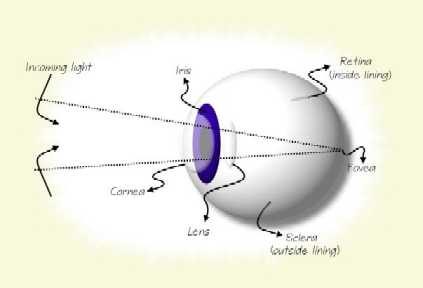
As you already
know, the eye is a complex light-sensitive organ
that is capable of distinguishing tiny variations
in size, shape, color, brightness, and distance.
The function of the eye is to translate light
energy into nerve impulses, which are then
transmitted to the brain for interpretation.
The eyeball is a
spherical structure with a pronounced bulge on
its forward surface called the cornea. Though it
has no internal blood supply, the cornea has a
remarkable capacity for self-repair and
regeneration. When scratched, for example, it is
capable of repairing itself in a matter of hours.
The cornea is actually a transparent lens that
provides the main focusing power for the eye.
When light rays from all different angles hit the
cornea, they are bent inward toward the interior
of the eye. On the microscopic level, the cornea
has five different layers. The top layer of the
cornea is constantly being removed by blinking
and replaced by deeper cell layers.
The main body of
the eye is filled with a jelly-like substance
called vitreous humor, which is enclosed in a
thin sac. The outer part of the eye is composed
of three layers: the outside layer is called the
sclera, the middle layer is called the choroid,
and the innermost layer is the light-sensitive
retina.
Separating the
cornea from the lens is a small chamber filled
with a clear, watery fluid called aqueous humor.
Funny, but I bet you didn't know the eye was so
"humorous" (ba da ba, crash!
"Thank you very much, I'll be here all
week...!")
The lens is a
flattened sphere constructed of transparent
fibers arranged in layers. It is connected to the
ciliary muscle, which flattens the lens or makes
it more spherical to change focus. The colored
iris is behind the cornea and in front of the
lens. It has a circular opening, the pupil, in
its center. A muscle around the pupil's edge
makes it larger or smaller depending on the
available ambient light: in bright light, it
contracts (gets smaller) to protect the retina,
and in dim light, it dilates (gets bigger) to
allow more light into the back of the eye.
The inside lining
in the back of the eye is called the retina. The
retina is composed of light-sensitive receptor
cells packed closely together. Individual cells
are divided into two groups called rods and
cones. Directly behind the pupil is a small
yellow-colored spot on the retina that is the
area of greatest visual perception called the
fovea centralis.
Incoming light is
focused twice -- once by the cornea and then
again by the lens. When the eye is more or less
round and the light is focused properly, the
light rays converge to a single point on the
fovea. When this happens, the vision is clearest.
When the eyeball is oddly shaped, however, then
the focal point of the incoming light misses the
fovea and blurry vision results.
When the focal
point of incoming light falls short or in front
of the fovea, such vision is considered myopic or
nearsighted. Generally, people with myopia see
near objects better than they do distant objects.
Conventional science attributes this to the fact
that the eyeball has grown too long, but I don't
fully agree with this conclusion. In a little
while, I'll explain why.
When the focal
point of incoming light would actually fall
beyond or in back of the fovea, then such vision
is considered hyperopic or farsighted. Generally,
people with hyperopia are able to see distant
objects better than they do near objects. Again,
conventional science attributes this to the fact
that the eyeball is too short. While this may be
true, I will explain why eye length can actually
change.
When the eyeball
is oddly shaped, it's possible to have multiple
diverging shafts of incoming light. This
condition is described as astigmatism, where
perhaps objects both near and far may appear to
have multiple images.
To recap, good
vision is a function of eyeball shape or contour
-- how round or spherical the eye is will
determine how well the vision will be. Our goal,
then, is to understand what governs eyeball shape
and how to change it. To do this, we must first
understand muscle tension.
Principle #3: The Mind
and Body are connected
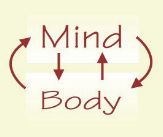 .
.
Myopia is a whole
body problem that requires a whole body solution.
Also, few people ever become myopic overnight;
generally, a person becomes myopic slowly over
time. Remember, slow and steady will always win
the race over fast and furious. Consider the
incredible potential for change within a single
drop of water -- drop by drop, over time, even
the hardest rocks can be smoothed by something as
soft as water. This is how myopia develops,
slowly over time, and likewise this is how it can
be reduced or eliminated.
Generally
speaking, we are conditional responding beings.
Like Pavlov's dog, we are conditioned to respond
physically and emotionally to different
situations in very predictable ways. Over time,
we have been conditioned to respond to different
sights, sounds and smells to ensure our personal
safety and wellbeing. Long before a child or
adult ever receives their first pair of glasses
or contacts, they started practicing a myopic
response to different situations, and the longer
this myopic response to the world is practiced,
the higher potential myopia a person may have.
Just like a
computer, people are made up of two sides:
hardware and software. Hardware consists of the
physical you -- your skin, bones, muscles,
tendons, hair, teeth, blood, etc. -- all the
stuff you can physically touch, hold, weigh, and
measure. The software consists of the spiritual
you -- your spirit, mind, emotions, feelings,
consciousness, awareness, character, passions,
etc. -- all the things that can't be measured in
a laboratory but combine to make the Real You.
These two sides of
a person, the hardware side and the software
side, are connected. Sometimes people refer to
this as the Mind-Body connection or something
similar. By simply thinking or hearing certain
things, we can have a physical response. This was
proven by by Dr. Pavlov, for which findings he
won the Nobel Peace Prize in 1904. Conversely, by
doing certain things with our physical body, we
can generate an emotional response. For example,
if you've ever been depressed, sad or bored, your
body and face look and feel a certain way.
Basically, if you're feeling sad, you might have
a frown on your face, your shoulders might be
hunched, and your body might be slumping over
generally. When you're happy, on the other hand,
your body looks and acts differently -- you feel
energized and awake, you might have a smile on
your face, and you look and act a little taller
than usual. The great secret to all this is that
our emotional response to a given situation is
hard-coded into our physical bodies.
Did you ever feel
happy about something, but forgot how to smile?
Or did you ever see something funny on TV but
ended up frowning by accident? Generally
speaking, emotional patterns of behavior lead to
predictable physical responses and vice versa.
When you're happy, you smile, and when you're
sad, you frown. No one has to be taught how to
smile or how to frown -- we are all born with
this innate understanding and capability.
Conversely, if you're feeling sad and you decide
to stand up as tall as you can and put on a big
smile, you will instantly start to change the way
that you feel emotionally.
Principle #4: Tension
changes the shape of your body, and the shape of
your body determines the shape of your eye.
Tension is defined
as the act or process of stretching something
tight, or the condition of being stretched tight.
The word tension itself comes from a Latin root
which means "to stretch out." Stress, a
close relative of tension, is similar in meaning:
an applied force or system of forces that tends
to strain or deform a body. Basically, when you
experience tension and/or stress, shape of your
emotional and physical bodies is being changed.

When you're happy,
how does your body and mind feel? Light? Buoyant?
Agile? Weightless? When under stress, however, do
you feel the same? Probably not. When you're
"stressed out", perhaps you feel heavy,
weighed down, encumbered, and burdened. When
describing these two different situations, it's
important to realize that both the physical and
emotional/spiritual bodies will experience
similar feelings. In other words, the mind is
capable of feeling as equally light or heavy as
the physical body.
By definition,
tension leads to contraction, both physically and
emotionally. Under extreme stress, your body may
feel tight and unable to move freely. The mind
will experience a similar condition -- you might
feel constricted, stuck and compressed in your
thinking. The body is designed to handle a
tremendous amount of stress but only for short
periods of time. The body, however, does not do
as well at handling a thin layer of stress spread
over a long period of time. When this happens,
then long term effects normally result. Remember,
slow and steady will always win against fast and
furious.
Have you ever
braced yourself for some kind of shock? How did
your body respond? Did you tighten up or were you
completely relaxed? Why is that drunk drivers
have an amazing survival rate in high speed car
crashes? One reason is because their physical
bodies are relaxed. Relaxation = flexibility. If
a person in a car sees that they are about to
crash and they tighten up their body, these are
the ones who experience the most broken bones and
internal damage.
Muscles contract
in only one direction -- they only get shorter
when in use. Muscles don't
"un-contract" or "re-extend"
themselves automatically after use. The only way
a muscle that has contracted is restored to its
full length is if the muscle first relaxes.
Muscles normally work in groups or pairs. Take
the biceps (front upper arm) and triceps (back
upper arm) for example. When you grab a glass of
water and bring it up to your mouth, you're
flexing or contracting your biceps. Once you've
finished spilling the water all over your shirt,
then it's time to grab a towel and dry yourself
off. For you to bring the glass down, however,
your biceps have to first relax and then your
triceps take over to straighten out your arm.
Muscles that are
chronically tense become chronically shortened.
And no muscle is an island -- you are made up of
hundreds of muscles that are all attached. Like a
series of highways, you can quite literally start
at the top of your head, and move down to your
toes connecting individual muscles or muscle
groups to each other. It is this connection that
allows our bodies to move in so many different
directions.
Do you remember
that "game" while lining up in
elementary school? Someone, normally one of the
bigger kids, would hit the person next to him (or
her) and say "Pass it down". So before
long, everyone down the line, one by one, gets a
punch in their arm. Boy, that was a fun game,
wasn't it? Muscle tension plays this same
notorious game in the body. Muscle tension may be
localized to one central spot, but all
neighboring muscle groups will feel it's effect,
too. When one muscle tightens up, no matter how
slightly, the muscles that are attached to it
will feel a slight tug on themselves as well.
When it comes to muscle tension in the body, it
gets passed down the line.
As we've said
before, whatever is going on in the body was
first or will eventually become what is going on
in the mind. The mind affects the body and the
body affects the mind. As Dr. Bernie Siegel aptly
put it, the body is an expression of the mind. If
the mind is tense, the body will likely become
tense as well.
When people live
in a chronic state of tension, then their
physical and emotional bodies become chronically
contracted or compressed. They become inflexible
and rigid. Tension is felt in the eyes, face,
jaw, shoulders, back, and legs. Virtually the
entire body has become compressed. Perhaps you've
seen myopes whose shoulders are hunched and whose
necks are "bent" forward. This is a
direct result of muscle tension and body
compression.
And when this
happens, the eyes change shape.
Principle #5: Eye length
is a variable, not a constant.
As stated before,
myopia is a total body problem. When the body is
compressed with chronic tension, the body changes
shape, and when the body changes shape, then so
do the eyes.
One thing that
other NVI authors point out is that people with
myopia normally have tension in their shoulders.
The order is wrong in this statement, however.
Instead, people with tension in their shoulders
normally have myopia. Remember, the tension is
what drives the myopia, not the other way around.
Now, we come to an
important, defining point to all of this. How
does body shape affect eyeball shape? As I've
stated before, I strongly believe that eyeball
shape is a variable that can be changed and not a
constant. Conventional science states that a
person is myopic because their eye has grown too
long, but this makes no sense to me. By virtue of
its physiology and structure, the eyeball can
change shape when the body changes shape.
Attached to the
eyeball are three pairs of muscles that cause the
eyes to move in their sockets. Dr. Bates taught
that tension in these muscles, known as the
extraocular muscles or EOMs, is what distorts the
eye and leads to refractive errors. I disagree
with this assertion. I believe that the EOMs
function to move the eye and have no impact on
its shape.
One of the biggest
keys to understanding my theory of refractive
errors is the placement of the eyeball in the
face. From a profile, you'll notice that the
eyeball actually protrudes just a bit from the
face. Surrounding the eyeball is a big round
muscle called the orbicularis oculi (orbicularis
meaning round or spherical, and oculi meaning
eye). The eyelid is actually part of this muscle.
When older people get bags under their eyes, you
can actually see the outline of this muscle.
Do you remember
making funny faces as a child and your parents
saying, "Don't make faces like that or else
your face will grow that way." Sounds crazy,
but your parents were right. It's true that over
time, a person's facial expressions get carved
into their face, and the position and length of
these facial lines tell a story.
In the face, there
are essentially two basic areas that work to
express emotions: the eyes and the mouth. There's
a reason why the eyes are called the window to
the soul -- you can tell a lot about how a person
is feeling just by looking at their eyes. The
other area is the mouth. With the mouth, we not
only speak, but we can smile, frown, curl the
lips, etc.
When a person is
under stress, a common place tension to be stored
is in the jaw, mouth, and chin. It is so
important to express emotions to others, whether
directly in person or on paper. Otherwise, these
unexpressed emotions have a way of
"storing" themselves in different spots
of the body. Unresolved fears and hurt seem to
get stored in the chin -- have you ever seen
someone's chin quiver because they were afraid or
upset? Resentment and anger seems to get stored
in the jaw -- have you ever seen someone clench
their jaw when they're angry? Effort and trying
seems to get stored in the mouth and tongue --
have you ever seen someone making a great effort
of some kind and their tongue sticks out of their
mouth or their lips get pursed together?
Over time, if
these above tensions persist, then the muscles in
the face and neck will become chronically
shorter. When this happens, the facial muscles
are actually pulled downward. Some of the
strongest muscles in the body are in the jaw. The
muscles in the forehead, around the eyes, and in
the cheeks are no match for the strong jaw
muscles.
Dr. Bates noticed
this same phenomenon taking place when he took
pictures of people who exhibited facial tension.
After practicing relaxation and other vision
promoting activities, the facial expressions of
these people changed to appear more relaxed over
all. This is because the facial muscles
themselves are relaxing, not simply the
extraocular muscles attached to the eyes.
The face is a
microcosm of the entire body. Emotions expressed
in the face are also expressed in the body at
large. Likewise, when there is tension in the
body, there will likely be tension in the face.
And when there is tension in the face, then the
shape or roundness of the eye are susceptible to
change.
With prolonged
tension in the face, especially in the mouth,
chin, and jaw, the shape of the orbicularis oculi
muscle is changed. Normally round, it becomes
flattened and oval. Under the weight of the
falling orbicularis oculi muscle, the eye is
pushed out of shape. The eyelids and eyebrows of
myopes look different from those of emmetropes or
people who don't need glasses. In the myope,
there is an extra build-up of skin directly above
the eyes. This is because the face has quite
literally been pulled downward. When this
happens, again, the downward pull of the
orbicularis oculi pushes the eyeball out of
shape. Depending on physical makeup, this
downward pushing on the eye could lengthen it or
shorten it. When the downward push lengthens the
eye, myopia results, and when the downward push
shortens the eye, hyperopia results.
Like innocent
bystanders, the eyes did not produce the problem
they are being accused of. Instead, they have
been misshapen by the collapsing orbicularis oris
muscles that surround them.
Removing the
tension will naturally lead to better vision.
When tension is relieved, muscle length
increases. When this happens, the facial muscles
will change their resting shape, especially the
orbicularis oculi. When the orbicularis oculi
muscles become more round, then so do the eyes.
This is why a face or scalp massage can actually
relieve tension felt near the eyes and improve
the vision. Tension described as being
"in" the eyes is normally tension that
is actually "around" the eyes.
Eye doctors know
that there is a difference in the progression of
myopia between glasses and contacts. Generally,
myopia becomes worse faster when glasses are
worn, and with contacts, the rate of myopia is
actually slowed down a bit. When asked why, eye
doctors will tell you that it has to something to
do with the fact that the contacts are sitting on
the cornea and they help to maintain a smooth
shape or something like that. I don't believe
that. I believe that the weight of the glasses
actually pull the center of the face downward,
namely the orbicularis oculi muscles. The heavier
the glasses, the stronger the pull. With
contacts, however, there is no such downward
pull. The face is free from the downward force of
glasses, and the orbicularis oculi muscles do not
have this added force to contend with.
A while back,
there was a vision improvement program called
Vision Freedom. One of the steps in Vision
Freedom was to raise the eyebrows and blink the
eyes while reading. As a customer of Vision
Freedom, I practiced this type of reading for
several months. It took a while for me to
realize, however, that this exercise was actually
reshaping my orbicularis oculi. The muscles that
raise the eyebrows are different from the
orbicularis oculi. By lifting the eyebrows and
blinking in a relaxed manner, I was actually
relieving tension around the eyes. Once this
tension was relieved, then the muscle changed its
resting shape, and once the orbicularis oculi
muscle changed shape, then so did the eyes.
I will have much
more to say about the causes and cures in the
future. For now, this is kind of shotgun approach
to get the reader introduced to my theory of
myopia.
Why, then, is the
theory called the Biomechanical Congruency
theory? Biomechanics is primarily the study of
forces exerted by the muscles and gravity on the
human body. When these forces are exerted in
specific ways over long periods of time, the
shape and length of resting muscles actually
change. Again, chronically tense muscles become
chronically shortened in length. When this
happens, the body actually becomes incongruent or
out of alignment. Forces are exerted where forces
should not be exerted. For example, there should
be zero force exerted on the orbicularis oculi
muscles. When a downward force is exerted on
these muscles, however, then the muscle shape is
changed, and the net effect is a change in the
eyeball shape.
Stay tuned as I
will be adding much more material and information
to this website in the coming weeks.
DISCLAIMER: The
information presented on this website is for
informational purposes only.
|


