Bubble Tower Problem
Last update: 12/16/08 10:51 pm
The following problem is taken from "Calculus 5th Edition" by James Stewart, Chapter 4, Problems Plus, page 313.
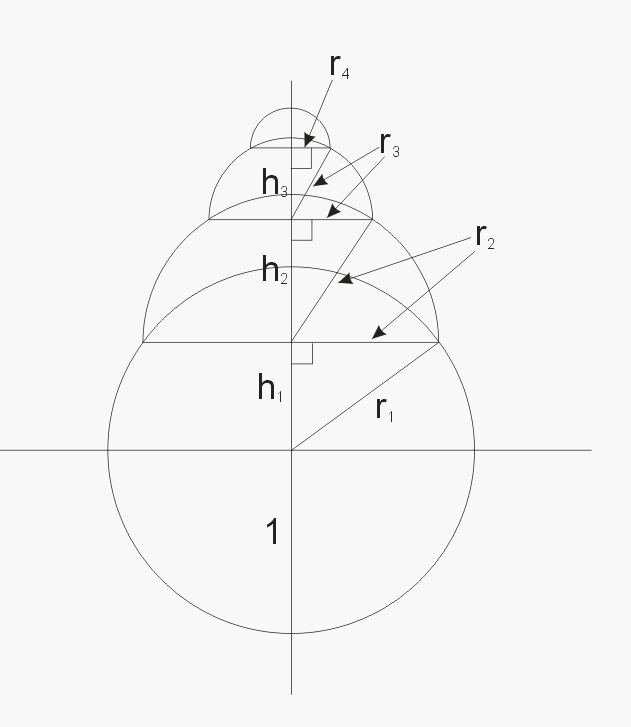
A hemispherical bubble is placed
on a spherical bubble of radius 1. A smaller hemispherical bubble is then placed
on the first one. This process is continued until n chambers, including the
sphere, are formed. (The figure below shows case n = 4.) Use Lagrange multiplier
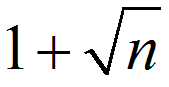
method to show that the maximum height of such tower is
 .
.
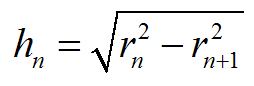
Every hn can be defined according to the following formula:
Note the following relationship, its importance will become apparent later:
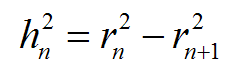 [1]
[1]
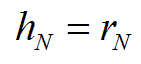
The radius of the last hemisphere is also the last hn:
From [1], we can expand the expression for rn as follows:

Let's consider the case for r1:
 [2]
[2]
From [2], we have just established the restriction for the sum of all hi.
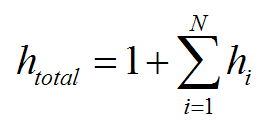
The height of the tower will be defined according to the following formula:
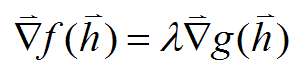
From multivariable calculus, we know that using Lagrange multiplier method, we can optimize a function of several variables. Briefly, Lagrange multiplier is a scalar such that:
 [3]
[3]
In [3], g(h) is the function that introduces restriction on the arguments of f(h). One can differentiate f(h) with respect to every variable, then differentiate g(h), equate the resulting vectors with proviso that second vector is multiplied by lambda. From the series of equations that result, one can express the arguments of f(h) in terms of lambda and then substitute the resulting representations in the equation for restricting function. That equation can be solved for lambda. Having solved for Lagrange multiplier, one can use its value to solve for optimal value of each argument for f(h). Substituting these values into expression for f(h), we obtain its maximal value.
In our case, the restricting function looks as below:

And the f(h) looks as follows:
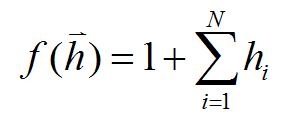
Carrying out the protocol to compute Lagrange multiplier, we get the following results:


Equating the results of differentiations, we have:
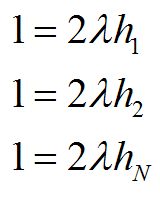
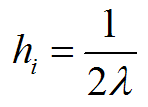

Expressing hi in terms of lambda, we have:
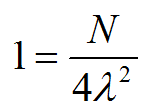
Finally solving for lambda, we obtain:
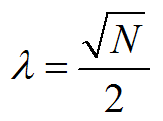
Substituting lambda as below, we obtain the expression for optimal value of hi:
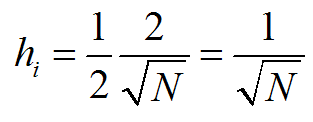
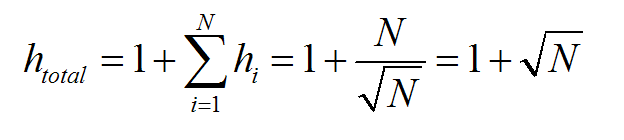
Finally, substituting into the original expression for the height, we obtain the sought-after result: