|
|
 |
|
quarterly publication for Bantoanons |
|
|
|||||
 |
 |
Yagting Connection |
by: Ryan Fauli |
|||
When
I was in Banton last Holy Week, I did a preventive maintenance to our personal computer.
As I was scanning all the files, a filename tunggo.doc caught my attention. I opened
it and I found out that it is a poem encoded by my mother – huh! She knows now how to
operate the PC using Microsoft Word. It is a beautiful poem with personal touch and one of
the many Bantoanon poems she had written. Below is the poem describing Bantoanons’
virtue of frugality and ingenuity.
For our text
generation youths here is an added trivia about tunggo. It is an irregularly shaped
naturally formed concave in a flat-surface rock – prevalent or trademark of Banton
– that can hold sufficient amount of water good for household consumption. Usually
the smaller tunggo can collect rainwater more or less ten liters and the bigger ones can
collect many gallons. When I was a child, I used to float paper boats in my
grandmother’s tunggo in Guyangan. She had four tunggos that can collect rainwater
suitable for a week’s consumption. Water then in Guyangan was as precious as
matchstick and kerosene. When there is no rain you have to fetch water one kilometer away
to our open well in Sitio Bugo, Barangay Toctoc. Just imagine how our ancestors living in
Guyangan survived when the island was hit by a year long drought. During those times
there were no plastic containers for fetching water. The mode of fetching water was by
bamboo pole usually five to six feet in length and six inches in diameter. The way
of the cross was literally carried on by them in another fashion – the way of the
bamboo pole - an uphill climb not just for a day but for the whole span of their lives. Going
back to tunggo, do you know that not only our ancestors depended on this natural rain
collector but also animals and birds? From the smallest mosquitoes to birds especially the
crow to the water consuming beasts like cows and carabaos – they are also aware of
existing tunggos in a particular place. So what our forefathers did, they fenced the
surroundings to protect the tunggos from these animals. Nevertheless, the crow will always
be farmers’ enemy number one. In the cornfields it is annoying, much so in the barn
when the hen had a week-old hatchlings, and more, as a partaker of tunggo water. Ever
heard of an idiomatic expression – ligong uwak? I
had the opportunity or shall I call it an ethnic privilege to taste and drink a natural
mineral water fetched from a tunggo. Even though I personally float paper boats in
it, it is only peanuts compared to all the foreign materials floating above, swimming and
crawling underwater sans the decaying leaves fallen from trees. Name it you have it:
tadpoles – anyway this is an exotic delicacy when it becomes a matured frog; beetles,
house lizards – anyway these can be found in tuba untold by mayanggiteros and
unminded by tuba drinkers; mosquito wrigglers – just an ordinary thing for barrio
folks, during those times there was no dengue fever; earthworms – not as nasty as you
think, it is used as substitute for meat nowadays; fallen feathers of birds – no
worry, I never heard of a bird’s flu epidemic in the island. For all these creatures
that depend on tunggo water and co-exist with our forefathers, still they are an envy to
me (our forefathers not the creatures). They lived a long life as attested by our
grandparents who are still alive today in Banton. Do you have grandparents in their
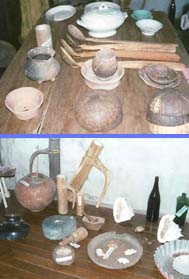
sixties or seventies? Ask them about tunggo, pasok, panligis, sagurang, tikudan and many
more. These are the things of the past yet very dear to them. As my mother calls it -
katumoy it pangabuhian – companions in life
|
||||
Picture |
||||||
 |
||||||
|
||||||
|