|
Learning Center on Caribbean Weather and Climate |
Forecaster Training |
Back to Weather organizations - CIMH
by Dr. Colin Depradine, the Principal of the Caribbean Institute for Meteorology and Hydrology (CIMH). (The article was originally published in "The Advisory", The 35th Anniversary Edition of the CIMH, 2002.)
In the context of this article, the Caribbean refers to the English-speaking Caribbean countries.
During the 1940’s and into the 1950’s, there were three forecast offices in the region located in Jamaica, Trinidad and Tobago and the Bahamas. These countries, at the time, were all colonial dependent territories and the Directors and forecasters of the meteorological services were from the United Kingdom. The meteorological observers were from within the region.
The three forecast offices and the meteorological services in the other islands were linked together under the umbrella of the British Caribbean Meteorological Service (BCMS), with its headquarters located in Trinidad and Tobago. The Director of the BCMS was Mr. W. A. Grinstead and his Deputy was Mr. K.V.W. Nicholls, both from the U.K.
The first effort to train forecasters (Class II) in the region was conducted around the mid-fifties for a group of six observers. These were J. Lee and M. Nancoo (Trinidad and Tobago), J. Blake and H. Crosdale (Jamaica) and N. Small and K. Richardson (Bahamas). The course was run by Mr. Nicholls and five of the participants were successful. Training for observers was conducted through in-house instruction from experienced observers in the forecast offices, and included participants from the other islands. The best known of the observers who were trained in Trinidad and Tobago was Mr. Harcus Charles who was from the meteorological office in Grenada and who later became the principal instructor in the observer training courses at the Institute.
The second forecasters’ course was held in 1960, by which time the BCMS had become part of the West Indies Federation. This course was offered for two groups. The first group comprised D. Best (Barbados), M. Lett (Trinidad and Tobago) and a third Trinidad and Tobago participant who did not complete the course, but switched to medicine. At the end of the course, Mr. D. Best went on to work in the Bahamas.
The second group comprised of J. Daniel, E. Berridge, J. Jackman and A. Shah (Trinidad and Tobago), C. Evans (Jamaica) and E. Tynes (Bahamas). The course for the first group, all of whom had “A” level Mathematics, lasted nine months and for the second group eighteen months.
In the meantime, Messrs D. Vickers (Jamaica), G. Rudder and A. Smith (Barbados) and others who had graduated from the UWI with B.Sc. degrees in Mathematics and Physics had journeyed to the British Meteorological Office Training College to do the Initial Forecasters’ Course. These were followed by others who took the Scientific Officers’ course, including the present Principal of the CIMH. While these were good courses, they did not emphasise the meteorology of the tropics.
Two further courses were held (circa 1964/65) in the region. One was conducted in Trinidad and Tobago by Mr. Arvind Shah for Messrs S. Pollonais, E. Henry and others, and a similar course was conducted in Jamaica, primarily for personnel from the Jamaica Meteorological Office, by Mr. M. Nancoo. Mr. Peter Drakes from the Barbados Meteorological Office attended the latter course.
In the mid-to-late 1960’s, several of the forecasters who had been trained in the locally organised courses, were awarded fellowships by the WMO to attend the Florida State University to pursue B.Sc. degrees in Meteorology.
Around this time it was proposed by the regional governments that a formal training Institution for meteorological personnel should be established in the region. A survey by the World Meteorological Organisation had indicated that there would be a need for about two hundred persons to be trained to meet the needs of the meteorological services.
Funding for the proposed Institute was obtained from the UNDP and the project executed by the WMO. The Institute was officially opened in Barbados August 1967.
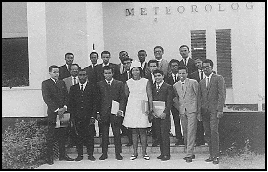
The first forecasters’ (Class II) course at the Institute was conducted by Dr. M. Lateef, the WMO expert, and lasted for two years from 1968-1970. There were seven participants on the course. These were K. Narayan, S. Khan and K. Singh (Guyana), K. Sylvester (Trinidad and Tobago), L. Moncrieff and W. Freckleton (Jamacia) and A. Smith (Bahamas). Mr. Narayan later took postgraduate studies in hydrology and is now a Hydrologist on the CIMH staff. The second course commenced in 1970 with 11 participants. These graduated in 1972 and among them were Mr. S. Burton who is now Chief of Data and Information Services at the Institute and Mr. Tyrone Sutherland, the Co-ordinating Director of the Caribbean Meteorological Organisation.
The first Class II 1968-1970
Since the inception of the Institute there have been 14 Class II Forecaster courses and a total of 114 forecasters have graduated at that level. These have come from throughout the region and include participants from the Bahamas, Bermuda and Surinam, which are not member states of the Institute. The Institute has become the primary training institution for forecasters in the region and it is no longer necessary for personnel to be trained at the UK Meteorological Office Training College.
In 1973, the then Caribbean Meteorological Institute was affiliated to the UWI and meteorology was offered as a subject in the B.Sc. degree programme. Since then, 309 students have graduated either with Meteorology as a major or have taken several meteorological courses along with their major subjects.
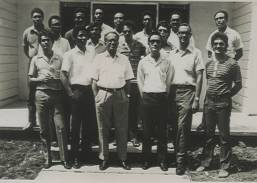
Among the many graduates of the UWI programme are the Directors of the Meteorological Services of Trinidad and Tobago (Eli Henry), Barbados (Chester Layne), St. Lucia (Herbert Regis), Antigua (Patrick Jeremiah), Bahamas (Arthur Rolle), Grenada (David Robertson), Guyana (Dilip Jaigopaul) and the Co-ordinating Director of the Caribbean Meteorological Organisation (Tryone Sutherland).
The Second Class II 1970-1972
The forecaster training programme at the CIMH lasts for eighteen months and is offered in alternate years. This level of training is still in demand both by the established Meteorological offices and other countries which are seeking to upgrade their services.
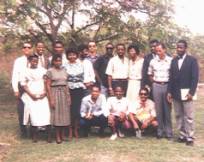
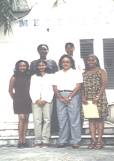
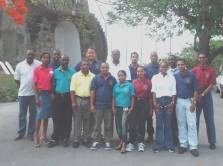
Class II 1986 Class I Forecasters' Certificate Course 1999 Class II 2002
Back to top of this page |
 yahoo.com with questions or comments
about this web site. Questions concerning material, copyright of which resides
outside of CIMH, should be directed to the institutions in question.
yahoo.com with questions or comments
about this web site. Questions concerning material, copyright of which resides
outside of CIMH, should be directed to the institutions in question.