|
Learning Center on Caribbean Weather and Climate |
Adventure on Essequibo River |
|
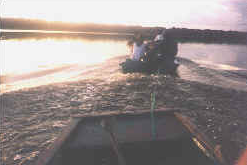
Go back to Hydrology, water resources and water pollution by Mr. Kailas Narayan, Hydrologist by the Caribbean Institute for Meteorology and Hydrology (CIMH). (The article was originally published in "The Advisory", The 35th Anniversary Edition of the CIMH, 2002.) In comparison with the Caribbean Islands, Guyana is a massive country with numerous large rivers. Hydrologically speaking, Guyana can be considered “rich”. Hence field work exercises for the hydrology courses at C.I.M.H. have been conducted in Guyana on a regular basis. This gives an exposure to students from the smaller islands which they may not have again in their working lives. The following is an account of one of the exercises. It was the 27th October, 1998. Our activity for this day was to visit the hydrological station at Plantain Island, a location approximately 150 kilometers up the Essequibo River, to make a discharge measurement. The group comprised the following: K. Narayan, the Hydrologist and group leader; J. Humphrey, the Technical assistant and students: T. Inniss of Barbados, L. Andrew of Guyana, M. Gabbidon and D. Murray of Jamaica. We were accompanied by Ms. J. Jafferally and Mr. S. October of the Guyana Hydrometeorological Service. We left Georgetown at 05:00 hours, very much in the dark, and drove to Linden, a two hour drive, where we had breakfast. We then followed the gravel road from Linden to Rockstone, about an hours drive through the steaming tropical jungle, arriving at Rockstone on the eastern bank of the Essequibo River at about 09:00 hours, hot, sweaty and caked with the dust from the road. At the Rockstone landing a small wooden boat with a 25 horse power engine was waiting for us for the one hour trip upriver to the station. At the sight of the river and the boat there were expressions of concern from students from the islands, as it seemed to them inconceivable to make the journey on such a small boat. This concern increased somewhat after the boat was loaded with our equipment and we boarded. The top of the boat was not more than ten centimeters above water. However, after some assurances from me and the hydrometeorological service’s staff, we set off for the station. At this time of the year the river is low, and a high degree of skill and knowledge of the river is required so as to avoid running on sandbanks. We made our way slowly upriver against the current, with Mr. L. Andrews at the controls. Mr. Andrews is an hydrological technician with the hydrometeorological service and has many years of experience on the river. He steered the boat from one side of the river to the next, ensuring that he kept in the main channel and to avoid sandbanks. The width of this stretch of the river varies between two and three kilometers. Everything seemed fine and the students tried to conceal their fear by telling jokes. Then, about half way on the journey, what we feared most happened. The propeller hit a sandbank; the engine roared, the front of the boat shot out of the water and settled back with a thump. Fortunately the boat did not flip over. It is left to the imagination to understand what passed through the minds of those on board, especially the islanders. The propeller was damaged and it took Mr. Andrews about an hour to get it working again. During this time we were “sitting ducks” on the boat, drifting downstream with the current. To counteract the drift we maneuvered the boat to the far side of the river and held on to the bushes. Of course this brought us closer to the dangers lurking in those bushes: snakes, tigers, bush cows, caimans, etc. In an effort to conceal the fear that was in everyone, including himself, Mr. Inniss of Barbados created some humour, shouting as loud as his lungs would allow, but this was no problem as there were no human beings for miles around. This did not have the intended effect and soon a gloomy silence took over, with all eyes fixed on Mr. Andrews and the engine. After what seemed to be a lifetime, the engine eventually roared into life and we made our way to the station without further incident. At the station were the wife, Savitri, and daughter Sophia, of the observer. There was also another boat and engine, so we felt reasonably safe with two boats and engines. The discharge measurement at the section commenced, using both the boats. We were assisted by Sophia, who piloted one of the boats. It was amazing to see the skill and confidence with which this small fifteen year old girl maneuvered the boat, keeping it steady in the treacherous black waters of the mighty Essequibo River. About halfway through the measurement, disaster struck again. Both engines broke down, which resulted in considerable delay in completing the measurement, as well as causing concerns, especially among the islanders, whether we would have to spend the night at the station. Luckily, a boat passing from upriver stopped and assisted in getting one of the engines working. We completed the measurement and left the station at about 17:30 hours, at that time already dark in the jungle. Since only one engine was working, we had to tow the other boat, as the observer’s family was also going out to Rockstone. From experience I knew that caimans would be out looking for food at this time of day – just at about sunset. I was concerned about this, as I feared that if the islanders saw any crocodiles a panic could result, with disastrous consequences. As we slowly made our way down river in the dark, at one point Ms. Jafferally shone a flashlight across the river and then made some signals to us in the other boat by flashing the torchlight at us. I knew she was trying to tell us something and that it was that she saw crocodiles. I tried peering in the dark but couldn’t see anything. I kept silent. After more than two hours on the river we reached Rockstone. “Did you see the caiman?” Ms. Jafferally asked when we were safely on land. “A caiman?” Mr. Inniss stammered, his eyes bulging out from their sockets, visible in the light of the Land Rover’s headlamps. “You mean we passed a caiman and did not see it?” questioned the Jamaicans, seemingly disappointed. However, I could sense them saying something else; perhaps “Thank God we did not see it.” I silently gave thanks for them not seeing the caiman, as that could have caused serious problems, at best. We loaded our equipment and proceeded to Georgetown, arriving at about midnight. It was a long day, but our task was accomplished. That was a great satisfaction.
End of an exciting day on the river. Back to the top of this page |
 yahoo.com with questions or comments
about this web site. Questions concerning material, copyright of which resides
outside of CIMH, should be directed to the institutions in question.
yahoo.com with questions or comments
about this web site. Questions concerning material, copyright of which resides
outside of CIMH, should be directed to the institutions in question.