Brain Cells
Te brain and the spinal cord are made up of living cells, neurons and glial cells. Neurons send and receive electro-chemical signals to and from the brain and nervous system. There are about 100 billion neurons in the brain. There are many more glial cells. they provide support functions for the neurons, and are far more numerous than neurons.
Neurons exist in various types. they vary in size from 4 microns (0.004mm) to 100 microns (0.1mm) in diameter. Their length varies from a fraction of an inch to several feet.
What are Neurons?
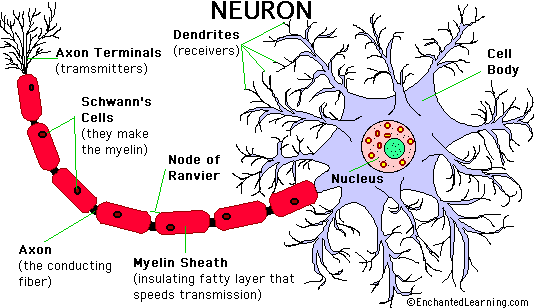
Neurons are nerve cells that transmit nerve signals to and from the brain at up to 200 mph. The neuron consists of a cell body (or soma) with branching dendrites (signal receivers) and a projection called an axon, which conduct the nerve signal. at the other end of the axon, the axon terminals transmit the electro-chemical signal across a synapse (the gap between the axon terminal and the receiving cell).
Structure of a Neuron
The axon is a long extension of a nerve cell, and take information away from the cell body. Bundles of axons are known as nerves or, within the central nervous system (CNS), as nerve tracts or pathways.
Dendrites bring information to the cell body. They branch from the cell body and receive messages.
Myelin coats and insulates the axon (except for periodic breaks called nodes of Ranvier), increasing transmission speed along the axon. It is manufactured by Schwann's cells and consists 70% to 80% lipids (fats) and 20% to 30% protein.
The cell body or soma contains the neuron's nucleus (with deoxyribonucleic acid or DNA and typical nuclear organelles).
What are Glial Cells?
They make up 90% of the brain's cells. They are nerve cells that do not carry nerve impulses. The various glial (meaning "glue") cells perform many important functions, such as, digestion of parts of dead neurons, manufacturing myelin for neurons, providing physical and nutritional support for neurons.

