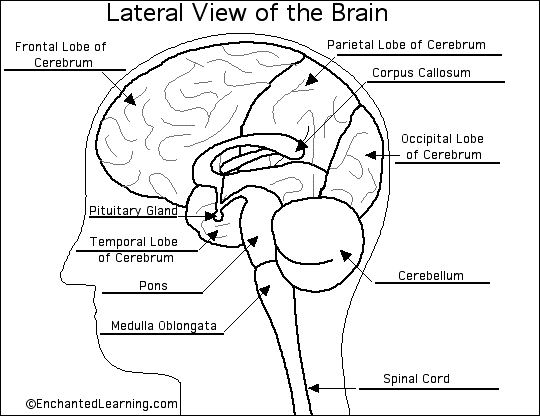
Structures of the brain
The Functions of the brain
Cerebellum
The part of the brain below the back of the cerebrum. It regulates balance, posture, movement, and muscle coordination.
Corpus Callosum
A large bundle of nerve fibres that connect the left anf right cerebral hemispheres. In th elateral section, it looks a bit like a "C" o its isde.
Frontal Lobe of the Cerebrum
The top, front regions of each of the cerebral hemispheres. They are used for reasoning, emotions, judgement, and voluntary movement.
Medulla Oblongata
The lowest section of the brain stem (at th etop end of the spinal cord), it controls automatic functions including heartbeat, breathing, etc.
Occipital Lobe of the Cerebrum
The region at the back of each cerebral hemisphere that contains the centres of vision and reading ability (located at the back of the head).
Parietal Lobe of the Cerebrum
The middle lobe of each cerebral hemisphere between th efrontal and occipital lobes, it contains important sensory centres (located at the upper rear of the head).
Pituitary Gland
A gland attached to the base of the brain (located between the Pons and the Corpus Callosum) that secretes hormones.
Pons
The part of the brain stem that joins the hemispheres of the cerebellum and connects the cerebrum with cerebellum. It is located just above the Medulla Oblongata.
Spinal Cord
A thick bundle of nerve fibres that runs from the base of the brain to the hip area, running through the spine (vertebrae).
Temporal Lobe of the Cerebrum
The region at the lower side of each cerebral hemisphere, contains centres of hearing and memory (located at the sides of the head).

