| |
Peru has a divided society in which the wealthy and mainly European
elites have long dominated its more numerous population of indigenous people and
mestizos (those of mixed European and indigenous ancestry). The
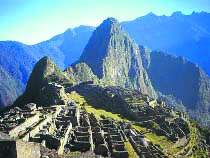
indigenous people are descendants of the Inca, who ruled an extensive South
American empire centered in the Peruvian highlands before they were conquered by
Spaniards in the 16th century. Attracted by the gold and silver mines of the
Andes, the Spaniards quickly converted Peru into the seat of their wealth and
power in South America. The sharp class and ethnic divisions that developed
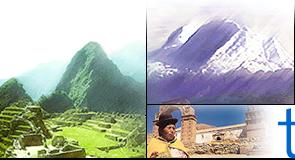
during the colonial period persist to this day.Peru may be divided into three main topographical regions:
the coastal plain, the sierra, and the montaña.
The coastal plain is an arid, elongated stretch of land
extending the entire length of the country and varying in width from about 65 to
160 km (about 40 to 100 mi). It is a northern extension of the Atacama Desert of
Chile. The plain has few adequate harbors. Most of the desert is so dry that
only 10 of the 52 rivers draining the Andean slopes to the Pacific Ocean have
sufficient volume to maintain their flow across the desert and reach the coast.
However, the coast is the economic center of Peru. Most of the nation's leading
commercial and export crops grow in the 40 oases of the
region.
Parallel to and lying east of
the coastal plain is the sierra, an upland region with towering mountain ranges
of the Andes, lofty plateaus, and deep gorges and valleys. The main range is the
Cordillera Occidental; other ranges include the Cordillera Oriental, the
Cordillera Central, and a number of lesser chains. The sierra, which covers some
30 percent of the country's land area, traverses the country from southeast to
northwest and varies in width from about 400 km (about 250 mi) in the south to
about 240 km (about 150 mi) in the north; the average height is some 3,660 m
(some 12,000 ft
Several of the highest peaks in the world are located in the various
sierran cordilleras and plateaus, notably Huascarán (6,768 m/22,205 ft), the
highest in Peru. Lake Titicaca is in the southeast. The rainy eastern slopes of
the Andes are deeply carved by rivers into a chaotic maze of sharp crests,
canyons 3,000 m (10,000 ft) deep, and V-shaped valleys through which emerge
several major tributaries of the Amazon River. This rugged border is the
principal barrier to trans-Andean travel. Earthquakes occur in the
sierra.
In the northeast the sierra
slopes downward to a vast, flat tropical jungle, the selvas, extending to the
Brazilian border and forming part of the Amazon Basin. The forested sierran
slopes and a somewhat less elevated region are collectively designated the
montaña. The montaña attains a maximum width of about 965 km (about 600 mi) in
the north and constitutes some 60 percent of the Peruvian land area; it is
covered with thick tropical forests in the west and with dense tropical
vegetation in the center and east. As a result, the region remains largely
unexplored and undeveloped. |
 Peru has three main drainage systems. One comprises about 50 torrential
streams that rise in the sierra and descend steeply to the coastal plain. The
second comprises the tributaries of the Amazon River in the montaña region. In
the third the principal feature is Lake Titicaca, which drains into Lake Poopó
in Bolivia through the Desaguadero River. Peru has three main drainage systems. One comprises about 50 torrential
streams that rise in the sierra and descend steeply to the coastal plain. The
second comprises the tributaries of the Amazon River in the montaña region. In
the third the principal feature is Lake Titicaca, which drains into Lake Poopó
in Bolivia through the Desaguadero River.
The Napo, Tigre, and Pastaza rivers rise in Ecuador and flow into Peru.
The latter two streams are tributaries of the Marañón River, and the Napo
empties into the Amazon River. The border between Peru and Colombia is
delineated by the Putumayo River.
The climate of Peru varies widely, ranging from tropical in the montaña
to arctic in the highest mountains of the Andes. Average temperatures decrease
about 1.7 Celsius degrees (about 3 Fahrenheit degrees) with every 450-m
(1,500-ft) increase in elevation. Permanent snow and ice fields cover peaks more
than 5,000 m (16,500 ft) above sea level, and the highest elevation at which the
land is suitable for agriculture is about 4,400 m (14,500
ft).
In the coastal plain the
temperature is normally equable, averaging about 20°C (about 68°F) throughout
the year. The coastal climate is moderated by winds blowing from the cool
offshore current known as the Peru, or Humboldt, Current. The coast receives
less than 50 mm (2 in) of precipitation each year, largely because the
cordilleras receive most of the rain carried by the trade winds from the east.
Mist-laden clouds known as garúa shroud many of the slopes of the sierra
from June to October, providing enough moisture to support
grasslands.
In the sierra the temperature
ranges seasonally from about -7° to 21°C (about 20° to 70°F). Rainfall is
usually scanty, but in some localities heavy rains fall from October to April.
In Cuzco, in the southeastern sierra, annual rainfall averages some 815 mm (32
in). The exposed eastern slopes of the Andes receive more than 2,500 mm (100 in)
of rain annually, but sheltered locations receive much less. Rainfall amounts
diminish rapidly southward, causing many changes in the
vegetation.
The montaña region is
extremely hot and humid, although at higher elevations it is less so. The
prevailing easterly winds blowing across that region gather moisture that is
later deposited on the eastern Andean slopes. Annual rainfall in some districts
averages as much as 3,810 mm (150 in). Most of this rain, which principally
falls from November through April, eventually drains back to the
montaña.
Peru's climate periodically
experiences a weather pattern known as El Niño. El Niño occurs every three to
seven years when unusually warm ocean conditions appear along the western coast.
During El Niño the wet weather conditions normally present in the western
Pacific move to the east, bringing heavy rains that can cause extensive
flooding.
Mineral deposits, the primary resources of Peru, include petroleum, found
on the northwestern coast and in the Amazon Basin; copper in northwestern Peru;
and substantial deposits of silver, iron ore, gold, lead, and zinc throughout
the cordilleras. Also important are the forests, especially the stands of cedar,
oak, and mahogany.
The plant life of the three main geographical regions varies widely. The
vast, fertile montaña contains a rich profusion of trees, plants, and jungle
vines, including mahogany, cedar, rubber, and cinchona trees, sarsaparilla and
vanilla plants, and a variety of exotic tropical flowers. The rugged sierra
supports a relatively sparse plant life. Sierra vegetation is largely
xerophytic—that is, adapted to survival on a restricted supply of water. Such
growths include mesquite, cactus, scrub and fodder grasses, and eucalyptus
plants. The dry, sandy reaches of the coastal plain support mainly desert
vegetation, such as shrubs, grasses, and tuberous plants.
he wildlife of coastal Peru is limited in number and
variety. The coastal plain and offshore islands support gulls and terns and some
albatrosses, but little other wildlife except lizards, insects, tarantulas, and
scorpions. Peruvian ocean waters abound in anchovy, pilchard, haddock, sole,
mackerel, smelt, flounder, lobster, shrimp, and other marine species. In the
sierra are found the llama, alpaca, vicuña, chinchilla, and huanaco. Birds of
the region include the giant condor, robin, phoebe, flycatcher, finch,
partridge, duck, and goose. Lake Titicaca and other sierran bodies of water teem
with fish. Animals of the tropical montaña include the jaguar, cougar,
armadillo, peccary, tapir, anteater, several dozen species of monkey, alligator,
turtle, and a variety of snakes and insects; among the birds are the parrot, the
flamingo, and other tropical species.
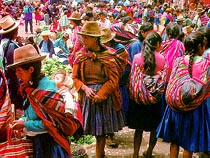
About 45 percent of Peru's inhabitants are Native
Americans, some of whom are descended from the Inca who established a great
civilization in the region by the 15th century. About 100 other indigenous
groups live in the rain forest of eastern Peru. These tribes live in virtual
isolation from the rest of Peru's population, speaking traditional languages and
surviving by hunting, fishing, and agriculture. Some 37 percent of the country's
people are mestizos, those of mixed white (mainly Spanish) and Native
American background. About 15 percent of Peruvians are of unmixed white descent,
and many of the remainder are of black African, Japanese, or Chinese ancestry.
Some 73 percent of the people live in urban areas.Politically and economically,
Peru is a divided society. At the top of the social structure is a minority of
Spanish-speaking Europeans living on the coast, and especially
in
Lima. They control most of the
country's wealth and political power. At the bottom are Quechua- and
Aymara-speaking Native Americans living in the highlands and in the shantytowns
surrounding Arequipa, Lima, and other coastal cities. In between is a largely
mestizo middle class of professionals, businessmen, army officers, and
government employees.
The military government that ruled from 1968 to 1980 carried out several
reforms to curtail the power of wealthy Peruvians and benefited people in the
middle and lower-middle classes. These reforms redistributed land to highland
Native Americans, turned sugar plantations over to worker cooperatives, and
extended the government's role in all sectors of the economy. In the end,
however, soaring inflation and unemployment left the mass of Peruvians as poor
as they were before the reforms, and the majority still have a very low standard
of living. Much of rural Peru lacks electricity, safe drinking water, adequate
sanitary facilities, and accessible health care, as do most of the shantytowns
to which former rural residents emigrated during the later decades of the 20th
century.
| A. Population
Characteristics |
 |
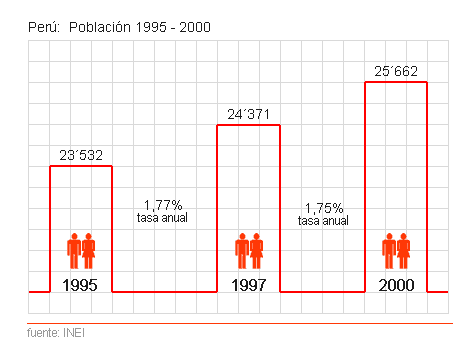
The population of Peru (2002 estimate) is
27,949,639, giving the country an estimated overall population density of 21
persons per sq km (55 per sq mi). The distribution, however, is uneven, with
about 50 percent of the people inhabiting the sierra region and about 40 percent
inhabiting the coastal plain. |
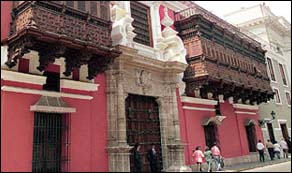
| The largest city in Peru is Lima (greater city population,
1996 estimate, 6,884,000), the country's capital and chief commercial
center.Other important cities include Callao (424,294), a major port located
near Lima; Arequipa (710,103), an industrial center; Trujillo (603,657), a
commercial center; Chiclayo (375,058), in the sugar district; and Cuzco
(278,590), famous for its Inca ruins. |
 |
Spanish, spoken by some 70 percent of the people, was the sole official
language of Peru until 1975, when Quechua, one of the principal languages of the
Native Americans, also was made an official language. Another Native American
language, Aymará, was declared official in 1980. English is also
spoken.
More than 90 percent of
Peruvians are Roman Catholic. In 1915 a law was passed that made Roman
Catholicism the established religion of the country. However, the constitution
of 1979 ended Roman Catholicism's status as the established religion, although
it recognized Catholicism “as an important element in the historical, cultural,
and moral formation of Peru.” Other religions are permitted and tolerated, and
small numbers of Protestants, Jews, and Muslims live in Peru.
 |
The literacy rate in Peru has increased substantially as a
result of greater emphasis on education. According to estimates, the adult
literate population rose from 42 percent in 1940 to 97 percent in 2001. Public
basic education in Peru is free and compulsory for all children between the ages
of 6 and 12. Many children in rural areas do not attend secondary school,
however, because of a lack of facilities. In 1998 some 4.2 million pupils
attended elementary schools, and 2 million students were enrolled in secondary
and vocational schools. | Peru has more than 45 institutions of higher education, including the
National University of San Marcos, in Lima (1551); the National University of
Central Peru (1962), in Huancayo; the National University of San Agustín (1828),
in Arequipa; the National University of San Antonio Abad (1962), in Cuzco; the
National University of La Libertad (1824), in Trujillo; the Pontifical Catholic
University of Peru (1917), and La Molina National Agrarian University (1902),
both in Lima. The National School of Music (1908) is in Lima. Some 755,900
students attended institutions of higher education in 1994.
|
|
 |
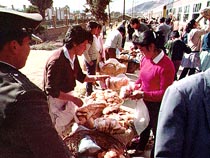
| Peru's estimated gross domestic product (GDP) in
1999 was $51.9 billion. Although the economy remains primarily agricultural, the
mining and fishing industries have become increasingly important. Peru relies
primarily on the export of raw materials—chiefly minerals, farm products, and
fish meal—to earn foreign exchange for importing machinery and manufactured
goods. During the late 1980s, guerrilla violence, rampant inflation, chronic
budget deficits, and drought combined to drive the country to the brink of
fiscal insolvency. However, in 1990 the government imposed an austerity program
that removed price controls and ended subsidies on many basic items and allowed
the inti, the national currency at that time, to float against the United
States dollar. |
 |
Some 5 percent of Peru's
working population is engaged in farming, forestry, or fishing.Most of the
coastal area is devoted to the raising of export crops; on the montaña
and the sierra are mainly grown crops for local consumption. Many farms in Peru
are very small and are used to produce subsistence crops; the country also has
large cooperative farms. |
The chief agricultural
products, together with the yield (in metric tons) in 2001, were sugarcane (7.9
million), root crops such as potatoes (4.3 million), rice (2 million), corn
(1,418,000), seed cotton (134,300), coffee (158,200), and wheat (190,200). Peru
is the world's leading grower of coca, from which the drug cocaine is
refined.
The livestock population
included 4.9 million cattle, 14.5 million sheep, 2 million goats, 2.8 million
hogs, 690,000 horses, 250,000 mules, and 90 million poultry. Llamas, sheep, and
vicuñas provide wool, hides, and skins
|
| Currency and Foreign
Trade | The unit of currency in Peru is the nuevo sol, divided into 100
céntimos (3.38 nuevo sols equal U.S.$1; 1999 average). The nuevo sol
replaced the previous currency, the inti, in 1991 (1 nuevo sol equaled 1
million inti). The inti had replaced the sol in 1985 at a rate of 1,000 to 1.
The Banco Central de Reserva del Perú (1922) is the central bank and bank of
issue. All private domestic banks were nationalized in 1987. The largest of
these, Interbanc, was reprivatized in 1994.Exports are more diversified in Peru
than in most South American countries. The principal exports are petroleum,
copper, lead, coffee, silver, fish meal, zinc, sugar, and iron ore. The chief
export markets are the United States, Japan, the United Kingdom, China, and
Germany. Exports earned $7 billion in 2000. The leading imports of Peru include
electrical and electronic items, foodstuffs, metals, chemicals, and
transportation equipment. The principal sources of these goods are the United
States, Colombia, Chile, Venezuela, and the United Kingdom. Imports cost $8.8
billion in 2000. Peru is a member of two international trade organizations, the
Latin American Integration Association (LAIA), which replaced the former Latin
American Free Trade Association in 1980; and the Andean Group. The LAIA works to
integrate the economies of all of Latin South America while the Andean Group
does the same for its members, which also include Bolivia, Colombia, Ecuador,
and Venezuela.
Peru's system of
railroads, highways, and airports was expanded considerably in the second half
of the 20th century. The country's mountains make surface transport difficult,
however. In 1998 Peru had about 77,999 km (about 48,466 mi) of roads, of which
13 percent were paved. The main artery is a section of the Pan-American Highway,
which traverses Peru from Ecuador to Chile, covering a distance of about 2,495
km (about 1,550 mi). The Central Highway links Lima and Pucallpa. Peru also has
about 1,691 km (about 1,051 mi) of railroads. One trans-Andean line, the Central
Railroad, ascends to some 4,815 m (15,800 ft) above sea level, the highest point
reached by any standard-gauge line in the world. The most notable inland
waterway is the Amazon River, which is navigable by ship from the Atlantic Ocean
to Iquitos in Peru. Lake Titicaca also serves as a waterway. Leading Peruvian
seaports include Callao, Salaverry, Pacasmayo, Paita, and San Juan. The
country's main international airports are situated near Lima, Cuzco, Iquitos,
and Arequipa. Aeroperú, the national airline, offers domestic and international
service.
Peru's telephone
system, which was nationalized in 1970 and reprivatized in 1994, has 67
mainlines for every 1,000 of Peru's residents. The country is served by more
than 300 radio stations and 8 television stations. In 1997 there were 273 radios
and 126 television sets in use for every 1,000 people. In the same period the
country had 74 daily newspapers. Dailies with large circulations included El
Comercio, Expreso, Ojo, and La República, all published in
Lima.
In 2000 Peru's
labor force was 9.7 million people. Some 6 percent are engaged in agriculture.
The next largest sectors are services and government, manufacturing, commerce,
and construction. About 40 percent of wage workers belong to various labor
unions. The main labor group is the Democratic Syndical Front, which includes
the General Confederation of Peruvian Workers.
Peru is a
republic governed by a constitution promulgated in 1993. This constitution
replaced the 1980 constitution, which was suspended in 1992. The new
constitution increased the power of the executive and allowed for the reelection
of the president to a second term. It also unified the formerly bicameral
legislature.
Evidence of
settlement in Peru dates back thousands of years but, except for some scattered
ruins, little is known of these early peoples. In about 1250 BC
groups such as the Chavín, Chimú, Nazca, and Tiwanaku migrated into the region
from the north. The Chimú built the city of Chan Chan about AD
1000, ruins of which remain today.
 |
The Inca, sometimes called peoples of the sun, were
originally a warlike tribe living in a semiarid region of the southern sierra.
From 1100 to 1300 the Inca moved north into the fertile Cuzco Valley. From there
they overran the neighboring lands. By 1500 the Inca Empire stretched from the
Pacific Ocean east to the sources of the Paraguay and Amazon rivers and from the
region of modern Quito in Ecuador south to the Maule River in Chile. This vast
empire was a theocracy, organized along socialistic lines and ruled by an Inca,
or emperor, who was worshiped as a divinity. Because the Inca realm contained
extensive deposits of gold and silver, it became in the early 16th century a
target of Spanish imperial ambitions in the Americas. |
| In November 1995 anthropologists announced the
discovery of the 500-year-old remains of two Inca women and one Inca man frozen
in the snow on a mountain peak in Peru. Scientists concluded that the trio were
part of a human sacrifice ritual on Ampato, a sacred peak in the Andes mountain
range. Artifacts from the find unveiled new information about the Inca and
indicated the use of poles and tents rather than traditional stone structures.
The arrangement of doll-size statuettes dressed in feathers and fine woolens
provided clues about Inca religious and sacrificial practices.
|
In 1532 Spanish soldier and
adventurer Francisco Pizarro landed in Peru with a force of about 180 men.
Conditions were favorable to conquest, for the empire was debilitated by a
just-concluded civil war between the heirs to the Inca throne, Atahualpa and
Huascar, each of whom was seeking to control the empire. This internal
dissension, plus the terror inspired by Spanish guns and horses—unknown to the
indigenous peoples until then—made it relatively easy for only a handful of
Spaniards to conquer this vast empire. The Spaniards met Atahualpa, the victor in the civil
war, and his army at a prearranged conference at Cajamarca in 1532. When
Atahualpa arrived, the Spaniards ambushed and seized him, and killed thousands
of his followers. Although Atahualpa paid the most fabulous ransom known to
history—a room full of gold and another full of silver—for his freedom, the
Spaniards murdered him in 1533.
The Spanish destroyed many of the irrigation projects and the north-south
roads that had knit the empire together, speeding the disintegration of the
empire. By November 1533 Cuzco had fallen with little resistance. In addition,
the indigenous population declined rapidly as a result of new diseases brought
by the Spaniards, diseases to which the Inca had no immunity. Members of the
Inca dynasty took refuge in the mountains and were able to resist the Spaniards
for about four decades. However, by 1572 the Spaniards had executed the last
Inca ruler, Tupac Amarú, along with his advisers and his
family.
In 1535 Pizarro founded on the banks of the Rímac River the
Peruvian capital city of Ciudad de los Reyes (Spanish for “City of the Kings”;
present-day Lima). Subsequently, disputes over jurisdictional powers broke out
among the Spanish conquerors, or conquistadors, and in 1541 a member of one of
the conflicting Spanish factions assassinated Pizarro in
Lima.
The Inca civilization had
unified what are now Peru, Ecuador, and Bolivia and created an integrated
society. The Spanish, whose main aims were plunder and the conversion of native
tribes to Christianity, stopped the development of the indigenous civilization.
The Spaniards treated the Inca ruthlessly, using their labor to produce the
minerals needed in Spain. The result was the creation of a psychic chasm between
the Inca and the Europeanized population, a chasm that has endured for more than
400 years.
The Spanish introduced a
system of land tenure consisting of European landlords and indigenous workers.
This system succeeded in solidly establishing a privileged and wealthy landed
aristocracy early in the colonial period. Little was done to educate the masses
of peoples. As a result, colonial Peru was a divided society, consisting of a
small class that owned the land and controlled education, political, military,
and religious power, and of a large, mostly indigenous class (about 90 percent
of the total population) that remained landless, illiterate, and
exploited.
In 1542 a Spanish imperial
council promulgated statutes called New Laws for the Indies, which were designed
to put a stop to cruelties inflicted on the Native Americans. In the same year
Spain created the Viceroyalty of Peru, which comprised all Spanish South America
and Panama, except what is now Venezuela.
The first Spanish viceroy arrived in Peru in 1544 and attempted to
enforce the New Laws, but the conquistadores rebelled and, in 1546, killed the
viceroy. Although the Spanish government crushed the rebellion in 1548, the New
Laws were never put into effect.
In 1569 Spanish colonial administrator Francisco de Toledo arrived in
Peru. During the ensuing 14 years he established a highly effective, although
harshly repressive, system of government. Toledo's method of administration
consisted of a government of Spanish officials ruling through lower-level
officials made up of Native Americans who dealt directly with the indigenous
population. This system lasted for almost 200 years.
| C. Revolts for
Independence | In 1780 a
force of 60,000 Native Americans revolted against Spanish rule under the
leadership of Peruvian patriot José Gabriel Condorcanqui, who adopted the name
of an ancestor, the Inca Tupac Amarú. Although initially successful, the
uprising was crushed in 1781. The Spanish tortured and executed Condorcanqui and
thousands of his fellow revolutionaries. The Spanish suppressed another revolt
in 1814.
Subsequently, however,
opposition to imperial rule grew throughout Spanish South America. The
opposition was led largely by Creoles, people of Spanish descent born in South
America. Creoles grew to resent the fact that the Spanish government awarded all
important government positions in the colonies to Spaniards born in Spain, who
were called peninsulares.
Freedom from Spanish rule, however, was imported to Peru by outsiders. In
September 1820 Argentine soldier and patriot José de San Martín, who had
defeated the Spanish forces in Chile, landed an invasion army at the seaport of
Pisco, Peru. On July 12, 1821, San Martín's forces entered Lima, which had been
abandoned by Spanish troops. Peruvian independence was proclaimed formally on
July 28, 1821. The struggle against the Spanish was continued later by
Venezuelan revolutionary hero Simón Bolívar, who entered Peru with his armies in
1822. In 1824, in the battles of Junín on August 6 and of Ayacucho on December
9, Bolívar's forces routed the Spanish. See Ayacucho, Battle of; Junín,
Battle of; See Latin American Independence.
Independence brought few
institutional changes to Peru aside from the transfer of power. Whereas before
independence peninsulares held the important government posts, after
independence Creoles monopolized power. The economic and social life of the
country continued as before, with two groups–Europeans and indigenous
people–living side by side but strongly divided. In 1822 leaders of the colony's
independence movement created a centralized government consisting of a president
and a single-chambered legislature. However, Spain's refusal to allow
Peruvian-born citizens a voice in the colonial administration had done little to
prepare Peru for democracy.
The years following independence were extremely chaotic. Bolívar left
Peru in 1826, and a series of military commanders who had served under him ruled
over the nation. Andrés Santa Cruz served until 1827, when he was replaced by
José de La Mar, who was in turn supplanted by Agustín Gamarra in 1829. Gamarra
ruled until 1833. In the meantime Santa Cruz had become president of Bolivia,
and in 1836 he invaded Peru, establishing a confederation of the two countries
that lasted three years. After that, Gamarra took power
again.
The country, however, enjoyed
no peace until 1845, when Ramón Castilla seized the presidency. Fortunately, he
proved to be an able ruler, who during his two terms in office (1845 to 1851 and
1855 to 1862) initiated many important reforms, including the abolition of
slavery, the construction of railroads and telegraph facilities, and the
adoption in 1860 of a liberal constitution. Castilla also began exploitation of
the country's rich guano and nitrate deposits, which were highly valued as an
ingredient in fertilizer. In 1864 these deposits involved Peru in a war with
Spain, which had seized the guano-rich Chincha Islands. Ecuador, Bolivia, and
Chile aided Peru, defeating the Spanish forces in 1866. The resulting treaty of
1879 constituted the first formal Spanish recognition of Peruvian
sovereignty.
In 1873 Peru signed a secret defensive alliance with Bolivia, the purpose
of which was to defend Bolivia's nitrate interests against Chile. When a quarrel
arose between Chile and Bolivia over the Atacama nitrate fields along the
disputed border of the two nations, Peru was drawn into the War of the Pacific,
fighting against Chile on the side of its ally, Bolivia.
Chile defeated its opponents, occupied Lima, and, under the
Treaty of Ancón (1884), was awarded Peru's nitrate province of Tarapacá. Chile
also occupied the provinces of Tacna and Arica. A plebiscite was supposed to
decide ten years later which country would get these provinces, but the
Tacna-Arica Dispute did not end until 1929, with Chile keeping Arica and Peru
regaining Tacna. The war severely depleted Peruvian financial reserves and
placed continuing strain on subsequent relations between the two countries. For
the next 25 years Peru was ruled by a succession of dictators
In 1908 a program of
economic reform was instituted by President Augusto Leguía y Salcedo. After his
first term from 1908 to 1912, Leguía traveled in the United Kingdom and the
United States, where he learned methods of banking and finance, which he later
applied in Peru, and made many friends in the business community. He regained
the presidency in 1919 by means of a military coup and thereafter ruled as
virtual dictator. Leguía preserved the country's old class organization.
However, he brought material progress to Peru, broadened education, and improved
labor conditions.
In 1924, during Leguía's
rule, some exiled Peruvian intellectuals founded the American Popular
Revolutionary Alliance (APRA), which Víctor Raúl Haya de la Torre led for more
than 40 years. APRA called for basic reforms—especially in the conditions of the
Native Americans. Leguía banned APRA, but the alliance managed nevertheless to
become the most influential of Peru's political parties.
Leguía stayed in power until 1930, when the world
depression ended the flow of foreign investments. He was deposed and jailed by
an army revolt. On April 9, 1933, a new constitution was adopted. Shortly
thereafter Leguía's successor, Luis Sánchez Cerro, was assassinated. The next
chief executive, General Óscar Raimundo Benavides, followed the new pattern of
harsh political rule combined with marked economic advances. When the APRA won
the election of 1936, Benavides ignored the results and extended his own term in
office. In 1939, in controlled elections, he installed Manuel Prado as
president. Prado was forced, however, to make concessions to the powerful reform
sentiment fostered by APRA.
| F. World War II and
After | During World War II
(1939-1945) Peru gave limited support to the Allied cause. It broke off
relations with the Axis powers in January 1942, but declared war against Germany
and Japan only in February 1945 in order to be accepted as a charter member of
the United Nations.
In 1945 the National Democratic Front, a coalition of liberal and leftist
parties, including APRA, supported José Luis Bustamante y Rivero, who won the
presidential election. The National Democratic Front also won a majority in both
houses of the legislature. The new government instituted numerous liberal
reforms, strengthened civil rights and freedom of the press, and passed a
constitutional amendment abolishing certain dictatorial powers formerly held by
the president.
In October 1948, however, rightist revolutionary leaders unseated
Bustamante, seized the government, and outlawed APRA. On July 2, 1950, Manuel A.
Odría, the leader of the 1948 coup d'état, won the presidential election.
Odría's chief opponent was not placed on the ballot.
Along with Chile and Ecuador, Peru extended the country's
territorial waters to 320 km (200 mi) off the mainland. This action brought
sharp protests from the United States, as many U.S. fishing vessels operated in
South American waters.
The Odría administration disbanded Peru's labor unions, outlawed all
opposition, and imposed tight censorship. It also strengthened Peru's defenses,
initiated a large public-works program, and concluded a series of economic and
cultural pacts with Brazil that provided for closer cooperation between the two
countries. The demand for a return to civilian rule was so great, however, that
in 1956 free elections were held
In the elections of 1956,
former president Prado was again victorious. He immediately effected sweeping
liberal reforms, but was soon hampered by strikes and riots occasioned by
economic instability and runaway inflation. In 1959 the government introduced a
program to restrict the outflow of dollars and encourage domestic industries by
various means, including facilitating the import of capital goods. By May 1960
the economy had improved markedly, and foreign capital flowed into Peru in the
form of loans and development contracts. In October of that year the government
won approval of its policy of gradual nationalization of most Peruvian
oil-production facilities.
In the presidential elections of 1962 none of the three major candidates,
Haya de la Torre of APRA, Fernando Belaúnde Terry of the Popular Action Party,
and Manuel Odría, received the necessary one-third of the votes to win the
election. The task of choosing a president thus went to the newly elected
congress. The military, which favored Belaúnde, overthrew the government to
forestall an agreement between Odrístas and the APRA to elect Odría president
with an APRA vice-president. A military junta took control. To appease the
Peruvian people and foreign governments, the junta promised new elections. The
junta installed General Ricardo Pío Pérez Godoy as president in July 1962, but
deposed him in March 1963.
Elections in 1963 brought Belaúnde to the presidency. President Belaúnde
and the APRA, which dominated congress, competed to introduce reforms. Progress
was made in public works and social benefits. However, the government's programs
resulted in budgetary deficits and a spiraling inflation. Belaúnde was also
unable to create a stable government coalition.
A long dispute over the
claims of the International Petroleum Company (IPC), a subsidiary of the
Standard Oil Company (New Jersey), in the operation of the rich La Brea y
Pariñas oil fields was finally settled by the Belaúnde government in August
1968. Widespread disapproval of this settlement, however, forced the resignation
of the Cabinet on October 1, and two days later the armed forces ousted Belaúnde
and suspended the constitution. A military junta formed, headed by General Juan
Velasco Alvarado. His government expropriated the IPC's assets, seriously
straining relations with the United States. Relations deteriorated still further
in February 1969, when a Peruvian gunboat accosted two U.S. fishing vessels off
the Peruvian coast, claiming they were poaching in Peruvian waters. In 1970,
despite these differences, U.S. relief supplies were quickly sent to Peru
following an earthquake that killed about 67,000 people and left some 600,000
homeless.
In the early 1970s the Velasco
government began a radical reform of the social and economic system. Among the
major actions were seizure of foreign-owned ranchlands, the imposition of price
controls on basic goods and services, and a sweeping land-reform law. The
anchovy fishing industry, seriously hurt in 1972 by alteration of ocean
currents, was nationalized in 1973. The 1973-1974 budget provided a 35 percent
increase in spending to build up and diversify private industry. In June 1973
the World Bank extended credits of $470 million to Peru, and the Inter-American
Development Bank lent Peru $30 million. Relations with the United States and
with U.S. investors were largely normalized, but U.S. economic aid was sharply
reduced.
Another
military coup toppled the Peruvian government on August 29, 1975, after a series
of strikes and demonstrations expressed popular discontent with the ailing
President Velasco. The following day, General Francisco Morales Bermúdez, who
had been prime minister and minister of war under Velasco, was sworn in as
president. His government announced that the country would be returned to
democratic rule in 1980. Morales pledged to continue the “revolutionary process”
begun in 1968. However, the military government was unable to cope with Peru's
deepening economic crisis, which was marked by an immense national debt, rampant
inflation, and massive unemployment. In 1978 it received a loan from the
International Monetary Fund to ease its debt burden, but only in exchange for
imposing economic austerity measures, which worsened the lot of most
Peruvians.
In 1980, as promised,
presidential elections were held.The winnerformer president Belaúnde, took
office in July, when a new constitution came into effect. Belaúnde immediately
adopted a conservative program that aimed to reverse many of the reforms of the
Velasco era, and he began a series of extravagantly costly large-scale
construction projects in the rain forest region. Belaúnde was immediately
overtaken by political crisis and economic disaster. An extreme left-wing
guerrilla movement, Shining Path (Sendero Luminoso), began activity in
the highlands and gained strength. At the United States' behest the government
tried to suppress production of coca, the Native Americans' main source of
income, and this alienated them still further. Output of the anchoveta fisheries
collapsed as a result of ecological devastation from earlier overfishing. The
country entered a deep depression accompanied by runaway inflation, and it had
to suspend payments on its enormous foreign debt. By the time presidential
elections were held in 1985, Belaúnde and his government were completely
discredited. His party got only 5 percent of the vote.
In the 1985
presidential elections, voters chose the APRA candidate, Alan García Pérez.
García tried to reverse the economic decline. He introduced policies that
attempted to reduce imports and limit annual payments on foreign debts. Despite
some temporary success, by 1987 Peru had been cut off from international
financing, and inflation again began to increase. In an attempt to limit
inflation, García nationalized private banks and insurance companies and
tightened government controls over the economy, but by 1990 the annual rate of
inflation was approaching 3,000 percent. Meanwhile, despite unabated repression
by the security forces, the Shining Path remained powerful.
In an upset in
the 1990 presidential election, Alberto Fujimori, an agricultural economist of
Japanese descent, defeated novelist Mario Vargas Llosa. Fujimori, who ran in the
runoff with left-wing support, imposed an austerity program to deal with
hyperinflation and to restore Peru's ability to borrow money internationally.
Economic hardship led to an escalation of violence by the Shining Path. In April
1992 Fujimori, alleging that congress and the judiciary had blocked his efforts
to suppress the drug trade and the guerrillas, suspended parts of the
constitution and took full control of the government. In September several key
Shining Path guerrillas were captured, including Shining Path leader Abimael
Guzmán, and in November Fujimori's supporters won a solid majority in a
legislative election. In 1993 the United States and other creditor nations
resumed loans to Peru. In October 1993 Peruvians voted to accept a new
constitution, signed by Fujimori in December, that increased presidential power,
changed the legislature from a bicameral body to a unicameral one, and allowed
Fujimori to run for a second term.
By 1994 Peru's economy had revived
dramatically, reaching a growth rate of more than 12 percent that year.
Fujimori's effort to privatize the economy moved forward with the sale of
Interbanc, the largest national bank, and the national telephone service to
private interests. The country also rejoined the Andean Group just as that group
began negotiations to reduce tariffs among member nations. At the same time, the
Fujimori government upheld its promise to crush the Shining Path movement,
capturing several high-ranking members of the organization's central committee.
In June former UN Secretary General Javier Pérez de Cuéllar announced that he
would run for the presidency. As presidential elections neared, Fujimori lost
momentum after feuding publicly with his wife, Susana Higuchi, a critic of his
policies, and relieving her of her duties as first lady. In response she formed
an opposition party and announced her intention to run for office in 1995. She
was denied candidacy when her party failed to assemble the necessary number of
signatures.
In January 1995 a series of skirmishes erupted along a contested
section of the Ecuadorian border. Fujimori capitalized politically on the
situation, gaining wide approval for his refusal to compromise with Ecuador. A
cease-fire accord was signed in Montevideo, Uruguay, in March 1995. Peru and
Ecuador entered into negotiations in 1998 and, toward the end of the year,
signed a treaty settling the border dispute.
Prior to the April 1995
elections Fujimori's opponents attempted to undercut his popularity by
challenging his human rights record. Despite those challenges, Fujimori's
accomplishments overwhelmed his critics at the polls, where he won the
presidential elections outright, gaining more than 60 percent of the
vote.
Fujimori declared a blanket amnesty in June 1995 for all human rights
abuses that may have been committed by members of the Peruvian military or
police forces between 1980 and 1995. He pushed the measure through the Peruvian
congress without a debate, outraging human rights activists and many Peruvian
citizens, and provoking condemnation from governments around the world. The law
absolved military personnel or civilians who had already been convicted, who
were under investigation, or who were in the process of being tried for alleged
crimes.
In November 1995 Peruvian authorities arrested 23 people, including a
U.S. citizen, and alleged that they were members of the Tupac Amarú
Revolutionary Movement and that they had been planning a terrorist attack on the
Peruvian Congress. Tupac Amarú was never as powerful as the Shining Path, but it
had been responsible for numerous guerrilla attacks in Peru in the 1980s and
1990s. The trials were conducted in secret, and the accused were unable to
cross-examine witnesses, challenge government evidence, or call witnesses on
their behalf. All 23 defendants were convicted and many of them were given life
sentences. International human rights groups and the U.S. government condemned
the trials, saying that they illustrated a lack of justice and due process in
Peru's legal system.
In December 1996 Tupac Amarú rebels seized the residence
of the Japanese ambassador in Lima, taking hundreds of hostages, including
foreign diplomats and Peruvian government officials. The rebels demanded the
release of imprisoned comrades, and freed all but 72 of their hostages while
negotiating with the government. After a four-month-long standoff, Fujimori
ordered a military raid on the mansion to free the hostages. Commandos killed
all of the rebels, and one hostage and two soldiers died in the attack.
A
series of government scandals damaged the public's perception of Fujimori's
government during mid-1997. In May Fujimori replaced three Constitutional Court
justices who ruled that the congress acted unconstitutionally when it declared
him eligible to run for a third consecutive presidential term despite a
constitutional prohibition. Evidence also emerged that the government authorized
telephone wire-tapping of prominent political opponents and paid Fujimori's
unofficial head of the intelligence service a salary of $600,000.
Fujimori's
public image was further damaged after a television station released information
showing that the intelligence service had tortured two women intelligence agents
who leaked information to the press about a government campaign to harass
journalists. Fujimori's approval rating dropped to 20 percent as a result of the
scandals and the controversy surrounding the replacement of the justices on the
Constitutional Court.
A particularly fierce weather pattern known as El Niño
struck Peru in late 1997. El Niño, which occurs periodically, caused severe rain
and flooding that killed more than 200 Peruvians and caused extensive damage in
many regions of the nation. Fujimori's public image improved after he became
personally involved in the crisis, making whirlwind tours to areas of the
country that had been ravaged by storms and personally directing measures to
control damage. The conflict between the government and the Shining Path
continued into 1998, with Shining Path guerrillas engaging in sporadic acts of
urban terrorism and attempting to establish or strengthen their bases in rural
areas. In March 1998 police in Lima arrested four important leaders in the
Shining Path organization.
In his bid for a third term in 2000, Fujimori drew
international criticism for alleged campaign abuses and faced a surprisingly
strong challenge from Alejandro Toledo, a business school professor. In the
April elections neither of the two front-running candidates won 50 percent of
the vote, and a runoff was scheduled for May. However, Toledo boycotted the race
because of concerns about election fraud, and Fujimori was reelected. In the
legislative elections Fujimori's coalition, Peru 2000, won the most
congressional seats but fell short of a majority.
Fujimori's presidency began
to unravel in September 2000 after his intelligence chief, Vladimiro Montesinos,
was linked to a corruption scandal. After firing Montesinos, Fujimori called an
early presidential election for April 2001 and promised not to run in it. By
mid-November Fujimori faced a groundswell of political opposition as new charges
of corruption and fraud continued to surface. While Fujimori was abroad for a
trade summit of Pacific Rim nations, opposition parties took control of congress
and elected a centrist legislator, Valentín Paniagua, as the leader of congress.
Fujimori announced from Japan that he would resign as president, and Paniagua
was chosen to lead an interim government pending new presidential and
legislative elections. In a public rebuke of Fujimori, the legislature rejected
the former president's resignation and voted to remove him from office for being
morally unfit.
Alejandro Toledo was elected president in June 2001 after a
runoff with former president Alan García Pérez. Toledo vowed to reform Peru's
criminal justice system, promote foreign investment, and reduce unemployment. In
legislative elections, held alongside the presidential election, Toledo's
Possible Peru Party emerged as the largest party in the congress, although it
did not attain a majority. The American Popular Revolutionary Alliance (APRA),
led by García, became the second largest party. |
 Spanish
  English
 Deutsche Schweiz