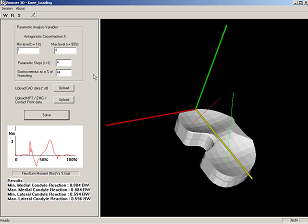
Design of the computer model is based on the work of Morrision (1968). A quasi-static analysis is performed sequentially in the sagittal and frontal planes to calulated implant contact forces. Our Approach is summarized as follows:
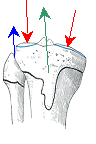
- Forces modeled:
- Contact Point
- Muscle
- Collateral ligaments
- Muscles are grouped
- Muscle forces parametrically varied to solve
indeterminate system
Inputs:
- External kne moment, force, and position data
- EMG data
- Anatomical data for muscle orientation
- CAD implant data for viualization and scaling
- Implant contact point data
Outputs:
- Internal 3-D contact point forces
- Visual display of forces on CAD implant